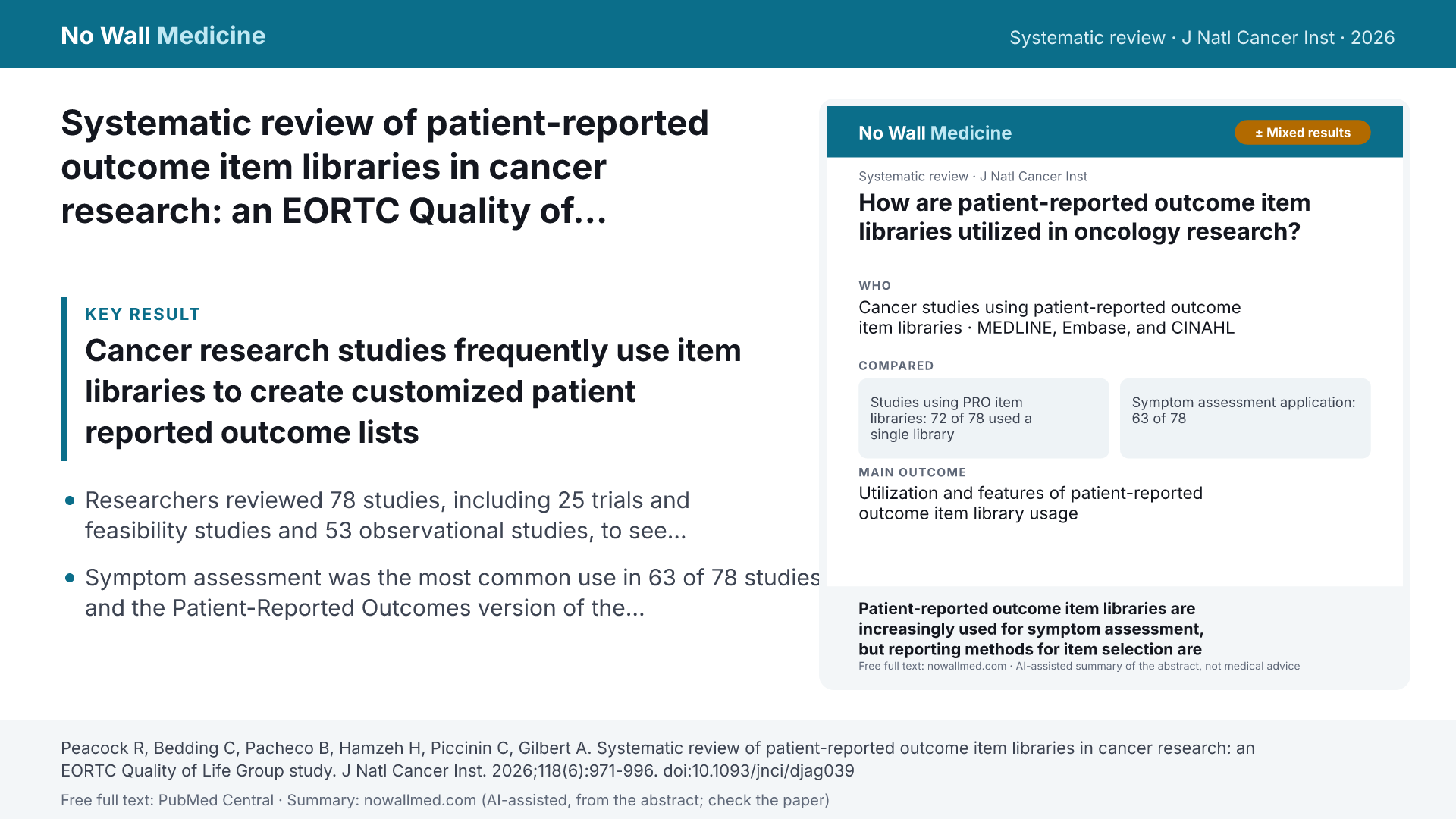
Cancer research studies frequently use item libraries to create customized patient reported outcome lists
Systematic review of patient-reported outcome item libraries in cancer research: an EORTC Quality of Life Group study
Systematic reviewMixed results
How are patient-reported outcome item libraries utilized in oncology research?
Who
78
Cancer studies using patient-reported outcome item libraries · MEDLINE, Embase, and CINAHL
Compared
Studies using PRO item libraries: 72 of 78 used a single library
Symptom assessment application: 63 of 78
Main outcome
Utilization and features of patient-reported outcome item library usage
Bottom line: Patient-reported outcome item libraries are increasingly used for symptom assessment, but reporting methods for item selection are inconsistent.
Limitation: Many studies did not report methods used for item selection.
J Natl Cancer Inst · 2026-02-16Download image
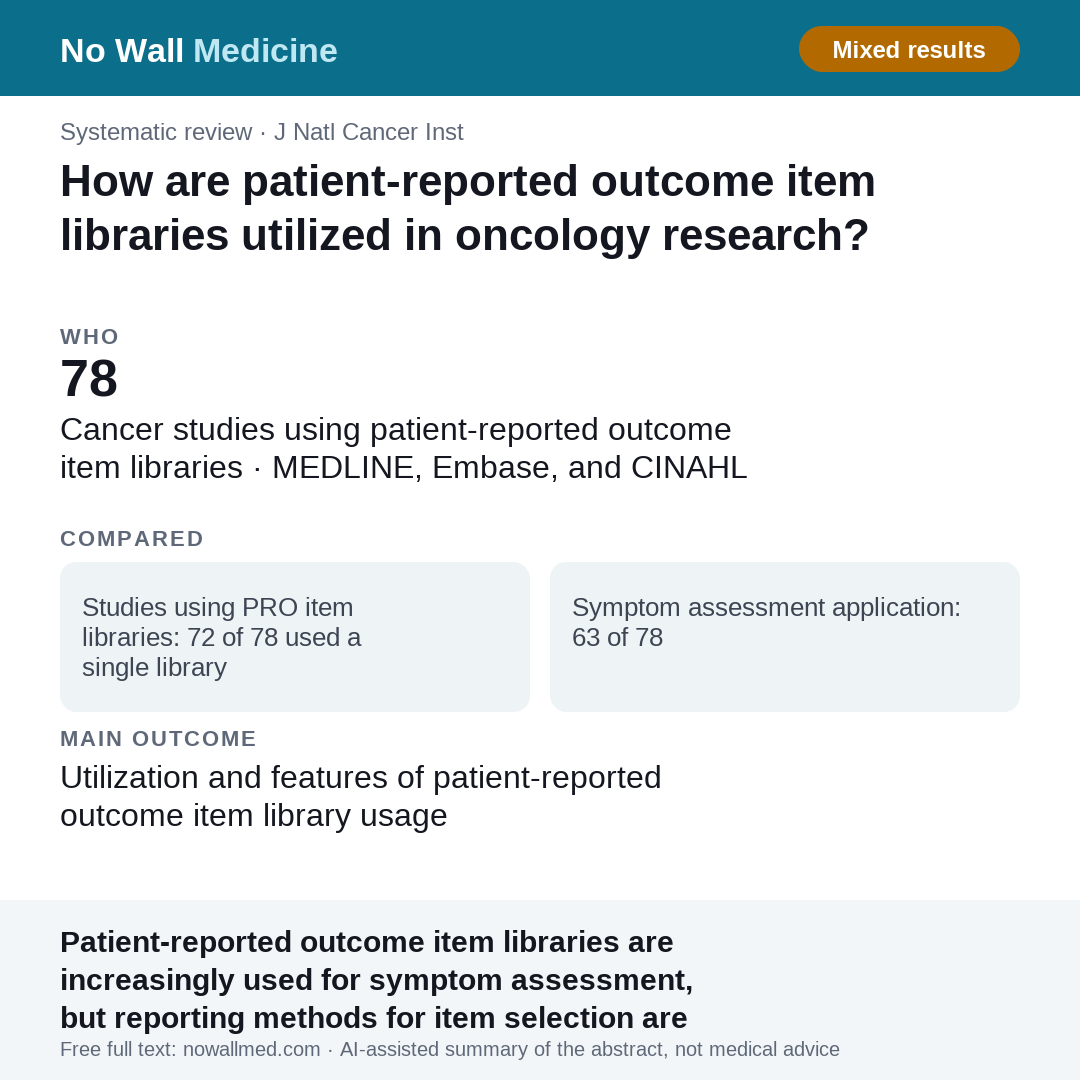
Clinical question: How are patient-reported outcome item libraries utilized in oncology research?
Why it matters: Little is known about how item lists, which are used to create customized patient reported outcome assessments, are utilized in clinical cancer research.
Key points
- Researchers reviewed 78 studies, including 25 trials and feasibility studies and 53 observational studies, to see how item libraries are used in oncology.
- Symptom assessment was the most common use in 63 of 78 studies, and the Patient-Reported Outcomes version of the Common Terminology Criteria for Adverse Events system was used in 49 of 78 studies.
- While 72 of 78 studies used a single library, 40 of 78 studies did not report the methods used to select their items.
Limitation the authors note: Many studies did not report the methods used to select the items for their lists.
Headline and key points written with AI from the paper’s abstract, with every number checked against it. Read the paper before relying on them.
Was this summary helpful?
Subject terms
Cite this article
Peacock R, Bedding C, Pacheco B, Hamzeh H, Piccinin C, Gilbert A. Systematic review of patient-reported outcome item libraries in cancer research: an EORTC Quality of Life Group study. J Natl Cancer Inst. 2026. doi:10.1093/jnci/djag039
Spotted a mistake? Suggest a correction