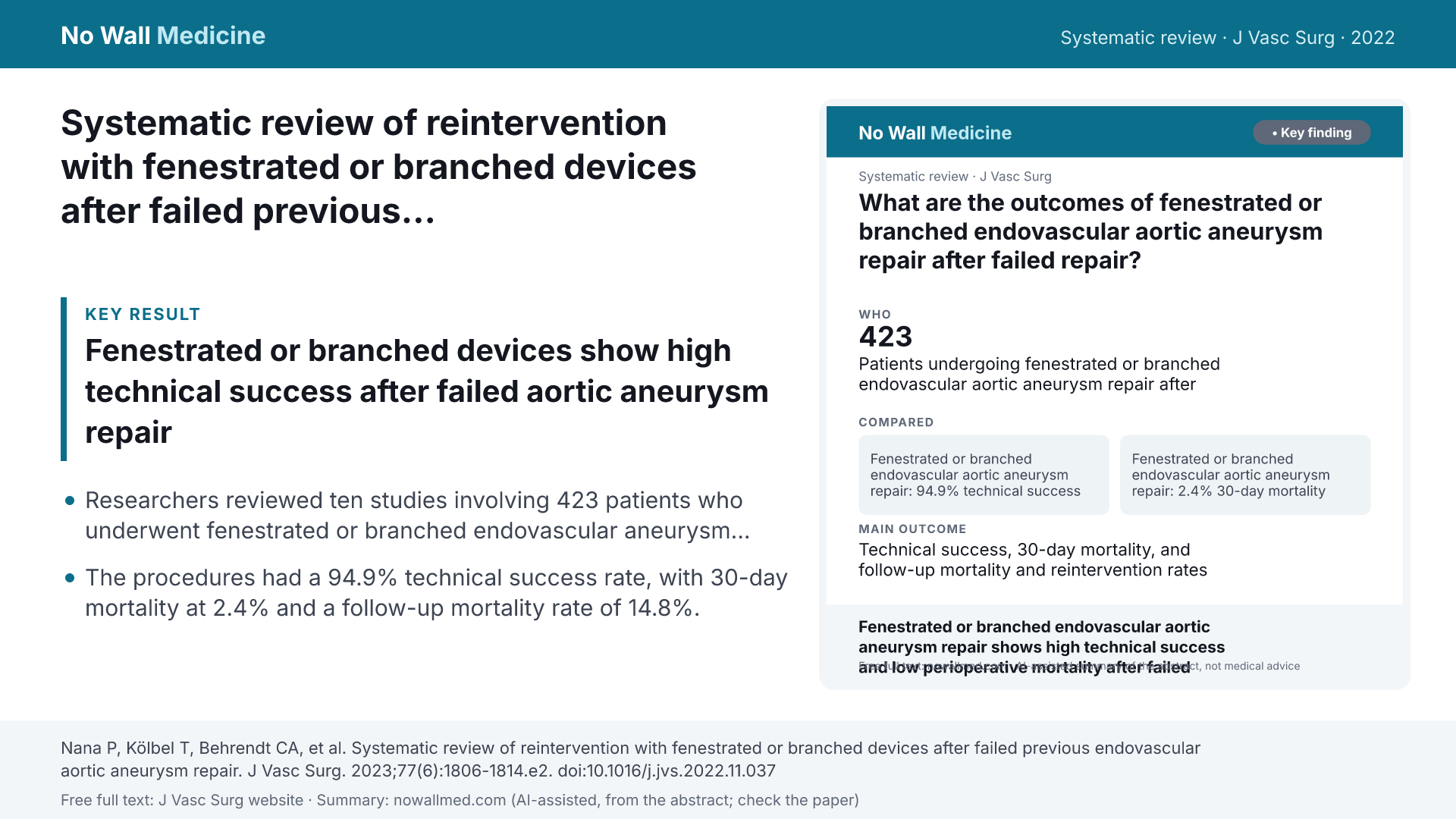
Fenestrated or branched devices show high technical success after failed aortic aneurysm repair
Systematic review of reintervention with fenestrated or branched devices after failed previous endovascular aortic aneurysm repair
Systematic reviewBenefit found
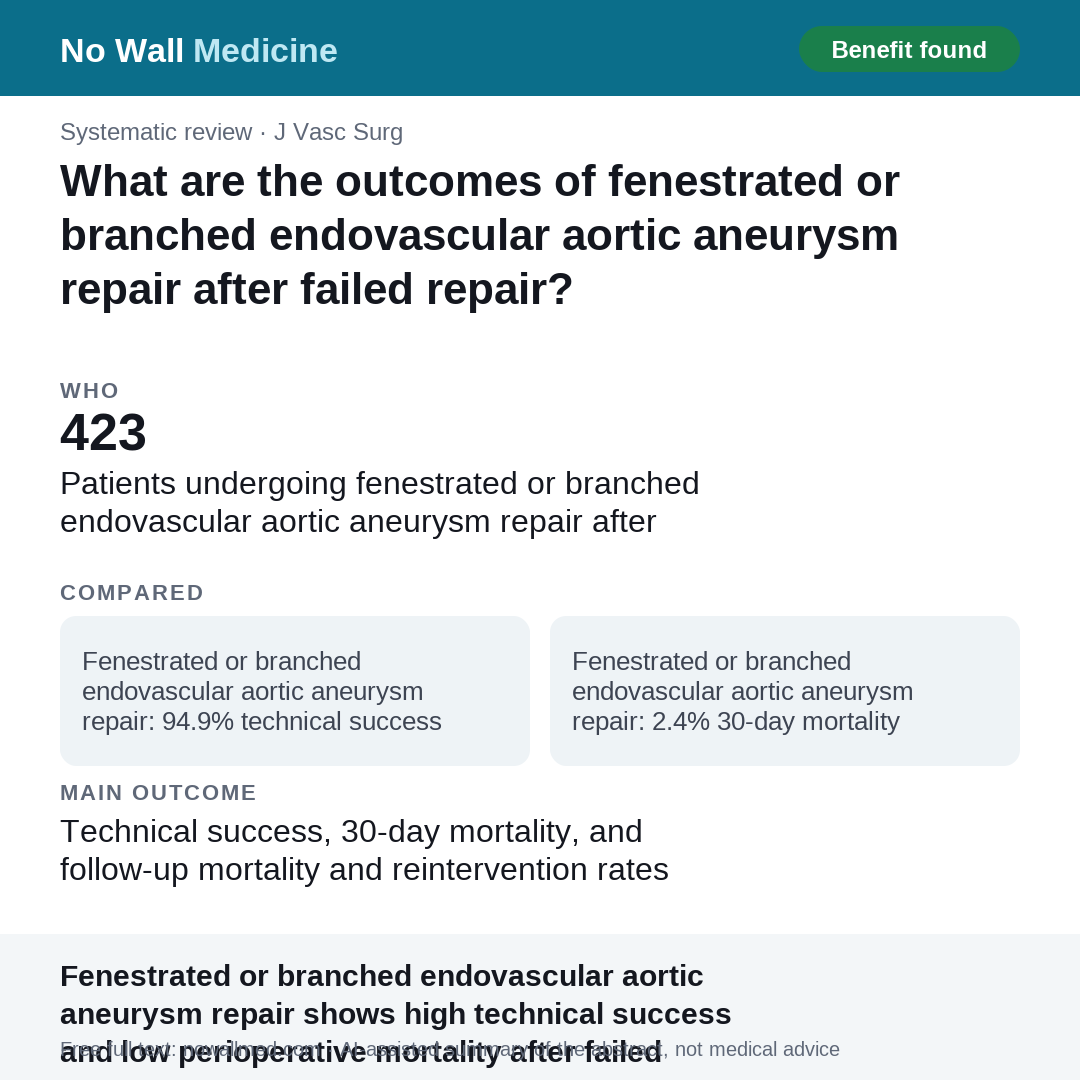
What are the outcomes of fenestrated or branched endovascular aortic aneurysm repair after failed repair?
Who
423
Patients undergoing fenestrated or branched endovascular aortic aneurysm repair after failed repair
Compared
Fenestrated or branched endovascular aortic aneurysm repair: 94.9% technical success
Fenestrated or branched endovascular aortic aneurysm repair: 2.4% 30-day mortality
Main outcome
Technical success, 30-day mortality, and follow-up mortality and reintervention rates
Bottom line: Fenestrated or branched endovascular aortic aneurysm repair shows high technical success and low perioperative mortality after failed repair.
Limitation: Further data are needed to provide firm conclusions regarding safety and durability.
J Vasc Surg · 2022-11-12Download image
Clinical question: What are the outcomes of fenestrated or branched endovascular aortic aneurysm repair after failed repair?
Why it matters: It was unknown how successful and safe fenestrated or branched endovascular techniques are for patients whose initial abdominal aortic aneurysm repair has failed.
Key points
- Researchers reviewed ten studies involving 423 patients who underwent fenestrated or branched endovascular aneurysm repair after a previous repair failed.
- The procedures had a 94.9% technical success rate, with 30-day mortality at 2.4% and a follow-up mortality rate of 14.8%.
- During follow-up, 16.5% of procedures required reintervention, and 6.8% of patients experienced acute kidney injury, which is sudden loss of kidney function.
Limitation the authors note: The authors state that further data are needed to provide firm conclusions regarding the safety and durability of these procedures.
Headline and key points written with AI from the paper’s abstract, with every number checked against it. Read the paper before relying on them.
Was this summary helpful?
Subject terms
Cite this article
Nana P, Kölbel T, Behrendt CA, Kouvelos G, Giannoukas A, Haulon S. Systematic review of reintervention with fenestrated or branched devices after failed previous endovascular aortic aneurysm repair. J Vasc Surg. 2022. doi:10.1016/j.jvs.2022.11.037
Spotted a mistake? Suggest a correction
Top studies every Monday
The week’s key trials and guidelines in your specialties, plus any topics you follow. By email, free.
Get the weekly digest