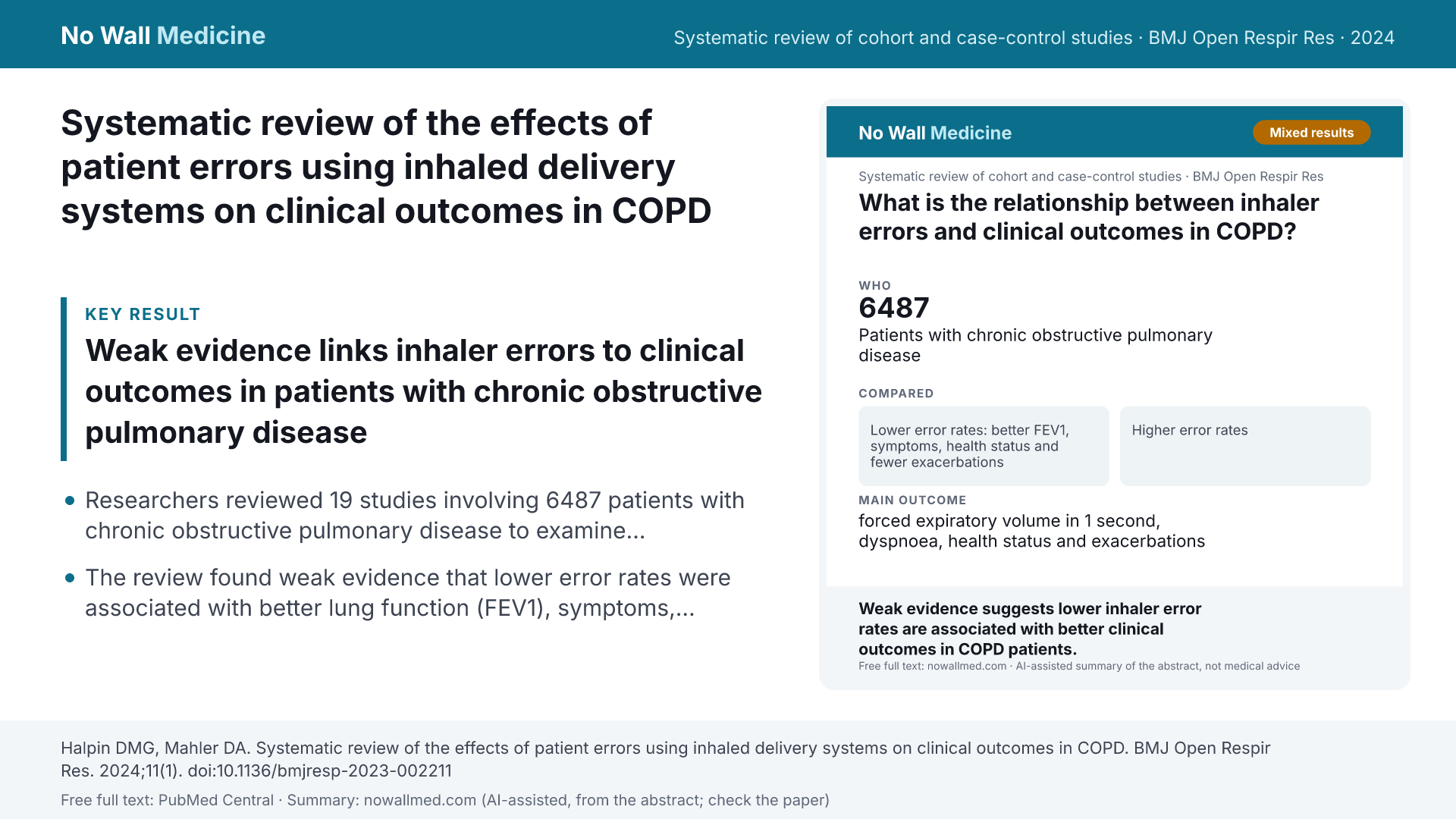
Weak evidence links inhaler errors to clinical outcomes in patients with chronic obstructive pulmonary disease
Systematic review of the effects of patient errors using inhaled delivery systems on clinical outcomes in COPD
Systematic review of cohort and case-control studiesMixed results
What is the relationship between inhaler errors and clinical outcomes in COPD?
Who
6487
Patients with chronic obstructive pulmonary disease
Compared
Lower error rates: better FEV1, symptoms, health status and fewer exacerbations
Higher error rates
Main outcome
forced expiratory volume in 1 second, dyspnoea, health status and exacerbations
Bottom line: Weak evidence suggests lower inhaler error rates are associated with better clinical outcomes in COPD patients.
Limitation: Most studies were low quality and confounded by the absence of adherence data.
BMJ Open Respir Res · 2024-04-16Download image
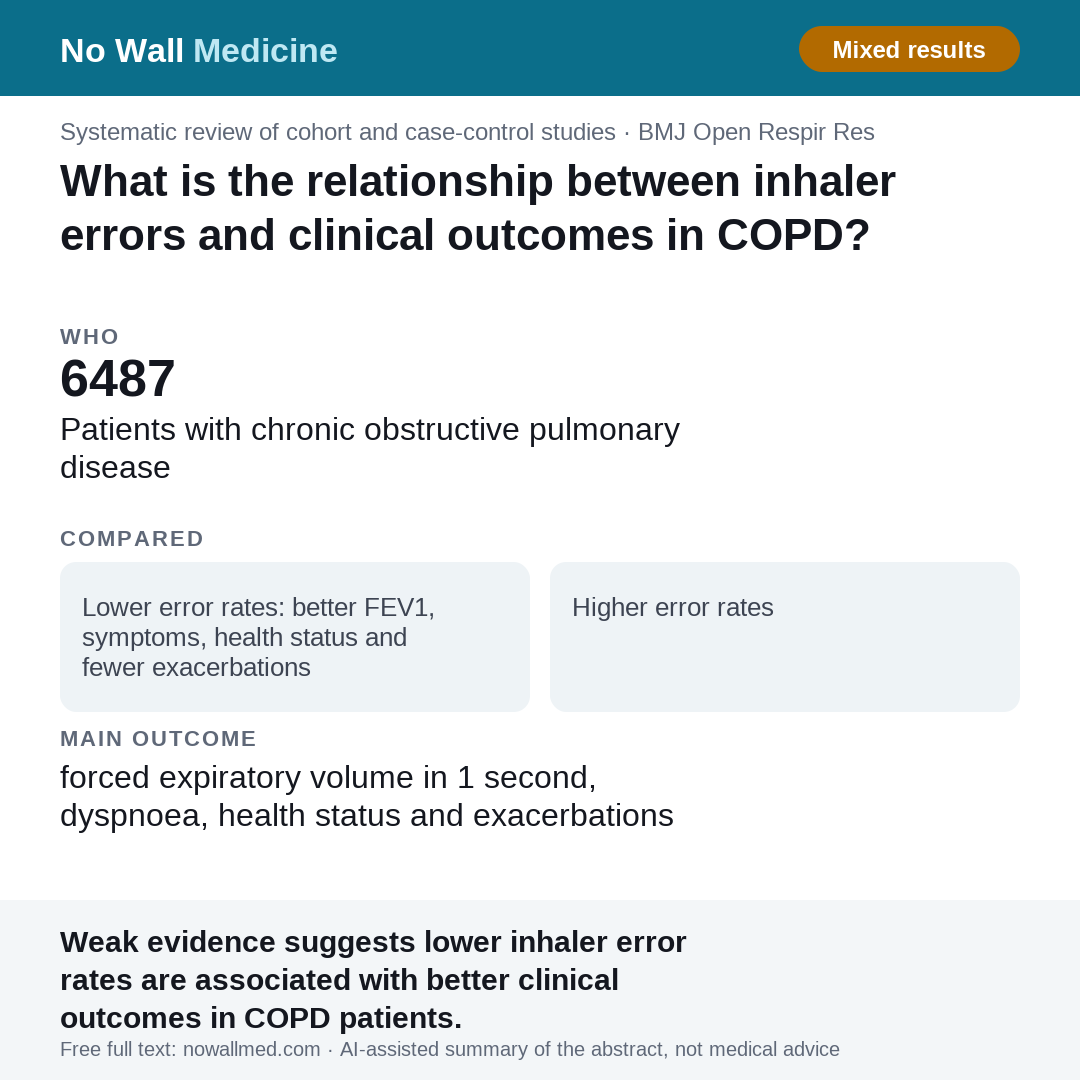
Clinical question: What is the relationship between inhaler errors and clinical outcomes in COPD?
Why it matters: It was unknown how specific errors in using inhaled delivery systems relate to clinical outcomes in patients with chronic obstructive pulmonary disease.
Key points
- Researchers reviewed 19 studies involving 6487 patients with chronic obstructive pulmonary disease to examine the relationship between inhaler errors and clinical outcomes.
- The review found weak evidence that lower error rates were associated with better lung function (FEV1), symptoms, health status, and fewer exacerbations.
- Only one study examined specific individual errors and found that only some were related to worse outcomes.
Limitation the authors note: Most included studies were low quality and were confounded by the absence of adherence data.
Headline and key points written with AI from the paper’s abstract, with every number checked against it. Read the paper before relying on them.
Was this summary helpful?
Abstract
Background
Errors using inhaled delivery systems for COPD are common and it is assumed that these lead to worse clinical outcomes. Previous systematic reviews have included patients with both asthma and COPD and much of the evidence related to asthma. More studies in COPD have now been published. Through systematic review, the relationship between errors using inhalers and clinical outcomes in COPD, including the importance of specific errors, was assessed.MethodsElectronic databases were searched on 27 October 2023 to identify cohort, case-control or randomised controlled studies, which included patients with COPD, an objective assessment of inhaler errors and data on at least one outcome of interest (forced expiratory volume in 1 s, (FEV1), dyspnoea, health status and exacerbations). Study quality was assessed using the Newcastle and Ottawa scales. A narrative synthesis of the results was performed as there was insufficient detail in the publications to allow quantitative synthesis. There was no funding for the review. Results
19 publications were included (7 cohort and 12 case-control) reporting outcomes on 6487 patients. 15 were considered low quality, and most were confounded by the absence of adherence data. There was weak evidence that lower error rates are associated with better FEV1, symptoms and health status and fewer exacerbations. Only one considered the effects of individual errors and found that only some were related to worse outcomes. Conclusion
Evidence about the importance of specific errors using inhalers and outcomes would optimise the education and training of patients with COPD. Prospective studies, including objective monitoring of inhalation technique and adherence, are needed. Prospero registration number
CRD42023393120.
Abstract reproduced under the article’s CC BY NC licence.
Subject terms
Cite this article
Halpin DMG, Mahler DA. Systematic review of the effects of patient errors using inhaled delivery systems on clinical outcomes in COPD. BMJ Open Respir Res. 2024. doi:10.1136/bmjresp-2023-002211
Spotted a mistake? Suggest a correction
Top studies every Monday
The week’s key trials and guidelines in your specialties, plus any topics you follow. By email, free.
Get the weekly digest