Systematic review of the effects of patient errors using inhaled delivery systems on clinical outcomes in COPD
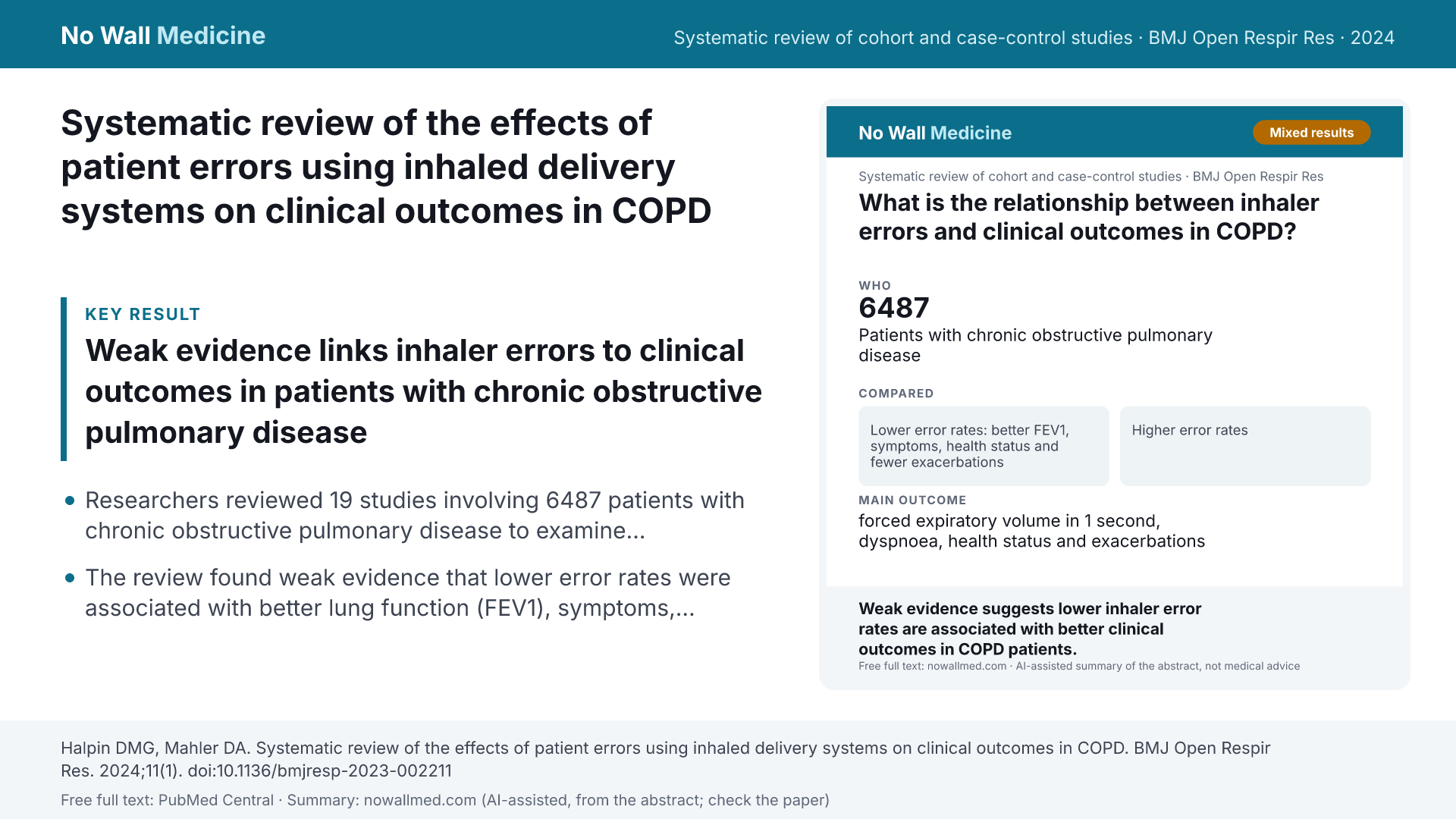
Key result: Weak evidence links inhaler errors to clinical outcomes in patients with chronic obstructive pulmonary disease
Systematic review of cohort and case-control studiesMixed results
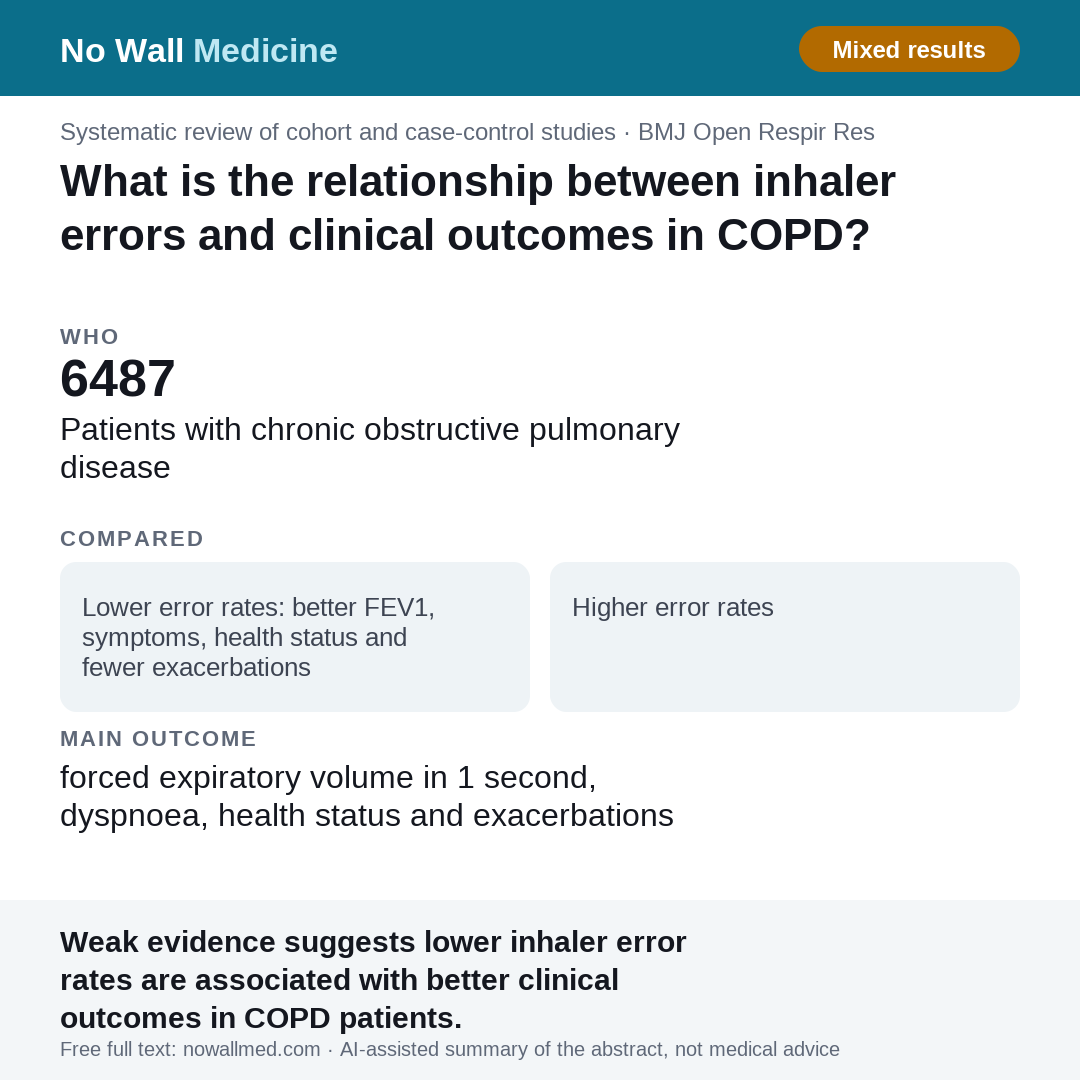
What is the relationship between inhaler errors and clinical outcomes in COPD?
Who
6487
Patients with chronic obstructive pulmonary disease
Compared
Lower error rates: better FEV1, symptoms, health status and fewer exacerbations
Higher error rates
Main outcome
forced expiratory volume in 1 second, dyspnoea, health status and exacerbations
Bottom line: Weak evidence suggests lower inhaler error rates are associated with better clinical outcomes in COPD patients.
Limitation: Most studies were low quality and confounded by the absence of adherence data.
BMJ Open Respir Res · 2024-04-16Download image
Key points
- Researchers reviewed 19 studies involving 6487 patients with chronic obstructive pulmonary disease to examine the relationship between inhaler errors and clinical outcomes.
- The review found weak evidence that lower error rates were associated with better lung function (FEV1), symptoms, health status, and fewer exacerbations.
- Only one study examined specific individual errors and found that only some were related to worse outcomes.
Limitation the authors note: Most included studies were low quality and were confounded by the absence of adherence data.
Discussion prompts
- Would these patients look like yours? Who was left out?
- Is the main outcome one that matters to patients?
- Is the difference large enough to change what you do?
Cite: Halpin DMG, Mahler DA. Systematic review of the effects of patient errors using inhaled delivery systems on clinical outcomes in COPD. BMJ Open Respir Res. 2024. doi:10.1136/bmjresp-2023-002211
Free full text: PubMed Central · Summary and visual abstract: nowallmed.com/a/systematic-review-of-the-effects-of-patient-errors-using-inhaled-q2vs4m/ (AI-assisted from the abstract; check the paper before relying on it).