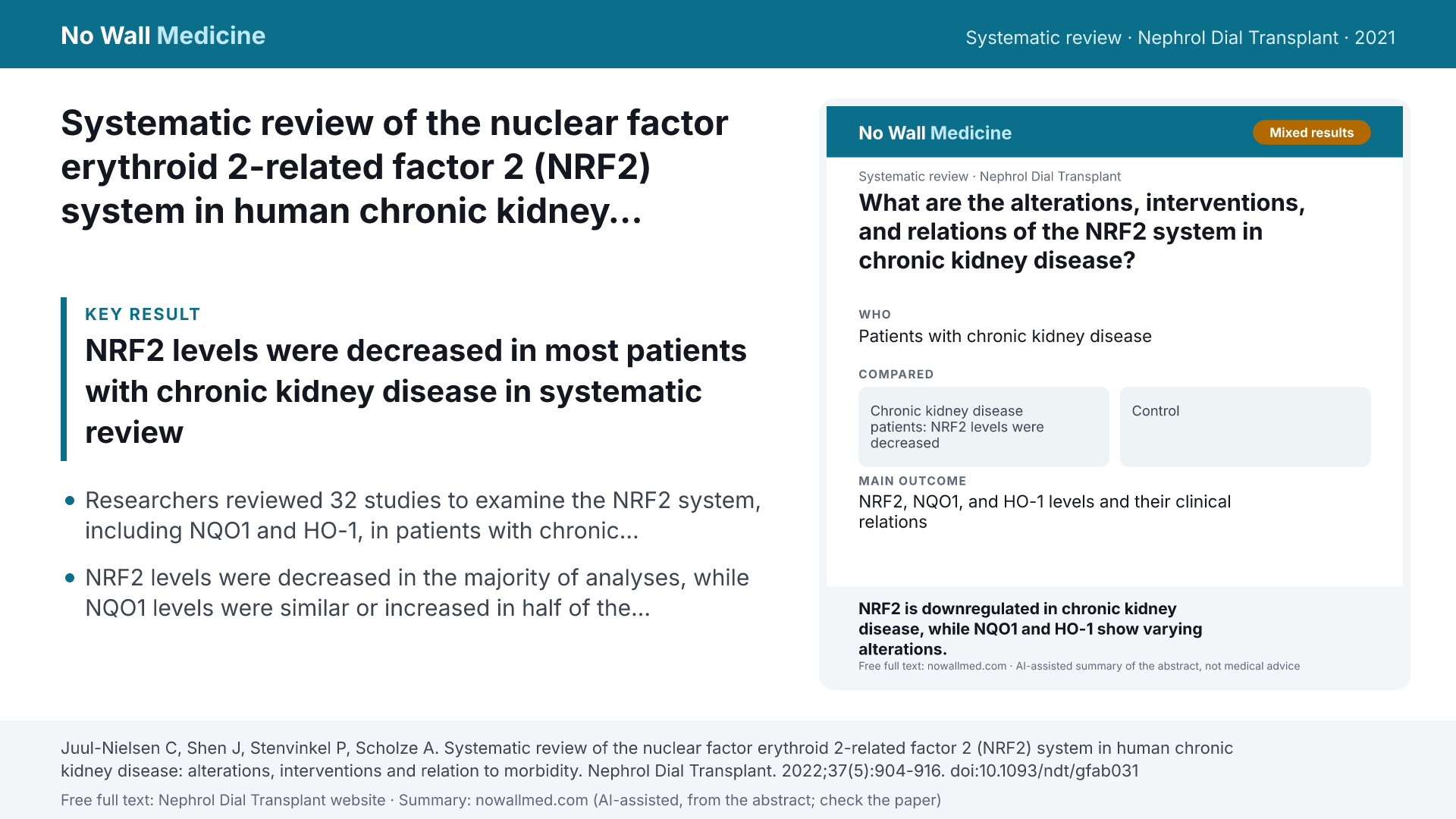
NRF2 levels were decreased in most patients with chronic kidney disease in systematic review
Systematic review of the nuclear factor erythroid 2-related factor 2 (NRF2) system in human chronic kidney disease: alterations, interventions and relation to morbidity
Systematic reviewMixed results
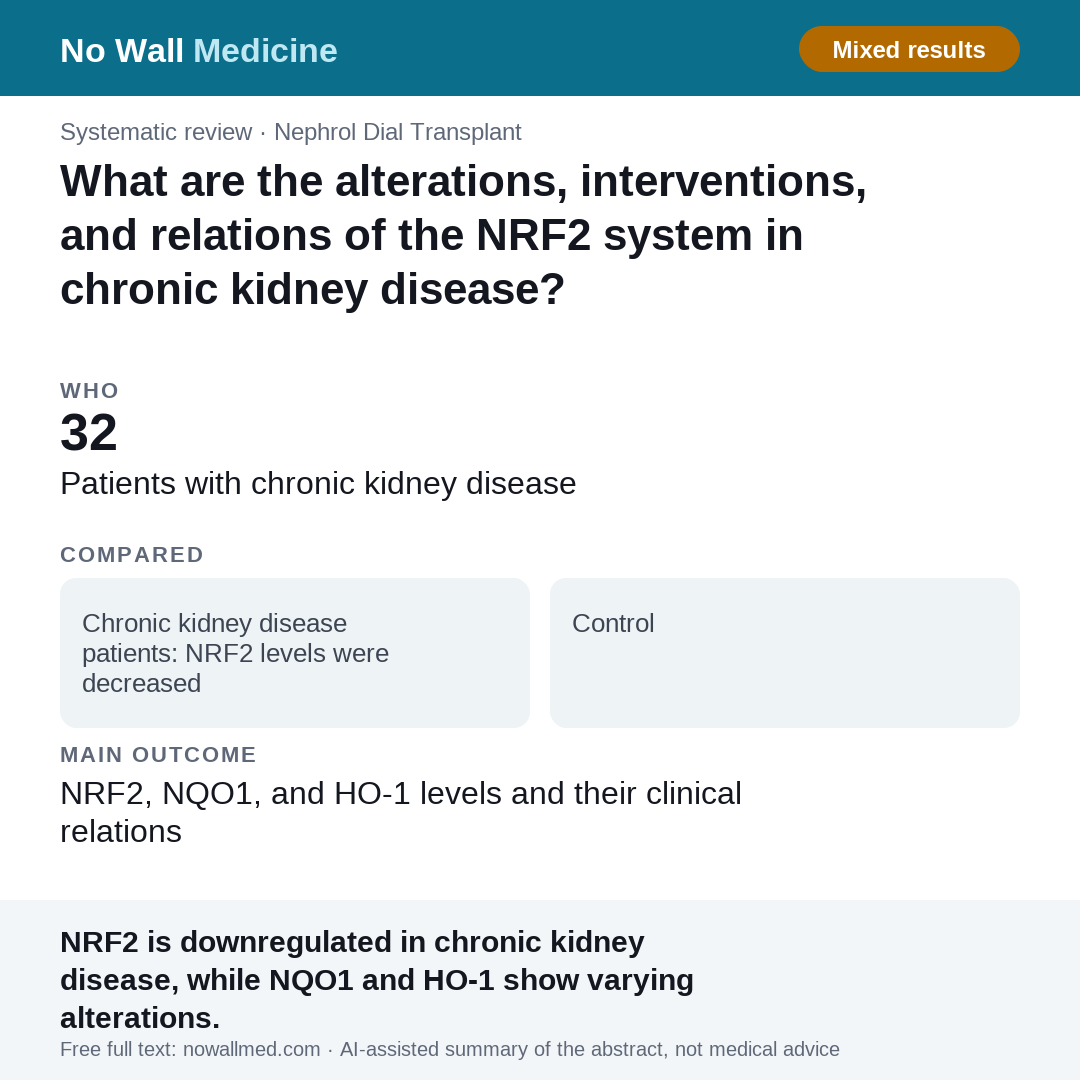
What are the alterations, interventions, and relations of the NRF2 system in chronic kidney disease?
Who
32
Patients with chronic kidney disease
Compared
Chronic kidney disease patients: NRF2 levels were decreased
Control
Main outcome
NRF2, NQO1, and HO-1 levels and their clinical relations
Bottom line: NRF2 is downregulated in chronic kidney disease, while NQO1 and HO-1 show varying alterations.
Nephrol Dial Transplant · 2021-02-07Download image
Clinical question: What are the alterations, interventions, and relations of the NRF2 system in chronic kidney disease?
Why it matters: The status of the NRF2 system, its response to interventions, and its relationship to clinical parameters in chronic kidney disease were not fully established.
Key points
- Researchers reviewed 32 studies to examine the NRF2 system, including NQO1 and HO-1, in patients with chronic kidney disease.
- NRF2 levels were decreased in the majority of analyses, while NQO1 levels were similar or increased in half of the analyses and decreased in the other half.
- Two-thirds of intervention studies, including 50% involving dietary changes like resistant starch, reported an increase in NRF2, NQO1, or HO-1.
Headline and key points written with AI from the paper’s abstract, with every number checked against it. Read the paper before relying on them.
Was this summary helpful?
Subject terms
Cite this article
Juul-Nielsen C, Shen J, Stenvinkel P, Scholze A. Systematic review of the nuclear factor erythroid 2-related factor 2 (NRF2) system in human chronic kidney disease: alterations, interventions and relation to morbidity. Nephrol Dial Transplant. 2021. doi:10.1093/ndt/gfab031
Spotted a mistake? Suggest a correction