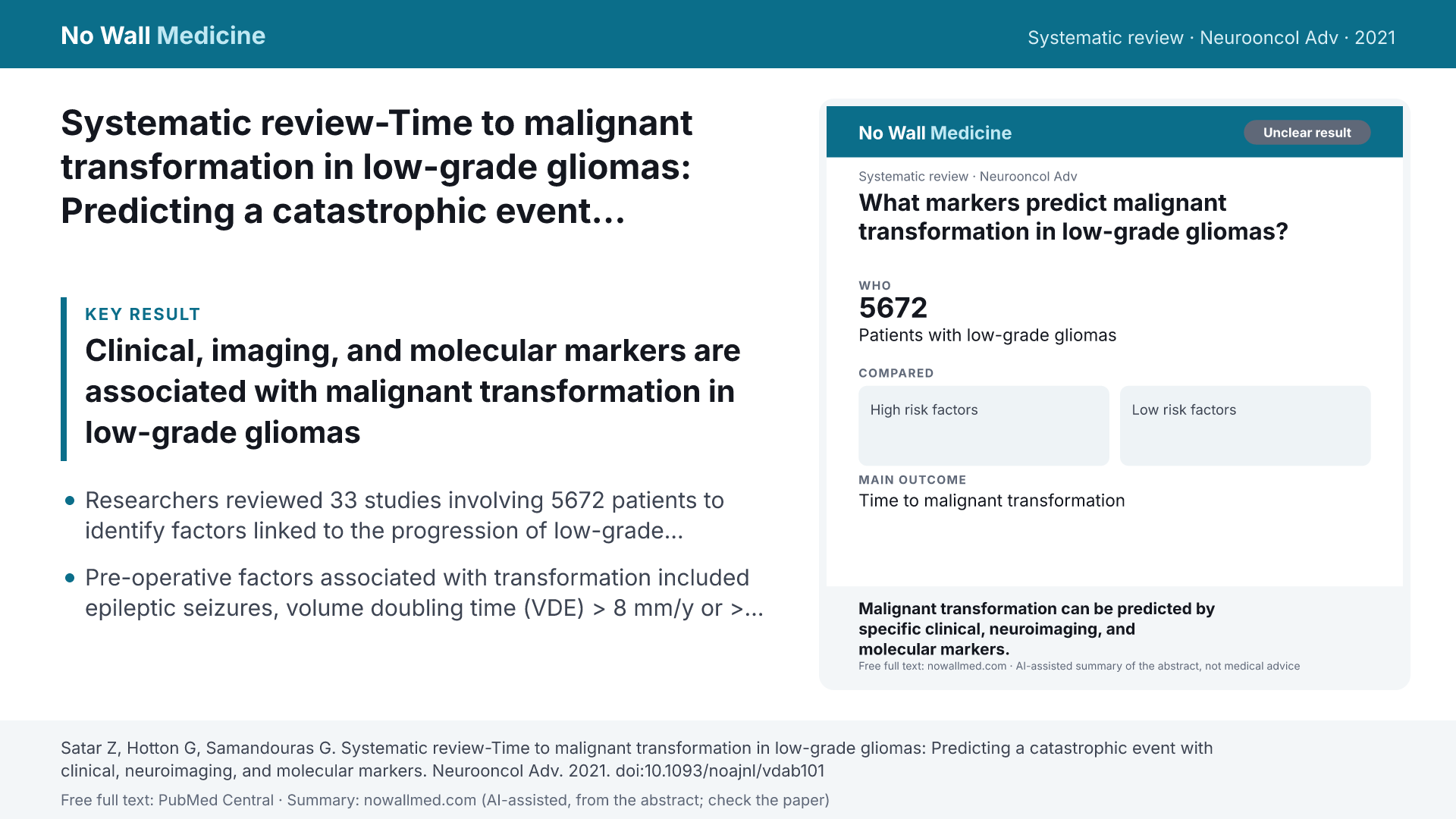
Clinical, imaging, and molecular markers are associated with malignant transformation in low-grade gliomas
Systematic review-Time to malignant transformation in low-grade gliomas: Predicting a catastrophic event with clinical, neuroimaging, and molecular markers
Systematic reviewUnclear result
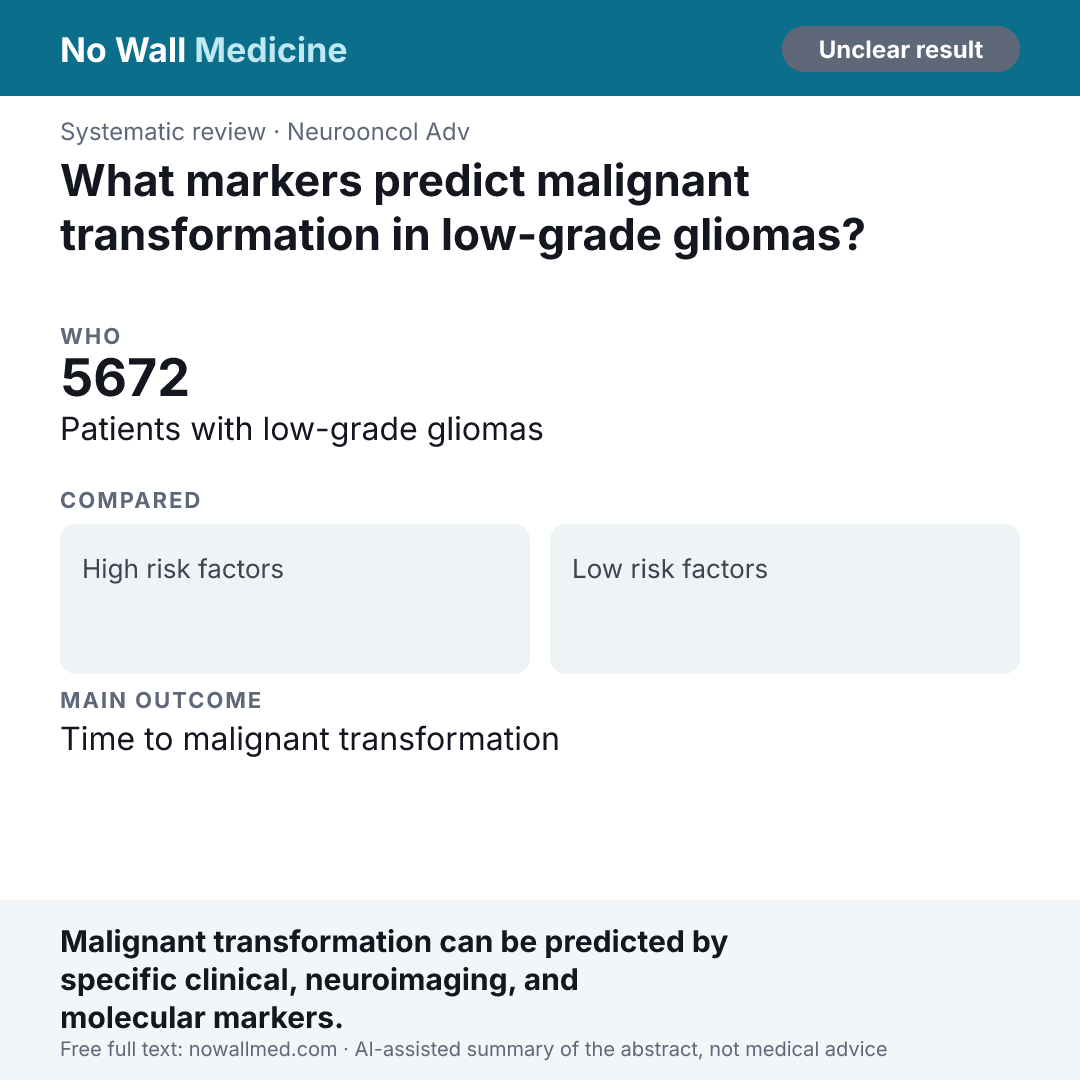
What markers predict malignant transformation in low-grade gliomas?
Who
5672
Patients with low-grade gliomas
Compared
High risk factors
Low risk factors
Main outcome
Time to malignant transformation
Bottom line: Malignant transformation can be predicted by specific clinical, neuroimaging, and molecular markers.
Neurooncol Adv · 2021-07-27 · Save PNG
Clinical question: What markers predict malignant transformation in low-grade gliomas?
Why it matters: It is currently difficult to predict when low-grade gliomas will transform into more aggressive malignant tumors to guide timing of medical interventions.
Key points
- Researchers reviewed 33 studies involving 5672 patients to identify factors linked to the progression of low-grade gliomas to higher grades.
- Pre-operative factors associated with transformation included epileptic seizures, volume doubling time (VDE) > 8 mm/y or > 4 mm/y, relative cerebral blood volume (rCBV) > 1.75, tumor volume (PTV) ≥ 5 cm (65 ml) or ≥ 100 ml, and cortical involvement.
- Post-operative factors associated with transformation included IDH-wildtype status, TP53 mutation, and temozolomide monotherapy.
Headline and key points written with AI from the paper’s abstract, with every number checked against it. Read the paper before relying on them.
Was this summary helpful?
Headline, design, result, key points, caveat and citation as plain text.
Cite this article
Satar Z, Hotton G, Samandouras G. Systematic review-Time to malignant transformation in low-grade gliomas: Predicting a catastrophic event with clinical, neuroimaging, and molecular markers. Neurooncol Adv. 2021. doi:10.1093/noajnl/vdab101
Spotted a mistake? Suggest a correction