Systemic medications were associated with different levels of dementia risk in an umbrella review
Systemic medications and dementia risk: a systematic umbrella review
Umbrella review of meta-analysesMixed results
Do systemic medications modulate dementia risk?
Who
Humans
Compared
Anti-hypertensives, statins, SGLT2 inhibitors, and GLP-1 receptor agonists: reduced risk of dementia
Anticholinergics: increased risk
Main outcome
dementia risk
Bottom line: Certain medications may reduce or increase dementia risk, but evidence is insufficient to recommend drug repurposing for dementia prevention.
Limitation: Confounding by indication and potential reverse causality were important limitations.
Mol Psychiatry · 2025-07-24Download image
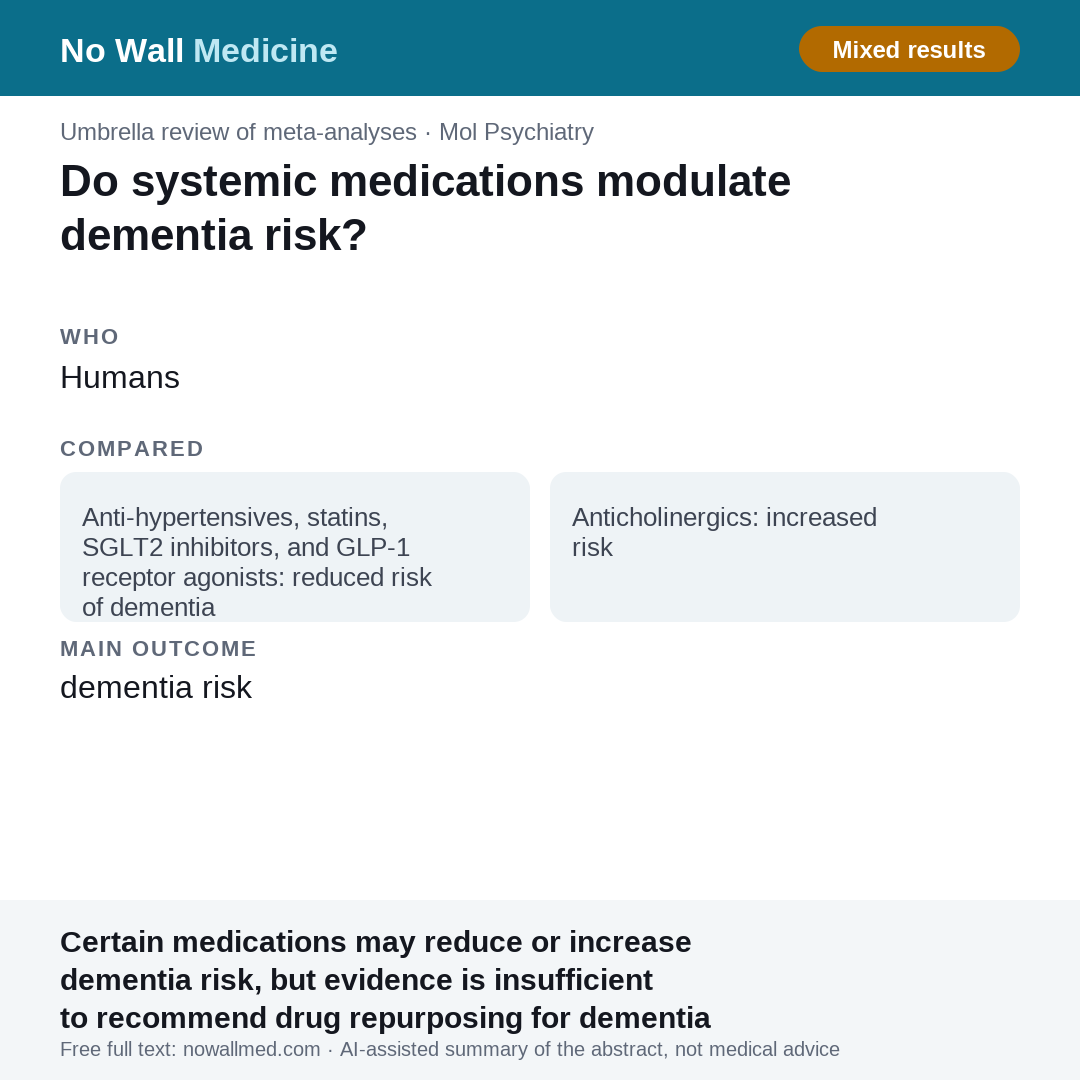
Clinical question: Do systemic medications modulate dementia risk?
Why it matters: Existing meta-analyses show varying results regarding whether systemic medications can modulate the risk of developing dementia.
Key points
- Researchers reviewed 68 meta-analyses across 11 drug categories to examine how systemic medications relate to dementia risk.
- Moderate certainty evidence showed dementia risk was associated with anti-hypertensives, statins, sodium-glucose transport protein 2 inhibitors, and glucagon-like peptide-1 receptor agonists.
- Moderate certainty evidence also linked anticholinergic drugs, which block acetylcholine in the brain, to an increased risk of dementia.
Limitation the authors note: The available data were primarily observational, meaning confounding by indication and potential reverse causality were important limitations.
Headline and key points written with AI from the paper’s abstract, with every number checked against it. Read the paper before relying on them.
Topics
Cite this article
Belessiotis-Richards C, Hayes J, Feng Yap Y, Talwar S, Eskinazi M, Li W. Systemic medications and dementia risk: a systematic umbrella review. Mol Psychiatry. 2025. doi:10.1038/s41380-025-03129-3
Spotted a mistake? Suggest a correction