Targeted self-help booklets helped dual users of combustible cigarettes and e-cigarettes quit smoking
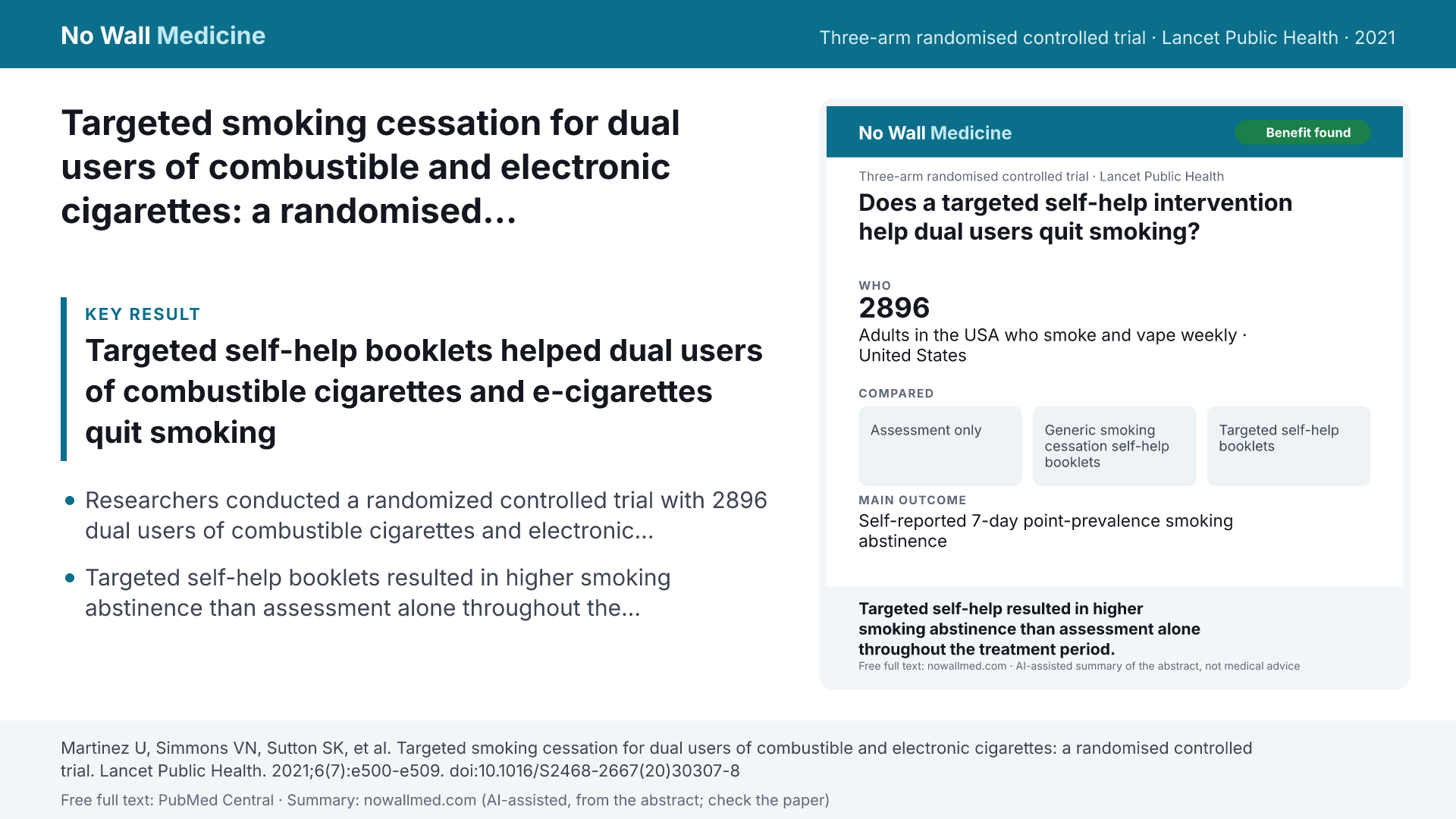
Targeted smoking cessation for dual users of combustible and electronic cigarettes: a randomised controlled trial
Three-arm randomised controlled trialBenefit found
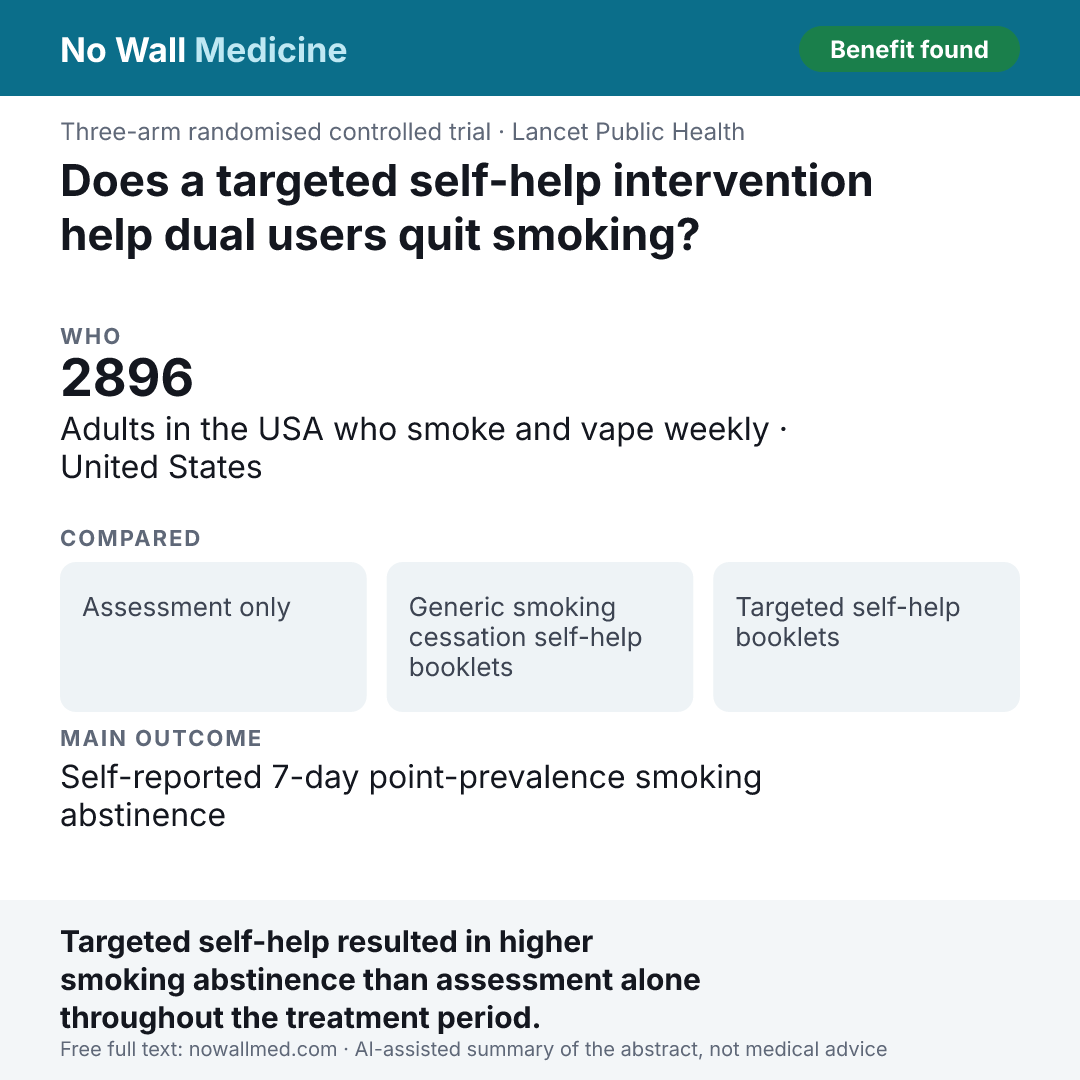
Does a targeted self-help intervention help dual users quit smoking?
Who
2896
Adults in the USA who smoke and vape weekly · United States
Compared
Assessment only
Generic smoking cessation self-help booklets
Targeted self-help booklets
Main outcome
Self-reported 7-day point-prevalence smoking abstinence
Bottom line: Targeted self-help resulted in higher smoking abstinence than assessment alone throughout the treatment period.
Funded by: National Institute on Drug Abuse, National Cancer Institute
Lancet Public Health · 2021-06-27 · Save PNG
Clinical question: Does a targeted self-help intervention help dual users quit smoking?
Key points
- Researchers conducted a randomized controlled trial with 2896 dual users of combustible cigarettes and electronic cigarettes in the USA.
- Targeted self-help booklets resulted in higher smoking abstinence than assessment alone throughout the 24-month treatment period.
- In the overall sample, 7-day smoking abstinence increased from 14% at 3 months to 42% at 24 months.
Headline and key points written with AI from the paper’s abstract, with every number checked against it. Read the paper before relying on them.
Was this summary helpful?
Abstract
Background
Although many smokers use electronic cigarettes (e-cigarettes) to quit smoking, most continue to smoke while vaping. This dual use might delay cessation and increase toxicant exposure. We aimed to test the efficacy of a self-help intervention designed to help dual users to quit smoking. Methods
In this three-arm randomised controlled trial we recruited individuals in the USA using Facebook and multimedia advertisements. Included participants were 18 years or older, smoked at least weekly in the preceding year, and vaped at least weekly in the preceding month. We used computer generated randomisation with balanced-permuted blocks (block size 10, with 2-4-4 ratio) to allocate participants to assessment only (ASSESS group), generic smoking cessation self-help booklets (GENERIC group), or booklets targeting dual users (eTARGET group). Individuals in the generic or targeted intervention groups received monthly cessation materials for 18 months, with assessments every 3 months for 24 months. The main outcome was self-reported 7-day point-prevalence smoking abstinence at each assessment point. All randomly allocated participants were included in primary analyses using generalised estimating equations for each of 20 datasets created by multiple imputation. Analysis of the χ2s produced an F test. The trial is registered with ClinicalTrials.gov, NCT02416011, and is now closed. Findings
Between July 12, 2016, and June 30, 2017, we randomly assigned 2896 dual users (575 to assessment, 1154 to generic intervention, and 1167 to targeted self-help). 7-day point-prevalence smoking abstinence increased from 14% at 3 months to 42% at 24 months (F7,541·7=67·1, p<0·0001) in the overall sample. Targeted self-help resulted in higher smoking abstinence than did assessment alone throughout the treatment period (F1,973·8=10·20, p=0·0014 [α=0·017]). The generic intervention group had abstinence rates between those of the assessment and targeted groups, but did not significantly differ from either when adjusted for multiple comparisons (GENERIC vs eTARGET F1,1102·5=1·79, p=0·18 [α=0·05]; GENERIC vs ASSESS F1,676·7=4·29, p=0·039 [α=0·025]). Differences between study groups attenuated after the interventions ended. Interpretation
A targeted self-help intervention with high potential for dissemination could be efficacious in promoting smoking cessation among dual users of combustible cigarettes and e-cigarettes. Funding
National Institute on Drug Abuse, National Cancer Institute.
Abstract reproduced under the article’s CC BY NC ND licence.
Subject terms
Headline, design, result, key points, caveat and citation as plain text.
Cite this article
Martinez U, Simmons VN, Sutton SK, et al. Targeted smoking cessation for dual users of combustible and electronic cigarettes: a randomised controlled trial. Lancet Public Health. 2021;6(7):e500-e509. doi:10.1016/S2468-2667(20)30307-8
Spotted a mistake? Suggest a correction