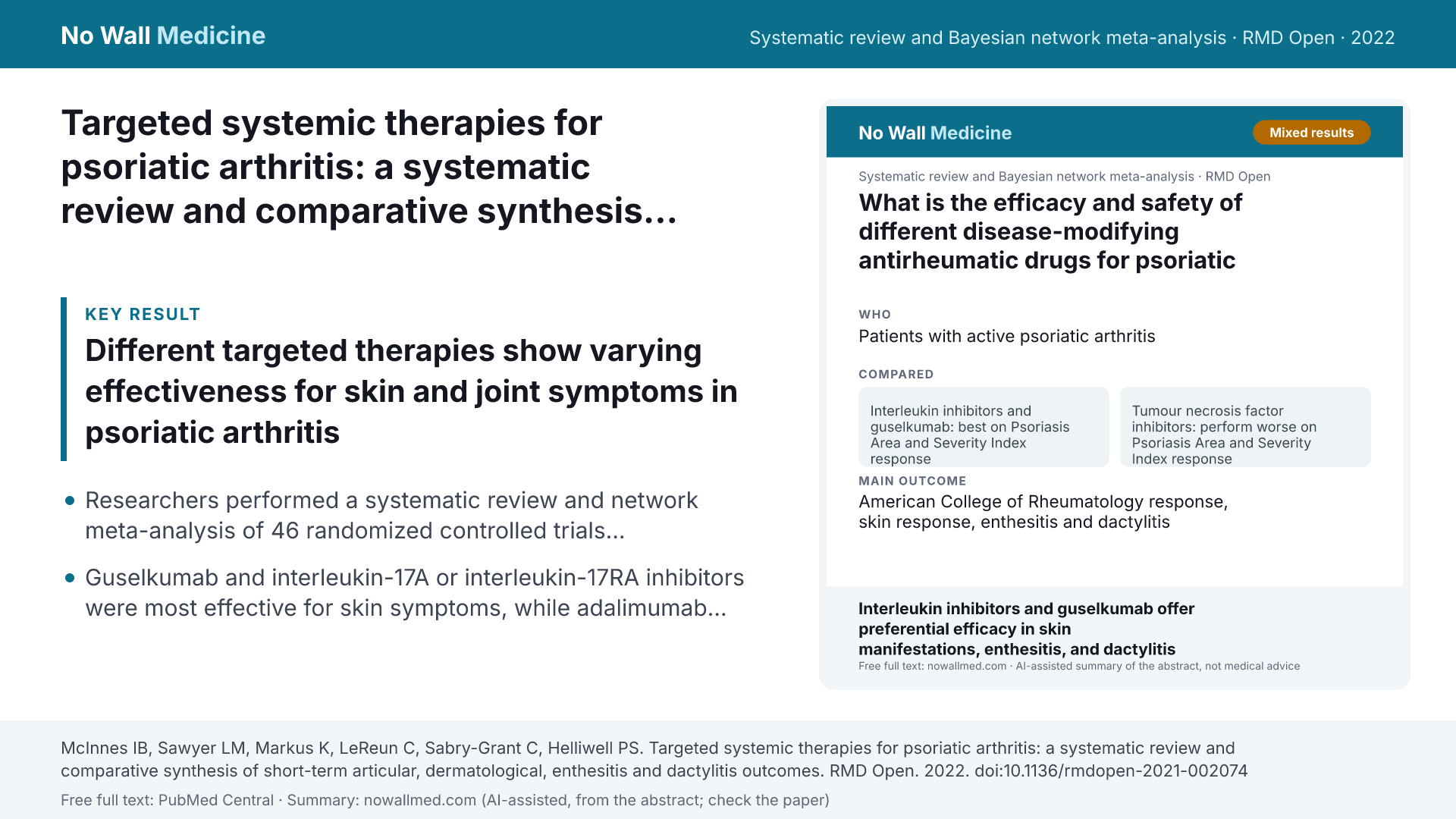
Different targeted therapies show varying effectiveness for skin and joint symptoms in psoriatic arthritis
Targeted systemic therapies for psoriatic arthritis: a systematic review and comparative synthesis of short-term articular, dermatological, enthesitis and dactylitis outcomes
Systematic review and Bayesian network meta-analysisMixed results
What is the efficacy and safety of different disease-modifying antirheumatic drugs for psoriatic arthritis?
Who
Patients with active psoriatic arthritis
Compared
Interleukin inhibitors and guselkumab: best on Psoriasis Area and Severity Index response
Tumour necrosis factor inhibitors: perform worse on Psoriasis Area and Severity Index response
Main outcome
American College of Rheumatology response, skin response, enthesitis and dactylitis resolution
Bottom line: Interleukin inhibitors and guselkumab offer preferential efficacy in skin manifestations, enthesitis, and dactylitis compared to tumour necrosis factor inhibitors.
RMD Open · 2022-03-24 · Save PNG
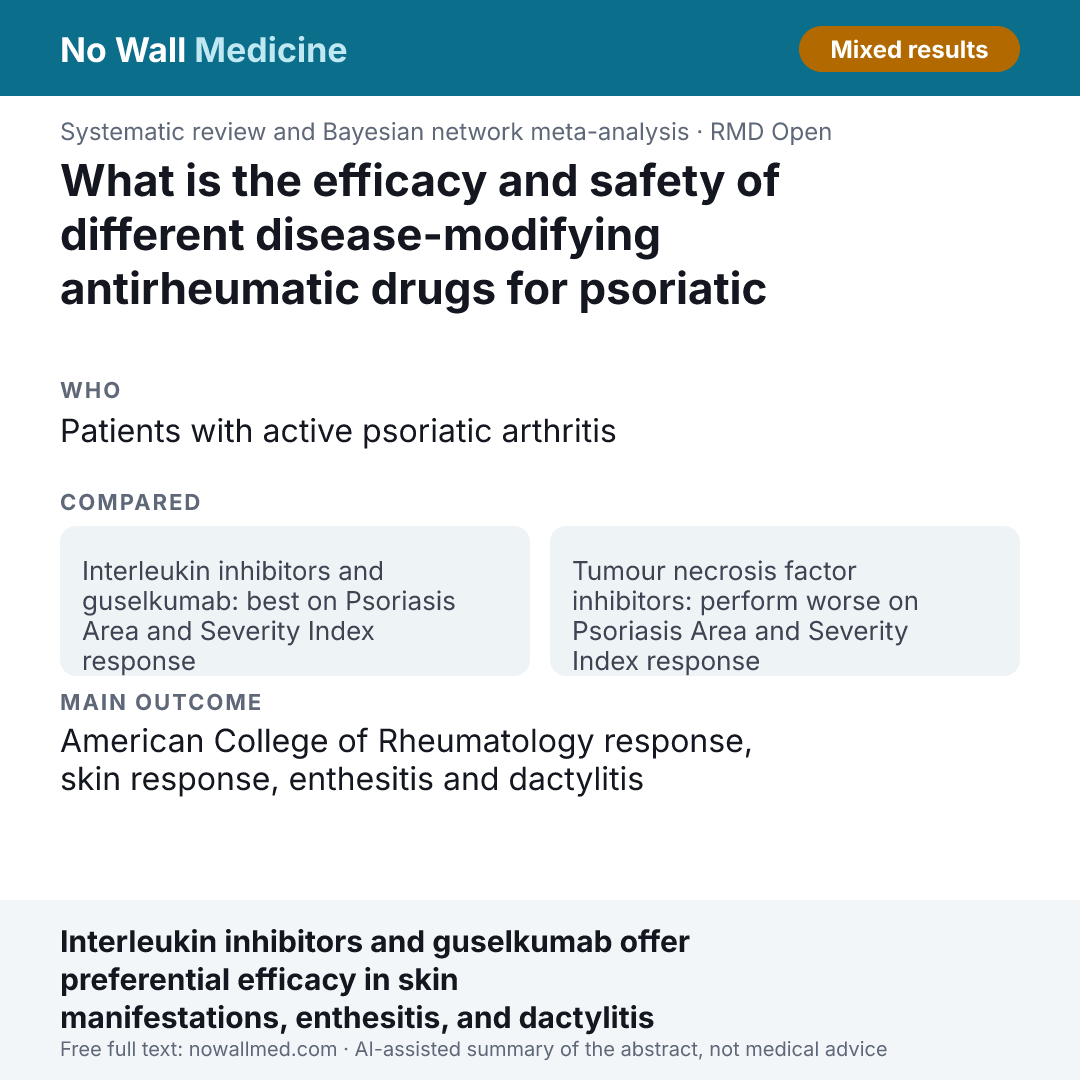
Clinical question: What is the efficacy and safety of different disease-modifying antirheumatic drugs for psoriatic arthritis?
Why it matters: Few studies have compared different biological and targeted systemic disease-modifying antirheumatic drugs directly against one another for psoriatic arthritis outcomes.
Key points
- Researchers performed a systematic review and network meta-analysis of 46 randomized controlled trials comparing various disease-modifying antirheumatic drugs for psoriatic arthritis.
- Guselkumab and interleukin-17A or interleukin-17RA inhibitors were most effective for skin symptoms, while adalimumab and interleukin inhibitors showed similar results for enthesitis and dactylitis resolution.
- Infliximab and certolizumab 400 mg every 4 weeks were associated with the highest rates of patients discontinuing treatment due to adverse events.
Headline and key points written with AI from the paper’s abstract, with every number checked against it. Read the paper before relying on them.
Was this summary helpful?
Abstract
Introduction
Randomised controlled trials (RCTs) have compared biological and targeted systemic disease-modifying antirheumatic drugs (DMARDS) against placebo in psoriatic arthritis (PsA); few have compared them head to head. Objectives
To compare the efficacy and safety of all evaluated DMARDs for active PsA, with a special focus on biological DMARDs (bDMARDs) licensed for PsA or psoriasis. Methods
A systematic review identified RCTs and Bayesian network meta-analysis (NMA) compared treatments on efficacy (American College of Rheumatology (ACR) response, Psoriasis Area and Severity Index (PASI) response, resolution of enthesitis and dactylitis) and safety (patients discontinuing due to adverse events (DAE)) outcomes. Subgroup analyses explored ACR response among patients with and without prior biological therapy exposure. Results
The NMA included 46 studies. Results indicate that some tumour necrosis factor inhibitors (anti-TNFs) may perform numerically, but not significantly, better than interleukin (IL) inhibitors on ACR response but perform worse on PASI response. Few significant differences between bDMARDs on ACR response were observed after subgrouping for prior bDMARD exposure. Guselkumab and IL-17A or IL-17RA inhibitors-brodalumab, ixekizumab, secukinumab-were best on PASI response. These IL-inhibitors and adalimumab were similarly efficacious on resolution of enthesitis and dactylitis. Infliximab with and without methotrexate, certolizumab 400 mg every 4 weeks and tildrakizumab showed the highest rates of DAE; abatacept, golimumab and the IL-inhibitors, the lowest. Conclusions
Despite similar efficacy for ACR response, IL-17A and IL-17RA inhibitors and guselkumab offered preferential efficacy to anti-TNFs in skin manifestations, and for enthesitis and dactylitis, thereby supporting drug selection based on predominant clinical phenotype.
Abstract reproduced under the article’s CC BY NC licence.
Subject terms
Headline, design, result, key points, caveat and citation as plain text.
Cite this article
McInnes IB, Sawyer LM, Markus K, LeReun C, Sabry-Grant C, Helliwell PS. Targeted systemic therapies for psoriatic arthritis: a systematic review and comparative synthesis of short-term articular, dermatological, enthesitis and dactylitis outcomes. RMD Open. 2022. doi:10.1136/rmdopen-2021-002074
Spotted a mistake? Suggest a correction