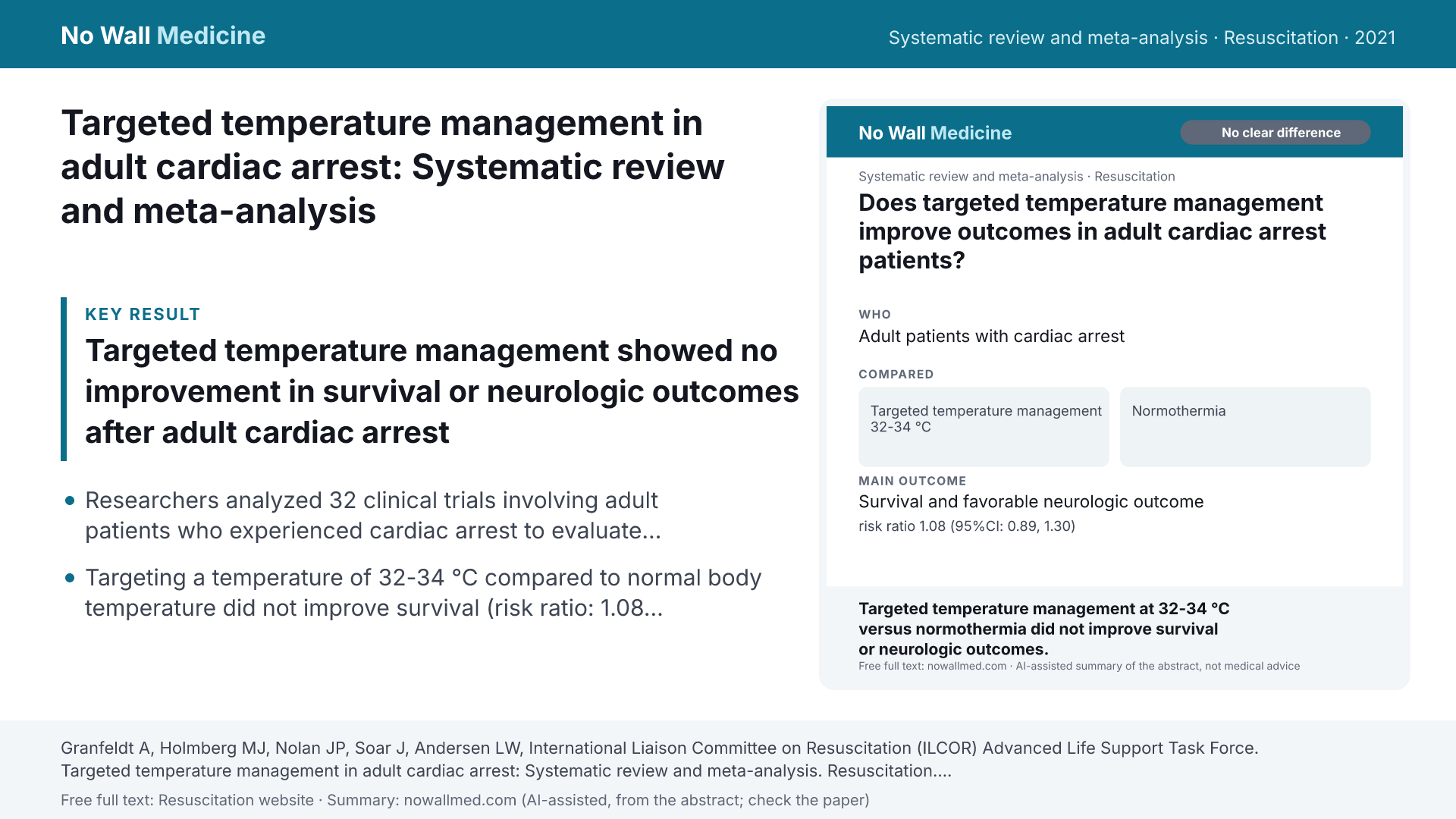
Targeted temperature management showed no improvement in survival or neurologic outcomes after adult cardiac arrest
Targeted temperature management in adult cardiac arrest: Systematic review and meta-analysis
Systematic review and meta-analysisNo clear difference
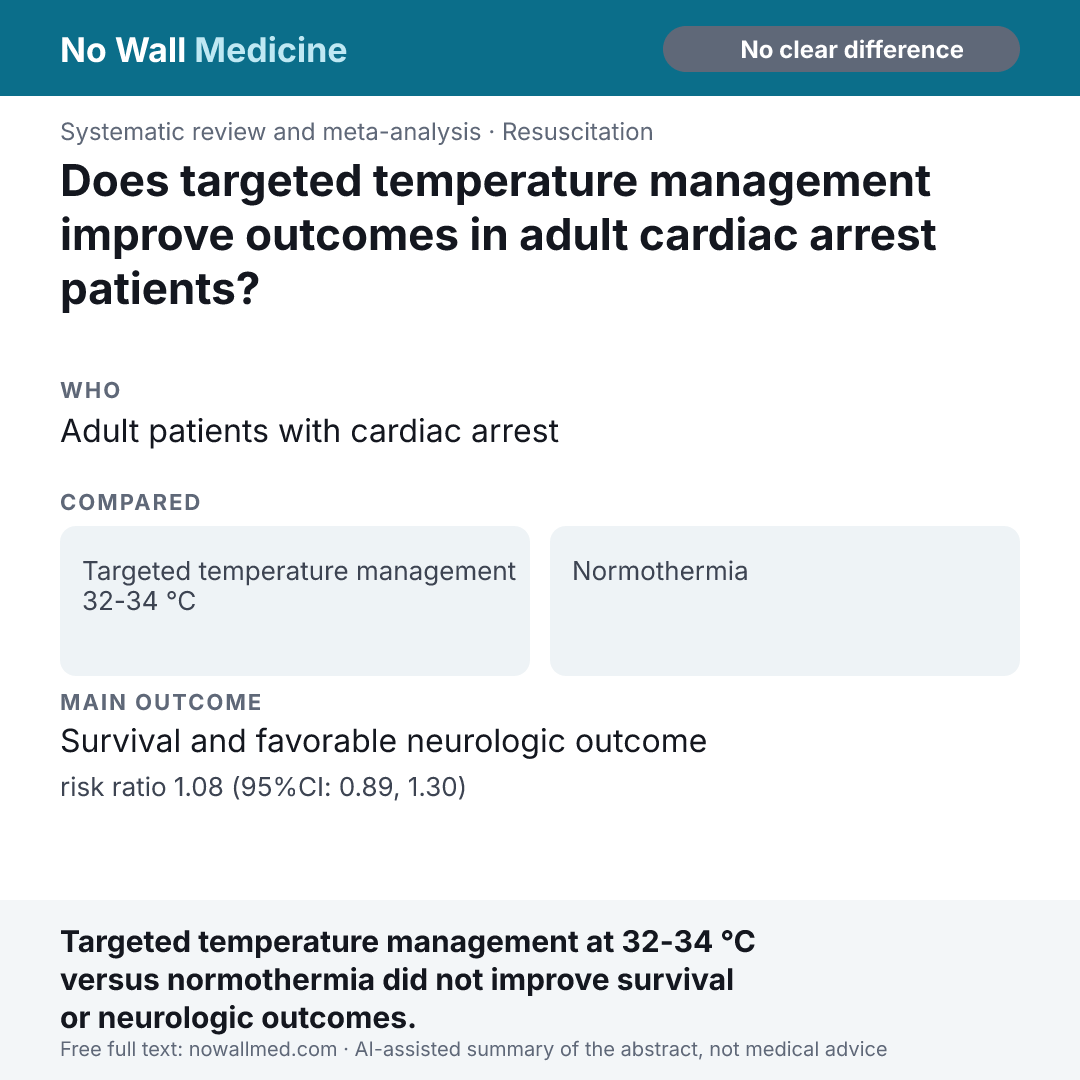
Does targeted temperature management improve outcomes in adult cardiac arrest patients?
Who
Adult patients with cardiac arrest
Compared
Targeted temperature management 32-34 °C
Normothermia
Main outcome
Survival and favorable neurologic outcome
Result: risk ratio 1.08 (95%CI: 0.89, 1.30)
Bottom line: Targeted temperature management at 32-34 °C versus normothermia did not improve survival or neurologic outcomes.
Limitation: Low certainty of evidence for primary outcomes and intermediate risk of bias.
Resuscitation · 2021-08-30 · Save PNG
Clinical question: Does targeted temperature management improve outcomes in adult cardiac arrest patients?
Key points
- Researchers analyzed 32 clinical trials involving adult patients who experienced cardiac arrest to evaluate various temperature management strategies.
- Targeting a temperature of 32-34 °C compared to normal body temperature did not improve survival (risk ratio: 1.08 [95%CI: 0.89, 1.30]) or neurologic outcomes (risk ratio: 1.21 [95%CI: 0.91, 1.61]).
- Comparing prehospital cooling to no prehospital cooling showed no improvement in survival (risk ratio: 1.01 [95%CI: 0.92, 1.11]) or neurologic outcomes (risk ratio: 1.00 [95%CI: 0.90, 1.11]) at hospital discharge.
Limitation the authors note: The certainty of evidence for several outcomes was low.
Headline and key points written with AI from the paper’s abstract, with every number checked against it. Read the paper before relying on them.
Was this summary helpful?
Subject terms
Headline, design, result, key points, caveat and citation as plain text.
Cite this article
Granfeldt A, Holmberg MJ, Nolan JP, Soar J, Andersen LW, International Liaison Committee on Resuscitation (ILCOR) Advanced Life Support Task Force. Targeted temperature management in adult cardiac arrest: Systematic review and meta-analysis. Resuscitation. 2021;167:160-172. doi:10.1016/j.resuscitation.2021.08.040
Spotted a mistake? Suggest a correction