Targeted visual cortex stimulation may improve symbol check accuracy in bipolar disorder patients
Targeted visual cortex stimulation (TVCS): a novel neuro-navigated repetitive transcranial magnetic stimulation mode for improving cognitive function in bipolar disorder
Randomized trialBenefit found
Does targeted visual cortex stimulation improve cognitive function in bipolar disorder?
Who
73
Patients with bipolar disorder
Compared
DLPFC active-sham rTMS
DLPFC sham-active rTMS
ACC active-sham rTMS: higher in the accuracy of Symbol Check at W2 compared with W0
ACC sham-active rTMS: did not differ significantly between W0 and W2
Main outcome
Changes in the scores of five THINC-integrated tool tests
Bottom line: Visual cortex stimulation functionally correlated with the anterior cingulate cortex may improve neurocognitive function in bipolar disorder.
Transl Psychiatry · 2023-06-08Download image
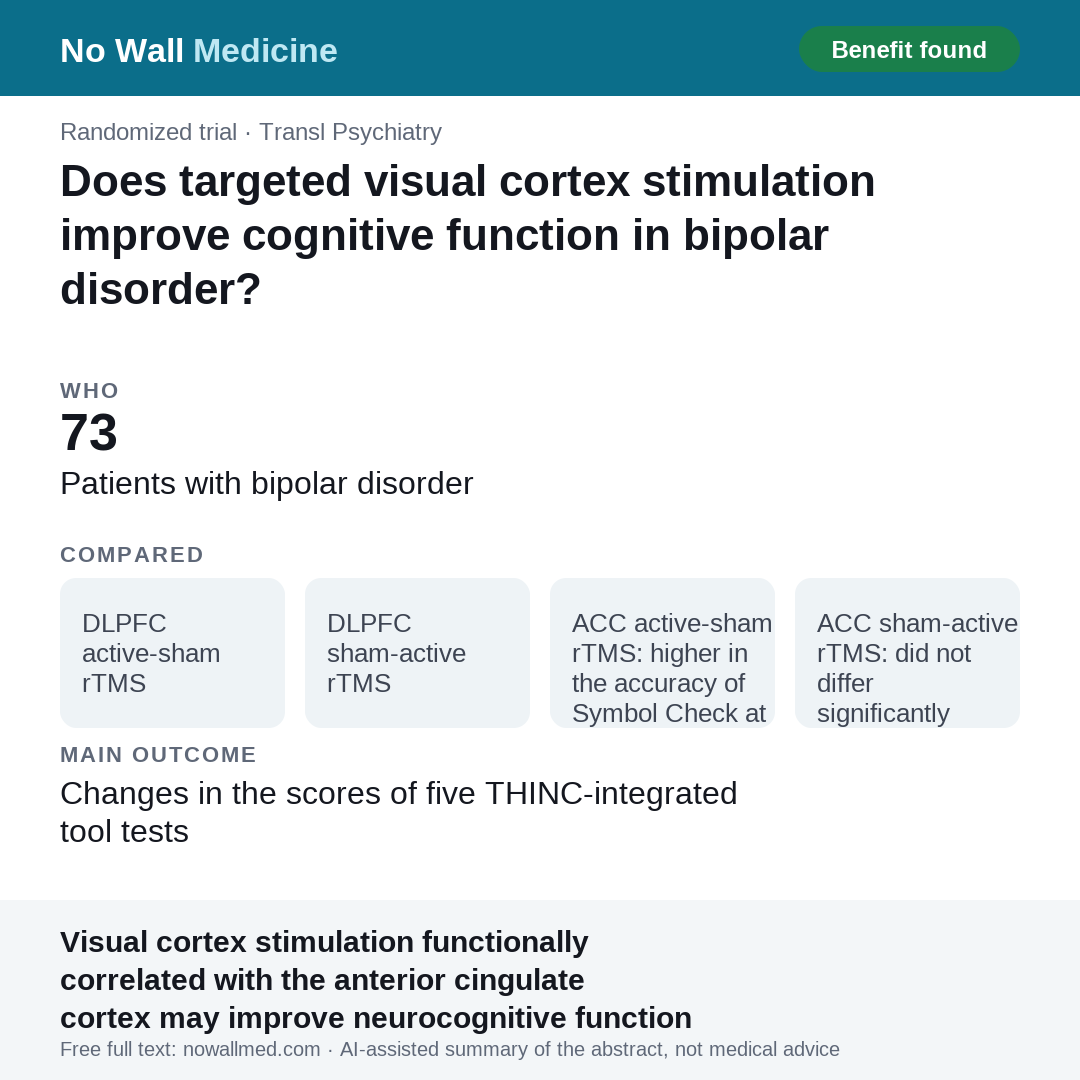
Clinical question: Does targeted visual cortex stimulation improve cognitive function in bipolar disorder?
Why it matters: It is unknown if stimulating the primary visual cortex is an effective site for repetitive transcranial magnetic stimulation to treat cognitive dysfunction in bipolar disorder.
Key points
- Researchers studied 86 patients with bipolar disorder who were randomly assigned to four groups receiving repetitive transcranial magnetic stimulation (rTMS) at either the dorsolateral prefrontal cortex or anterior cingulate cortex.
- In the group receiving active stimulation at the anterior cingulate cortex, Symbol Check accuracy scores were higher at week 2 compared to baseline (p < 0.001).
- No significant changes in functional connectivity between the targeted areas and the rest of the brain were observed in any group during the study.
Headline and key points written with AI from the paper’s abstract, with every number checked against it. Read the paper before relying on them.
Was this summary helpful?
Subject terms
Cite this article
Wang D, Tang L, Xi C, Luo D, Liang Y, Huang Q. Targeted visual cortex stimulation (TVCS): a novel neuro-navigated repetitive transcranial magnetic stimulation mode for improving cognitive function in bipolar disorder. Transl Psychiatry. 2023. doi:10.1038/s41398-023-02498-z
Spotted a mistake? Suggest a correction
Top studies every Monday
The week’s key trials and guidelines in your specialties, plus any topics you follow. By email, free.
Get the weekly digest