Technical Factors Associated With the Benefit of Prophylactic Pancreatic Stent Placement During High-Risk Endoscopic Retrograde Cholangiopancreatography: A Secondary Analysis of the SVI Trial Data Set
Secondary analysis of a randomized trialNo clear difference
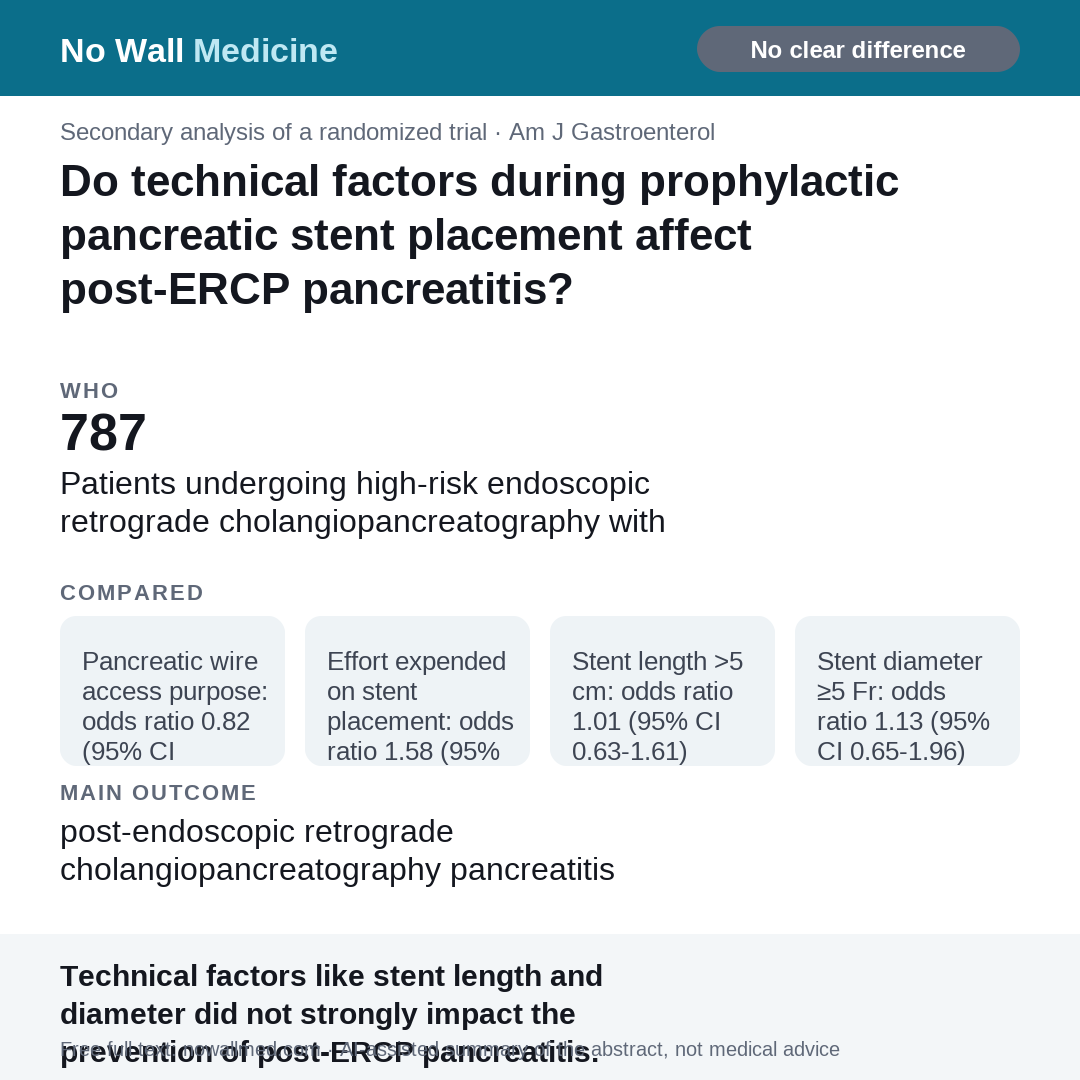
Do technical factors during prophylactic pancreatic stent placement affect post-ERCP pancreatitis?
Who
787
Patients undergoing high-risk endoscopic retrograde cholangiopancreatography with successful stent placement
Compared
Pancreatic wire access purpose: odds ratio 0.82 (95% CI 0.37-1.84)
Effort expended on stent placement: odds ratio 1.58 (95% CI 0.73-3.45)
Stent length >5 cm: odds ratio 1.01 (95% CI 0.63-1.61)
Stent diameter ≥5 Fr: odds ratio 1.13 (95% CI 0.65-1.96)
Main outcome
post-endoscopic retrograde cholangiopancreatography pancreatitis
Bottom line: Technical factors like stent length and diameter did not strongly impact the prevention of post-ERCP pancreatitis.
Limitation: limitations of post hoc subgroup analysis
Am J Gastroenterol · 2024-08-27Download image
Clinical question: Do technical factors during prophylactic pancreatic stent placement affect post-ERCP pancreatitis?
Abstract
Introduction
Prophylactic pancreatic stent placement (PSP) is effective for preventing pancreatitis after endoscopic retrograde cholangiopancreatography (ERCP) in high-risk cases, but the optimal technical approach to this intervention remains uncertain. Methods
In this secondary analysis of 787 clinical trial patients who underwent successful stent placement, we studied the impact of (i) whether pancreatic wire access was achieved for the sole purpose of PSP or naturally during the conduct of the case, (ii) the amount of effort expended on PSP, (iii) stent length, (iv) stent diameter, and (v) guidewire caliber. We used logistic regression models to examine the adjusted association between each technical factor and post-ERCP pancreatitis (PEP). Results
Ninety-one of the 787 patients experienced PEP. There was no clear association between PEP and whether pancreatic wire access was achieved for the sole purpose of PSP (vs occurring naturally; odds ratio [OR] 0.82, 95% confidence interval [CI] 0.37-1.84), whether substantial effort expended on stent placement (vs nonsubstantial effort; OR 1.58, 95% CI 0.73-3.45), stent length (>5 vs ≤5 cm; OR 1.01, 95% CI 0.63-1.61), stent diameter (≥5 vs <5 Fr; OR 1.13, 95% CI 0.65-1.96), or guidewire caliber (0.035 vs 0.025 in; 0.83, 95% CI 0.49-1.41). Discussion
The 5 modifiable technical factors studied in this secondary analysis of large-scale randomized trial data did not appear to have a strong impact on the benefit of prophylactic PSP in preventing PEP after high-risk ERCP. Within the limitations of post hoc subgroup analysis, these findings may have important implications in procedural decision making and suggest that the benefit of PSP is robust to variations in technical approach.
Subject terms
Cite this article
Elmunzer BJ, Zhang J, Coté GA, Edmundowicz SA, Wani S, Shah R. Technical Factors Associated With the Benefit of Prophylactic Pancreatic Stent Placement During High-Risk Endoscopic Retrograde Cholangiopancreatography: A Secondary Analysis of the SVI Trial Data Set. Am J Gastroenterol. 2024. doi:10.14309/ajg.0000000000003052
Spotted a mistake? Suggest a correction
Top studies every Monday
The week’s key trials and guidelines in your specialties, plus any topics you follow. By email, free.
Get the weekly digest