Systematic review identifies many technology-based methods for assessing spasticity but notes limited evaluation
Technology-assisted assessment of spasticity: a systematic review
Systematic reviewUnclear result
What are the psychometric properties and usability of technology-based spasticity assessment methods?
Who
124
Patients with spasticity, primarily stroke population
Compared
Technology-based methods
Clinical scales
Main outcome
Psychometric properties and usability of technology-based assessment methods
Bottom line: Technology-based spasticity assessments lack consistent evaluation of psychometric properties and sensitivity despite a large diversity of approaches.
J Neuroeng Rehabil · 2022-12-09Download image
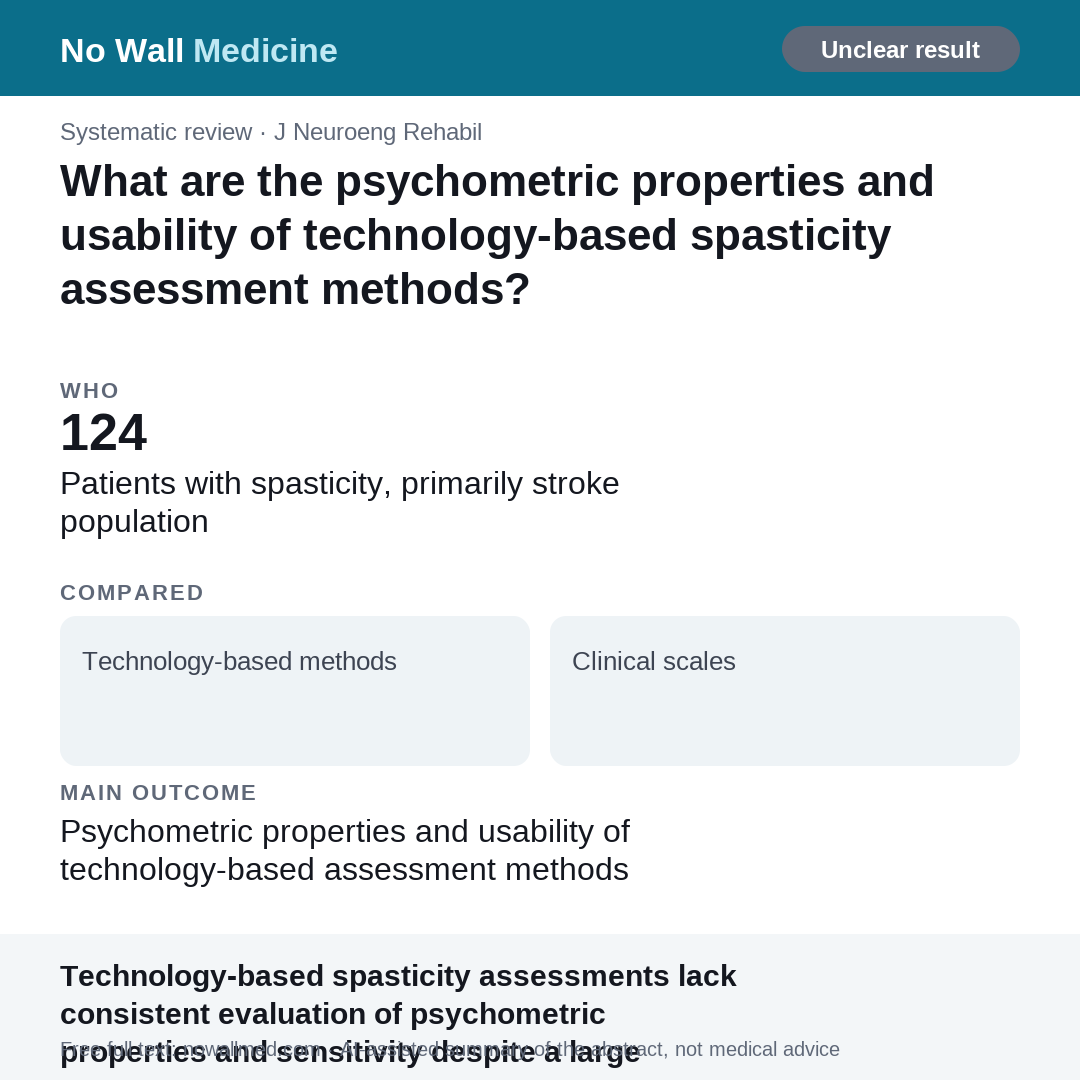
Clinical question: What are the psychometric properties and usability of technology-based spasticity assessment methods?
Why it matters: No consensus exists on which technology-based approaches provide the most specific, sensitive, and accurate alternatives to manual clinical scales for assessing spasticity.
Key points
- Researchers analyzed 124 studies involving 78 different outcome measures used to assess spasticity through various technological tools.
- While 54 studies used measures specific to spasticity, more than half of the papers did not thoroughly report psychometric properties.
- Repeatability and discriminant validity were found to be of good quality in 25 and 42 studies, respectively.
Headline and key points written with AI from the paper’s abstract, with every number checked against it. Read the paper before relying on them.
Was this summary helpful?
Subject terms
Cite this article
Guo X, Wallace R, Tan Y, Oetomo D, Klaic M, Crocher V. Technology-assisted assessment of spasticity: a systematic review. J Neuroeng Rehabil. 2022. doi:10.1186/s12984-022-01115-2
Spotted a mistake? Suggest a correction
Top studies every Monday
The week’s key trials and guidelines in your specialties, plus any topics you follow. By email, free.
Get the weekly digest