Technology-assisted dual-task training may improve gait, balance, and cognition in older adults
Technology-Assisted Cognitive Motor Dual-Task Rehabilitation in Chronic Age-Related Conditions: Systematic Review
Systematic reviewBenefit found
Is technology-assisted cognitive-motor dual-task rehabilitation effective in chronic age-related conditions?
Who
8
Older adults over 65 years with chronic conditions or frailty
Compared
Technology-assisted cognitive-motor dual-task rehabilitation
Control condition
Main outcome
Falls, balance, gait, dual-task performance, executive functions and attention
Bottom line: Technology-assisted cognitive-motor dual-task rehabilitation is a promising method to enhance motor-cognitive functions in older adults.
Limitation: Little information regarding multimorbidity, chronicity, or frailty status is available.
J Med Internet Res · 2023-05-22Download image
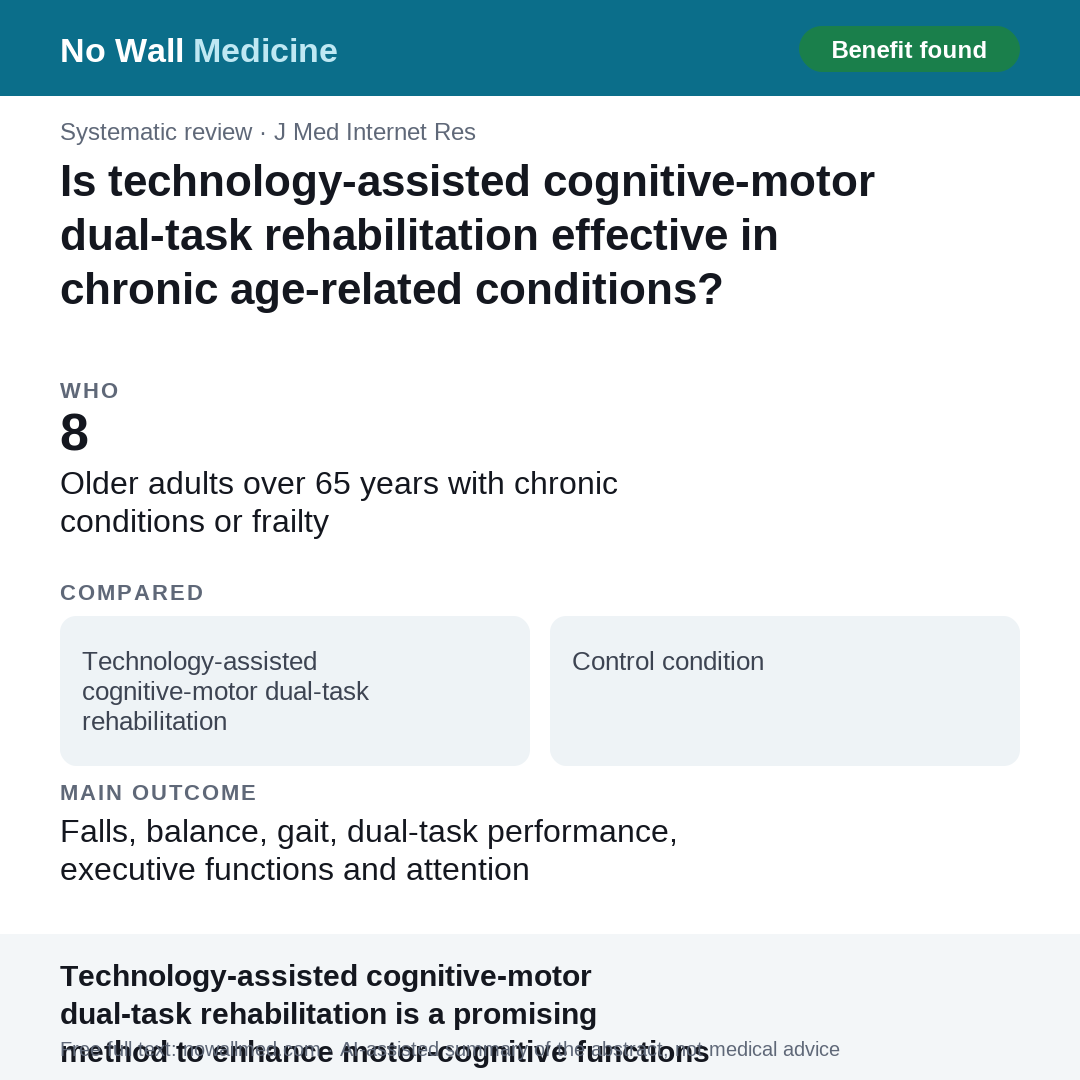
Clinical question: Is technology-assisted cognitive-motor dual-task rehabilitation effective in chronic age-related conditions?
Why it matters: It is unknown how technology-assisted cognitive-motor dual-task rehabilitation affects older adults living with frailty, chronic conditions, or multiple illnesses.
Key points
- Researchers reviewed 8 studies involving older adults over 65 years old with at least one chronic condition or frailty.
- Technology-assisted training involving motion-tracking and virtual reality was found to be effective for dual-task performance, falls, gait, and cognition.
- The effects of these technology-assisted rehabilitation programs were maintained during midterm follow-up periods.
Limitation the authors note: There is little information available regarding multimorbidity, chronicity, or frailty status in the included studies.
Headline and key points written with AI from the paper’s abstract, with every number checked against it. Read the paper before relying on them.
Was this summary helpful?
Subject terms
Cite this article
Tuena C, Borghesi F, Bruni F, Cavedoni S, Maestri S, Riva G. Technology-Assisted Cognitive Motor Dual-Task Rehabilitation in Chronic Age-Related Conditions: Systematic Review. J Med Internet Res. 2023. doi:10.2196/44484
Spotted a mistake? Suggest a correction
Top studies every Monday
The week’s key trials and guidelines in your specialties, plus any topics you follow. By email, free.
Get the weekly digest