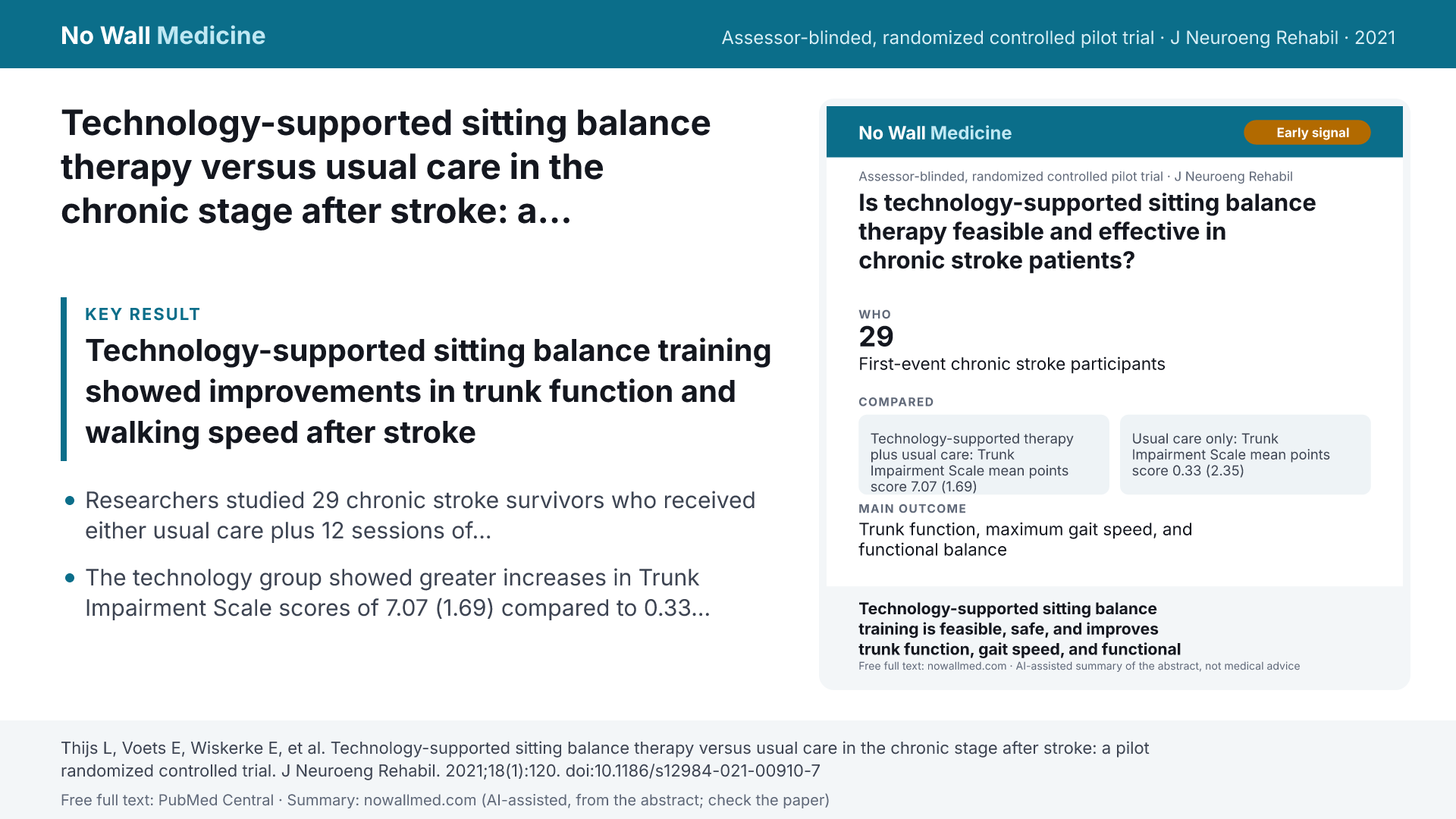
Technology-supported sitting balance training showed improvements in trunk function and walking speed after stroke
Technology-supported sitting balance therapy versus usual care in the chronic stage after stroke: a pilot randomized controlled trial
Assessor-blinded, randomized controlled pilot trialEarly signal
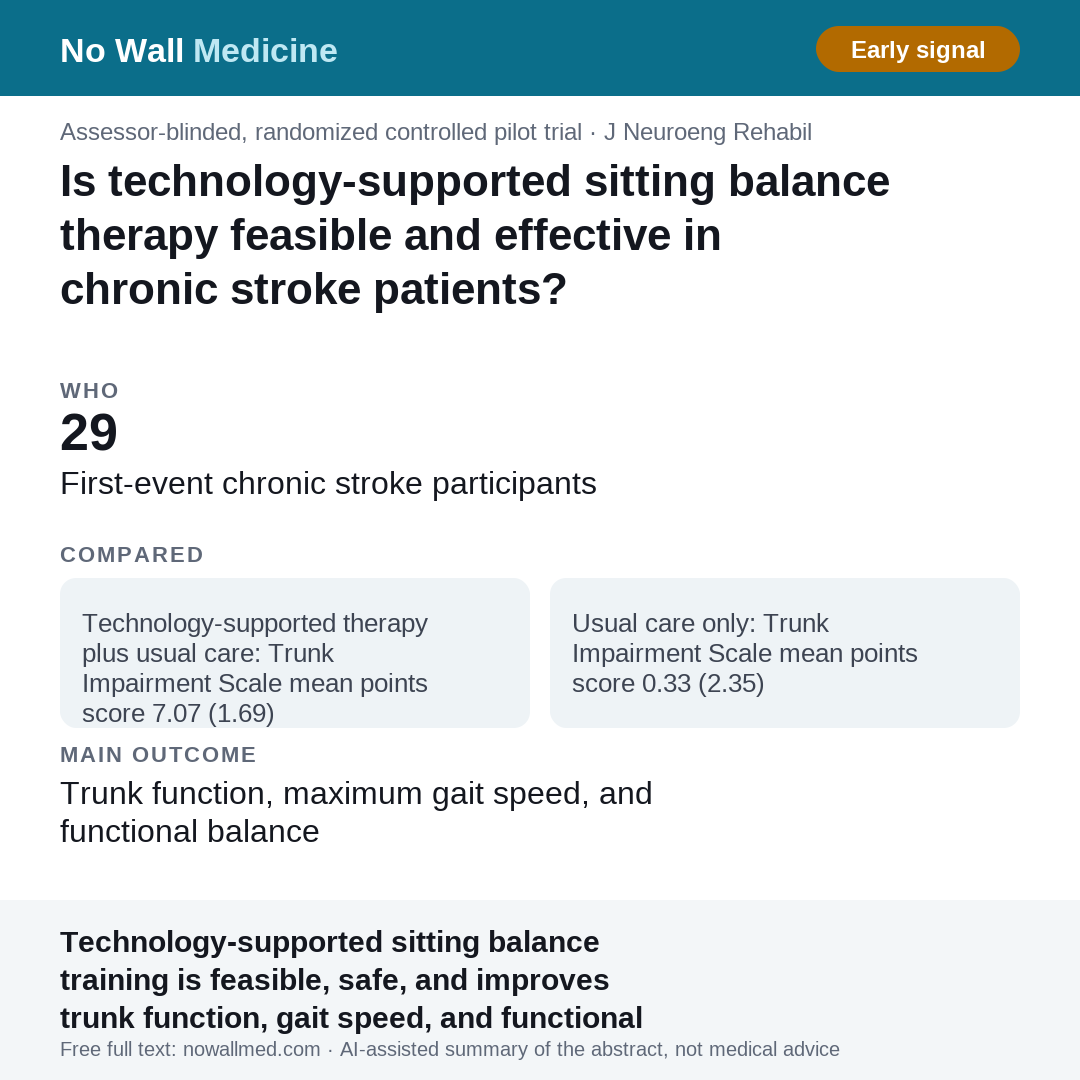
Is technology-supported sitting balance therapy feasible and effective in chronic stroke patients?
Who
29
First-event chronic stroke participants
Compared
Technology-supported therapy plus usual care: Trunk Impairment Scale mean points score 7.07 (1.69)
Usual care only: Trunk Impairment Scale mean points score 0.33 (2.35)
Main outcome
Trunk function, maximum gait speed, and functional balance
Bottom line: Technology-supported sitting balance training is feasible, safe, and improves trunk function, gait speed, and functional balance.
J Neuroeng Rehabil · 2021-07-28Download image
Clinical question: Is technology-supported sitting balance therapy feasible and effective in chronic stroke patients?
Why it matters: Technology for sitting balance therapy and trunk rehabilitation is scarce, currently requiring intensive one-to-one therapist-patient training.
Key points
- Researchers studied 29 chronic stroke survivors who received either usual care plus 12 sessions of technology-supported therapy or usual care alone.
- The technology group showed greater increases in Trunk Impairment Scale scores of 7.07 (1.69) compared to 0.33 (2.35) in the control group.
- Participants using the technology also showed higher maximum gait speed of 0.16 (0.16) m/s versus 0.06 (0.06) m/s and higher Berg balance scale scores.
Headline and key points written with AI from the paper’s abstract, with every number checked against it. Read the paper before relying on them.
Was this summary helpful?
Subject terms
Cite this article
Thijs L, Voets E, Wiskerke E, et al. Technology-supported sitting balance therapy versus usual care in the chronic stage after stroke: a pilot randomized controlled trial. J Neuroeng Rehabil. 2021. doi:10.1186/s12984-021-00910-7
Spotted a mistake? Suggest a correction