Technology-supported sitting balance therapy versus usual care in the chronic stage after stroke: a pilot randomized controlled trial
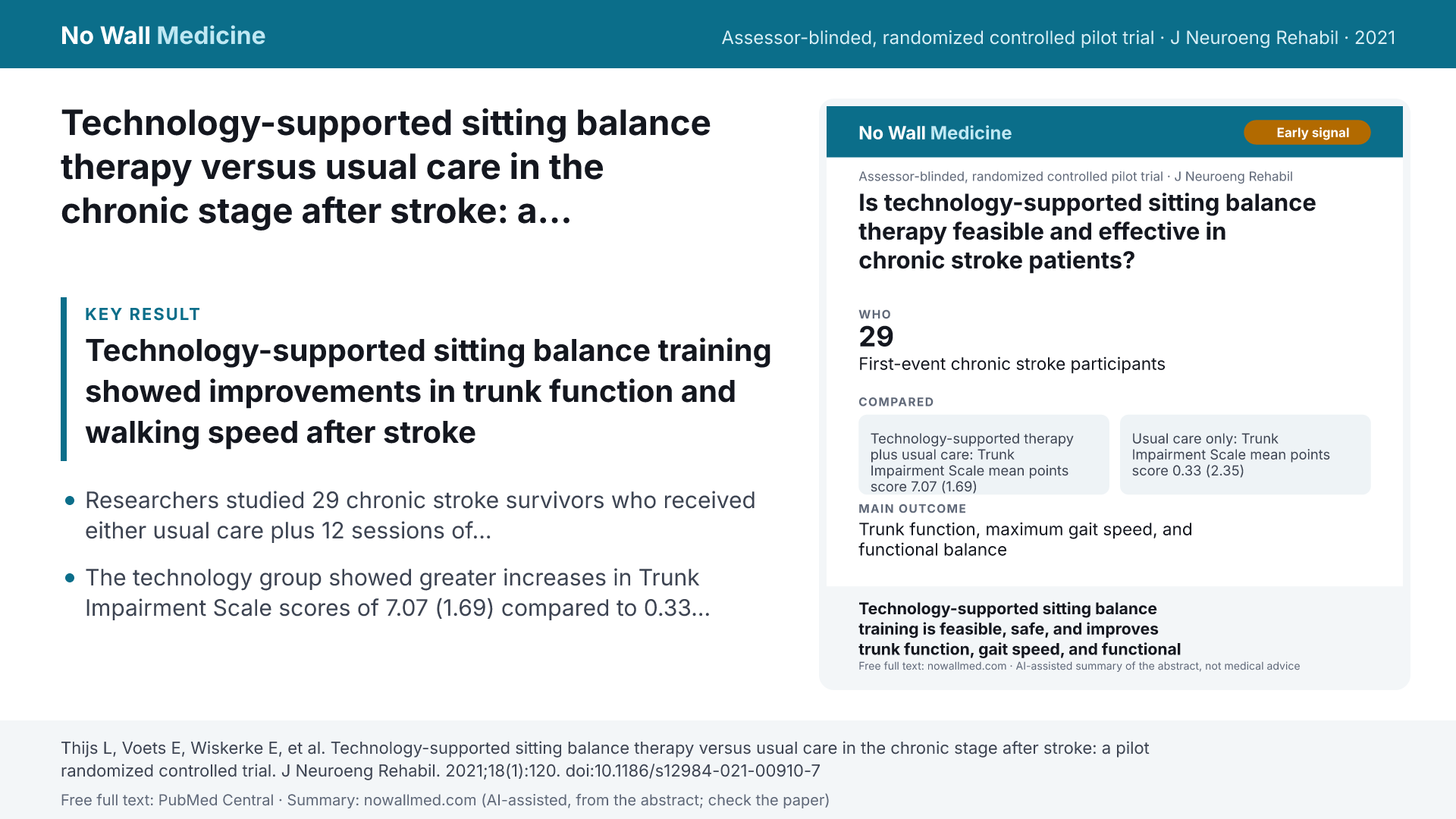
Key result: Technology-supported sitting balance training showed improvements in trunk function and walking speed after stroke
Key points
- Researchers studied 29 chronic stroke survivors who received either usual care plus 12 sessions of technology-supported therapy or usual care alone.
- The technology group showed greater increases in Trunk Impairment Scale scores of 7.07 (1.69) compared to 0.33 (2.35) in the control group.
- Participants using the technology also showed higher maximum gait speed of 0.16 (0.16) m/s versus 0.06 (0.06) m/s and higher Berg balance scale scores.
Why it matters: Technology for sitting balance therapy and trunk rehabilitation is scarce, currently requiring intensive one-to-one therapist-patient training.
Discussion prompts
- Would these patients look like yours? Who was left out?
- Is the main outcome one that matters to patients?
- Is the difference large enough to change what you do?
Cite: Thijs L, Voets E, Wiskerke E, et al. Technology-supported sitting balance therapy versus usual care in the chronic stage after stroke: a pilot randomized controlled trial. J Neuroeng Rehabil. 2021;18(1):120. doi:10.1186/s12984-021-00910-7
Free full text: PubMed Central · Summary and visual abstract: nowallmed.com/a/technology-supported-sitting-balance-therapy-versus-usual-care-in-the-gf3gz9/ (AI-assisted from the abstract; check the paper before relying on it).