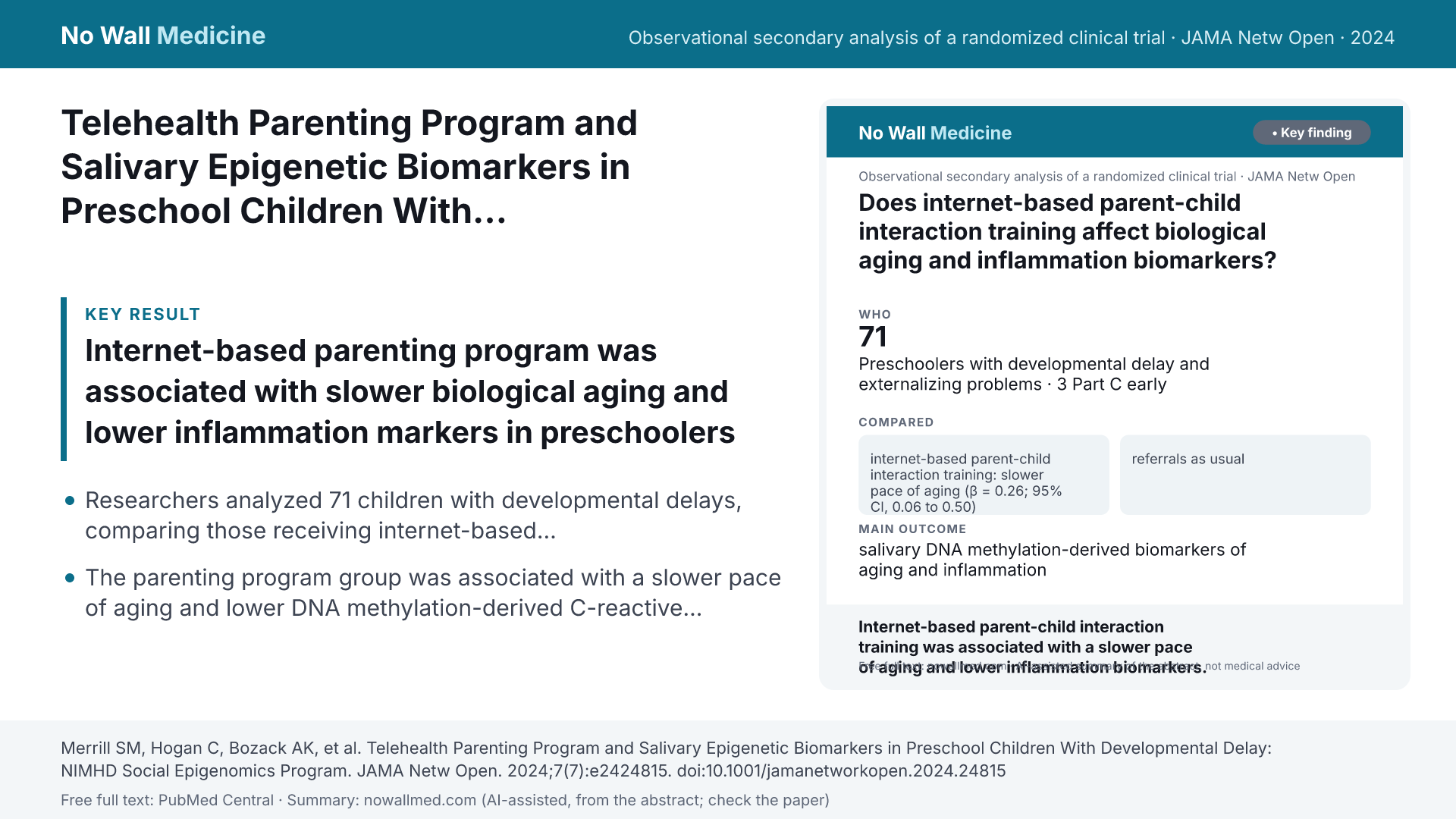
Internet-based parenting program was associated with slower biological aging and lower inflammation markers in preschoolers
Telehealth Parenting Program and Salivary Epigenetic Biomarkers in Preschool Children With Developmental Delay: NIMHD Social Epigenomics Program
Observational secondary analysis of a randomized clinical trialKey finding
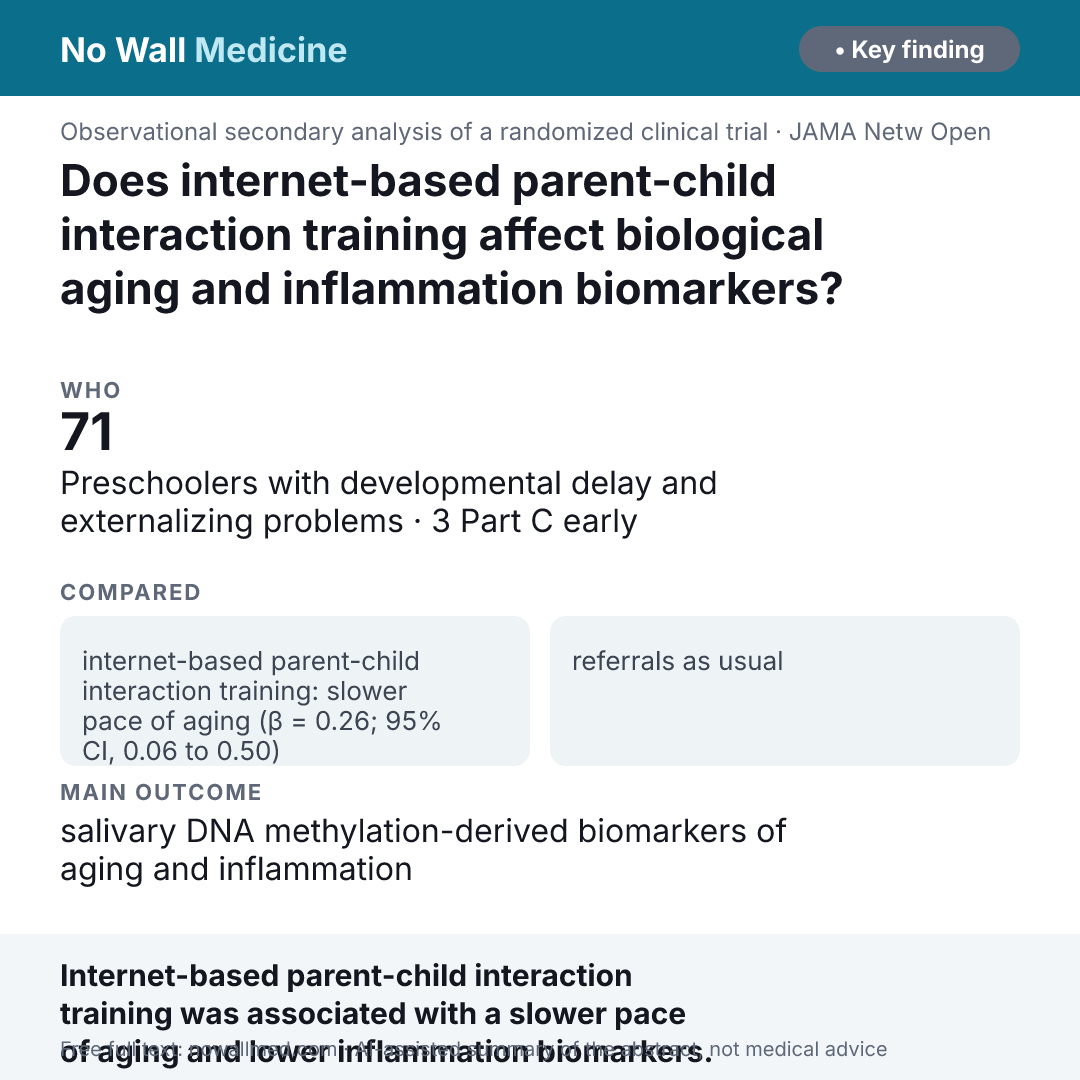
Does internet-based parent-child interaction training affect biological aging and inflammation biomarkers?
Who
71
Preschoolers with developmental delay and externalizing problems · 3 Part C early intervention sites, southeastern US city
Compared
internet-based parent-child interaction training: slower pace of aging (β = 0.26; 95% CI, 0.06 to 0.50)
referrals as usual
Main outcome
salivary DNA methylation-derived biomarkers of aging and inflammation
Result: DunedinPACE β = 0.26 (95% CI 0.06 to 0.50); CRP β = 0.27 (95% CI 0.05 to 0.49)
Bottom line: Internet-based parent-child interaction training was associated with a slower pace of aging and lower inflammation biomarkers.
JAMA Netw Open · 2024-07-01 · Save PNG
Same trial (NCT03260816)
Papers we list that report this registered trial, oldest first. Read a secondary analysis alongside the main results.
- Main results Benefit found
Telehealth parenting intervention improved behavior problems in young children with developmental delay JAMA Pediatr 2023-01 - Secondary analysis Key finding
This paper JAMA Netw Open 2024-07
Clinical question: Does internet-based parent-child interaction training affect biological aging and inflammation biomarkers?
Key points
- Researchers analyzed 71 children with developmental delays, comparing those receiving internet-based parent-child interaction training to those receiving usual referrals.
- The parenting program group was associated with a slower pace of aging and lower DNA methylation-derived C-reactive protein at 12-month follow-up.
- The intervention was not associated with changes in DNA methylation-derived interleukin-6, a marker of inflammation.
Limitation the authors note: This study was an observational secondary analysis of data from a randomized clinical trial.
Headline and key points written with AI from the paper’s abstract, with every number checked against it. Read the paper before relying on them.
Was this summary helpful?
Subject terms
Headline, design, result, key points, caveat and citation as plain text.
Cite this article
Merrill SM, Hogan C, Bozack AK, et al. Telehealth Parenting Program and Salivary Epigenetic Biomarkers in Preschool Children With Developmental Delay: NIMHD Social Epigenomics Program. JAMA Netw Open. 2024;7(7):e2424815. doi:10.1001/jamanetworkopen.2024.24815
Spotted a mistake? Suggest a correction