Tenecteplase improved functional outcomes but increased brain bleeding risk in delayed ischemic stroke treatment
Tenecteplase for Acute Non-Large Vessel Occlusion 4.5 to 24 Hours After Ischemic Stroke: The OPTION Randomized Clinical Trial
Randomized, open-label, blinded end-point clinical trialMixed results
Is tenecteplase effective and safe for non-large vessel occlusion stroke 4.5 to 24 hours after onset?
Who
566
Patients with non-large vessel occlusion stroke and salvageable brain tissue · 48 centers in China
Compared
43.6%Intravenous tenecteplase
34.2%Standard medical treatment
Main outcome
Excellent functional outcome at 90 days
Result: risk ratio 1.28 (95% CI 1.04-1.57)
Bottom line: Tenecteplase increased excellent functional outcomes but also increased the risk of symptomatic intracranial hemorrhage.
JAMA · 2026-02-05 · Save PNG
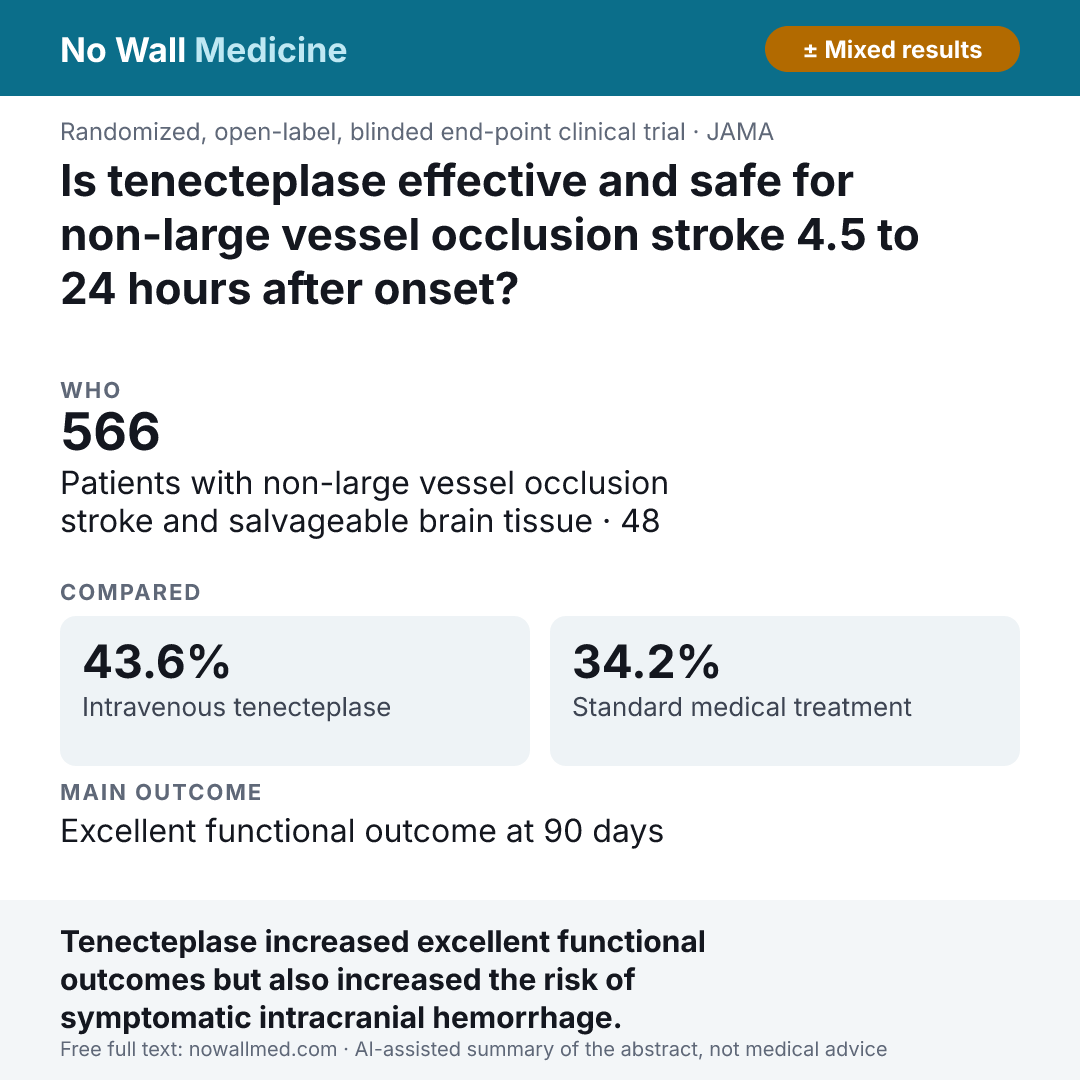
Clinical question: Is tenecteplase effective and safe for non-large vessel occlusion stroke 4.5 to 24 hours after onset?
Key points
- Researchers studied 566 patients with non-large vessel occlusion stroke and salvageable brain tissue to compare tenecteplase, a clot-dissolving drug, against standard medical treatment.
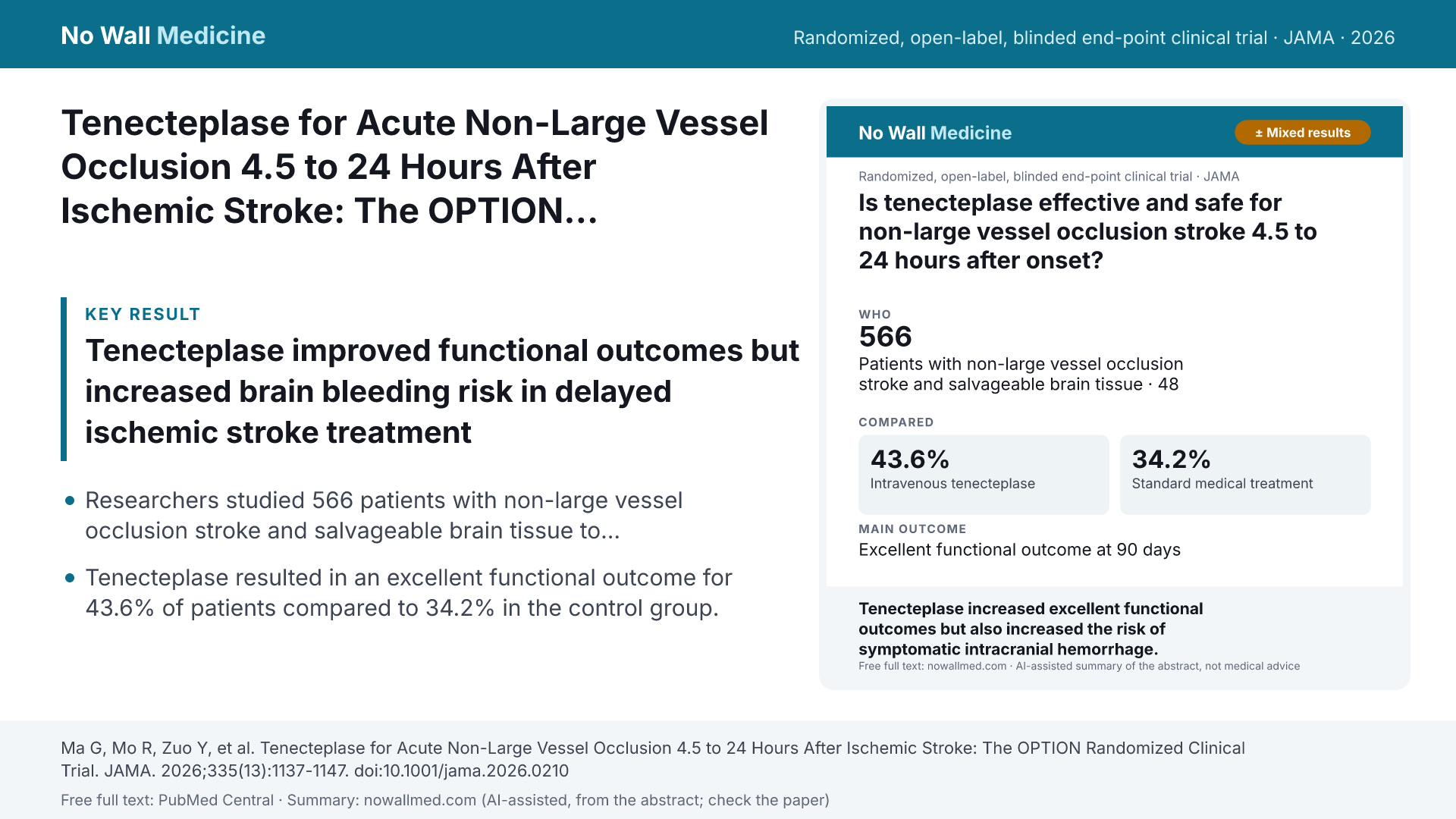
- Tenecteplase resulted in an excellent functional outcome for 43.6% of patients compared to 34.2% in the control group.
- The tenecteplase group had a higher rate of symptomatic intracranial hemorrhage at 2.8% compared to 0% in the standard treatment group.
Headline and key points written with AI from the paper’s abstract, with every number checked against it. Read the paper before relying on them.
Was this summary helpful?
Subject terms
Headline, design, result, key points, caveat and citation as plain text.
Cite this article
Ma G, Mo R, Zuo Y, et al. Tenecteplase for Acute Non-Large Vessel Occlusion 4.5 to 24 Hours After Ischemic Stroke: The OPTION Randomized Clinical Trial. JAMA. 2026;335(13):1137-1147. doi:10.1001/jama.2026.0210
Spotted a mistake? Suggest a correction