Brain bleeding was associated with higher mortality but not worse functional recovery in minor stroke
Intracranial Hemorrhage Patterns and Outcomes in Minor Stroke: Analysis of the TEMPO-2 Trial
Secondary analysis of a randomized controlled trialHarm found
Does intracranial hemorrhage affect outcomes in patients with minor ischemic stroke?
Who
884
Patients with minor ischemic stroke and visible vessel occlusion · Multicenter
Compared
Any intracranial hemorrhage: 9.8% mortality
No intracranial hemorrhage: 1.8% mortality
Main outcome
Return to premorbid functional status and 90-day mortality
Result: adjusted hazard ratio 3.71 (95% CI 1.54-8.95)
Bottom line: Any intracranial hemorrhage was associated with higher 90-day mortality in patients with minor ischemic stroke.
Stroke · 2026-04-10Download image
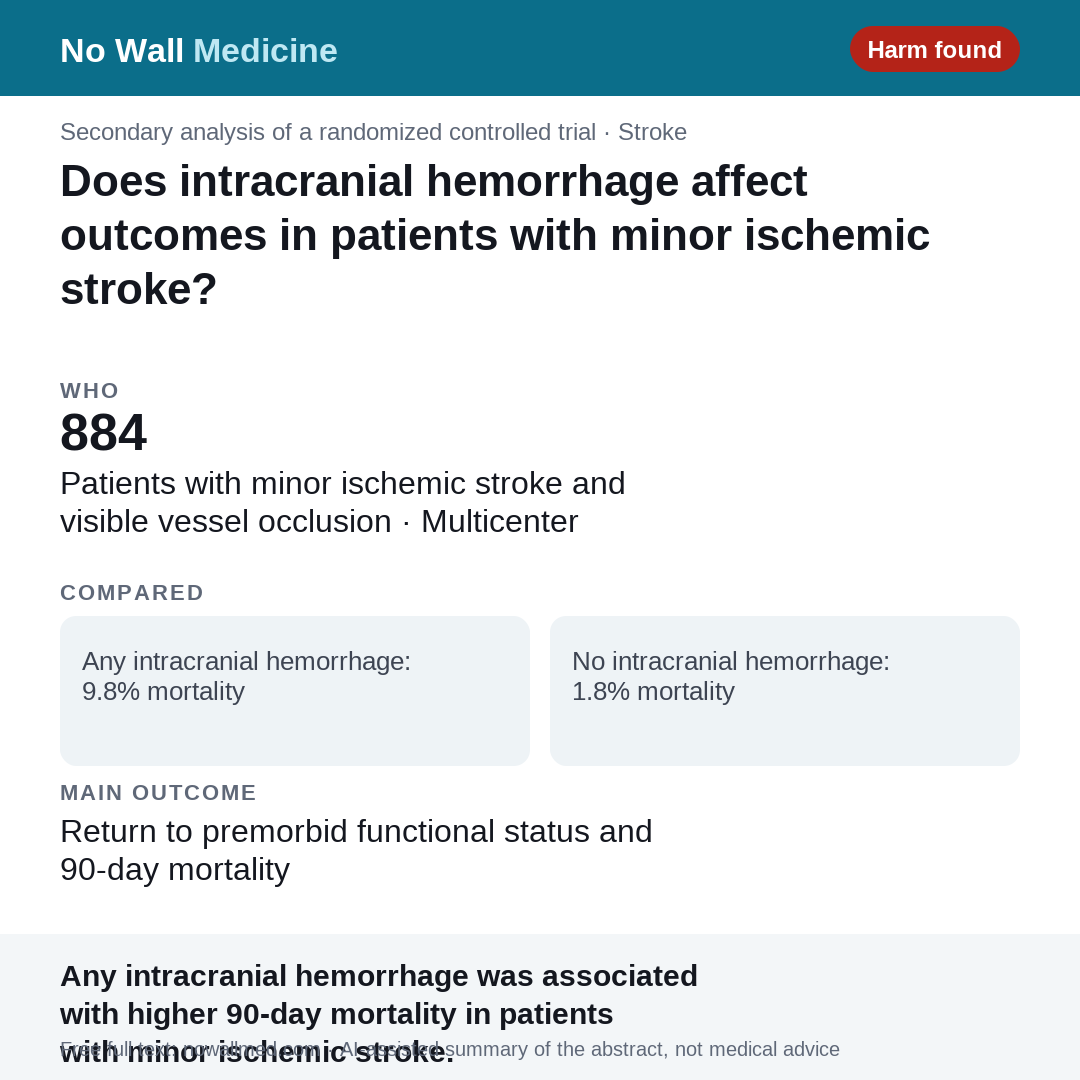
Clinical question: Does intracranial hemorrhage affect outcomes in patients with minor ischemic stroke?
Why it matters: The impact of intracranial hemorrhage on functional outcomes and its predictors in patients with minor ischemic stroke were not fully understood.
Key points
- Researchers analyzed 865 participants from the TEMPO-2 trial who experienced a minor ischemic stroke with visible vessel blockage.
- Any intracranial hemorrhage, or bleeding inside the skull, was associated with higher 90-day mortality at 9.8% compared to 1.8%.
- Bleeding was not associated with reduced odds of returning to baseline neurological function, and tenecteplase had higher rates of any hemorrhage than standard care.
Headline and key points written with AI from the paper’s abstract, with every number checked against it. Read the paper before relying on them.
Topics
Cite this article
Massicotte S, Vatanpour S, Doolan C, Zhang J, Ganesh A, Choi PMC. Intracranial Hemorrhage Patterns and Outcomes in Minor Stroke: Analysis of the TEMPO-2 Trial. Stroke. 2026. doi:10.1161/STROKEAHA.125.054491
Spotted a mistake? Suggest a correction