Social norm messages in workplace cafeterias did not increase meat-free meal sales
Testing the effect of a dynamic descriptive social norm message on meat-free food selection in worksite cafeterias: a randomized controlled trial
Randomized controlled trialNo clear difference
Does a dynamic descriptive social norm message increase meat-free food selection in worksite cafeterias?
Who
25
Worksite cafeterias · Worksite cafeterias
Compared
Intervention
Control
Main outcome
Change in weekly percentage of meat-free meal sales
Result: -2.22 percentage point change, 95% CIs [-7.33, 2.90]
Bottom line: Dynamic descriptive social norm messages did not increase meat-free meal sales in worksite cafeterias.
BMC Med · 2025-08-12Download image
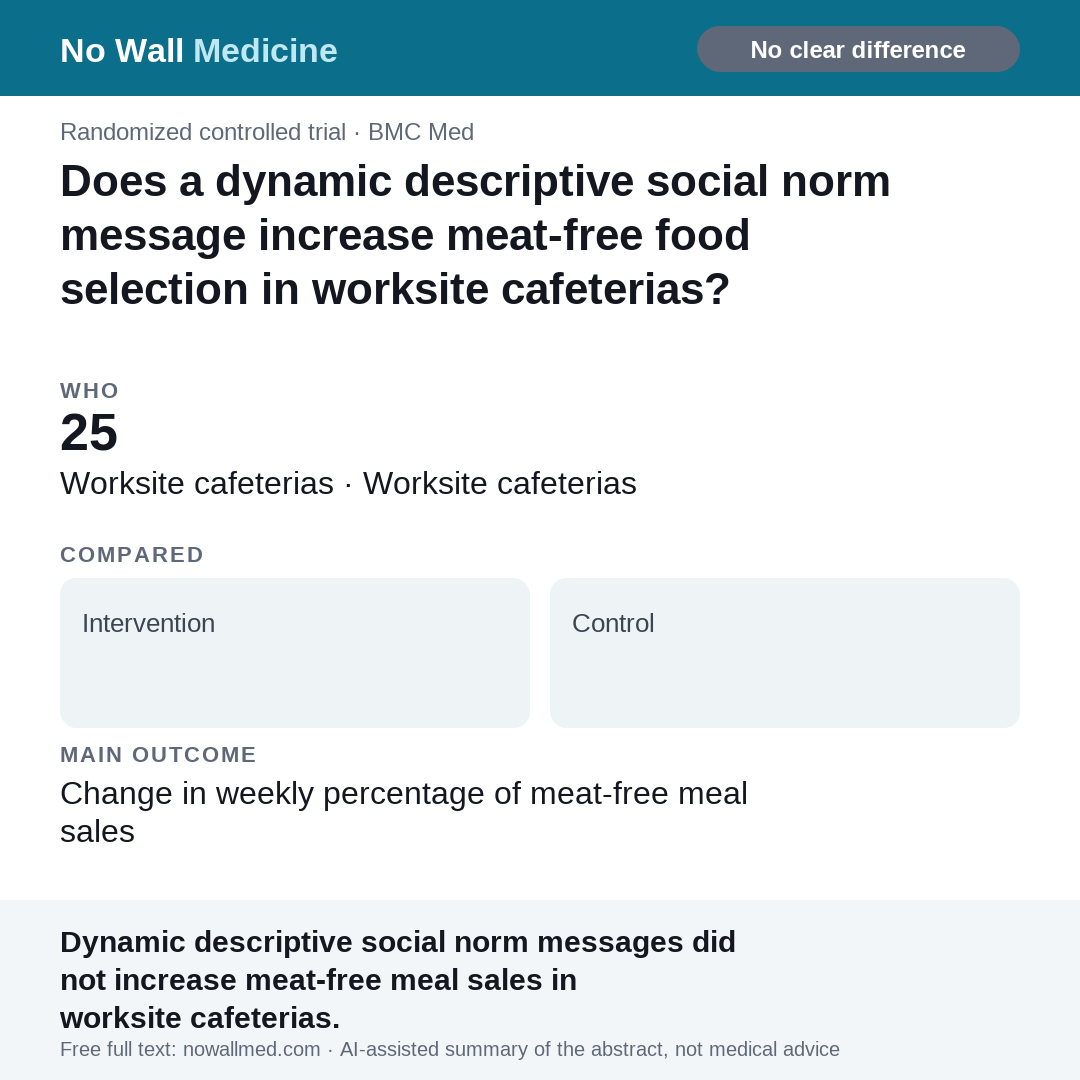
Clinical question: Does a dynamic descriptive social norm message increase meat-free food selection in worksite cafeterias?
Why it matters: It is unclear if using social norm messages, which describe common behaviors in a group, can effectively encourage meat reduction in workplace settings.
Key points
- Researchers conducted a randomized controlled trial in 25 worksite cafeterias to test if dynamic descriptive social norm messages increased meat-free meal selection.
- The intervention resulted in a -2.22 percentage point change in meat-free meal sales, which was not statistically significant (95% CIs [-7.33, 2.90], p=0.378).
- Among 155 interviewed customers, 57% reported they did not notice the messages and only 2% correctly recalled the message content.
Headline and key points written with AI from the paper’s abstract, with every number checked against it. Read the paper before relying on them.
Topics
Cite this article
Çoker EN, Pechey R, Jebb SA. Testing the effect of a dynamic descriptive social norm message on meat-free food selection in worksite cafeterias: a randomized controlled trial. BMC Med. 2025. doi:10.1186/s12916-025-04302-9
Spotted a mistake? Suggest a correction
Top studies every Monday
The week’s key trials and guidelines in your specialties, by email. Free.
Get the weekly digest