Text messaging interventions were associated with lower hemoglobin A1c levels in adults with diabetes
Text messaging interventions are associated with reductions in HbA1c among patients with diabetes: a systematic review and meta-analysis
Systematic review and meta-analysis of randomized controlled trialsBenefit found
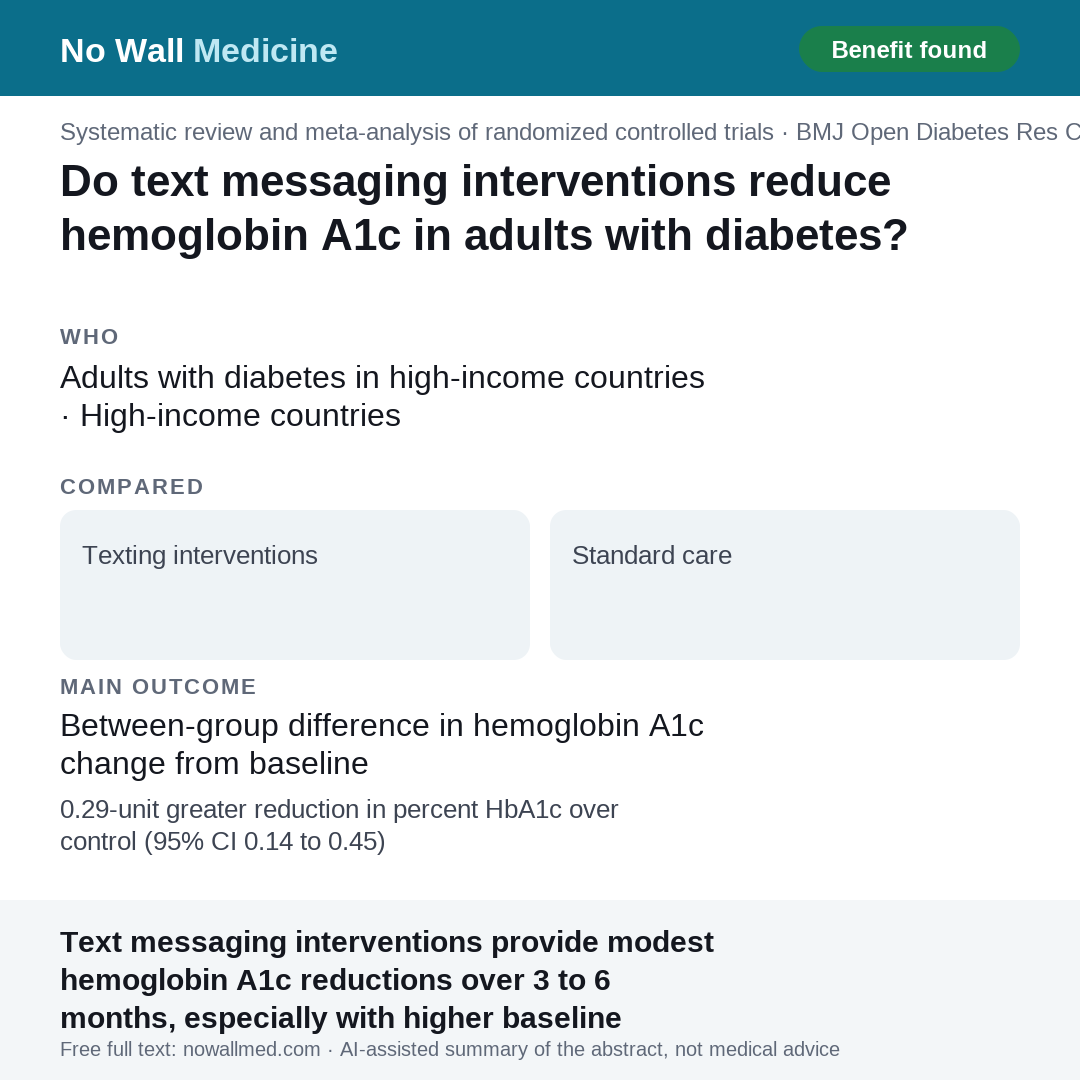
Do text messaging interventions reduce hemoglobin A1c in adults with diabetes?
Who
Adults with diabetes in high-income countries · High-income countries
Compared
Texting interventions
Standard care
Main outcome
Between-group difference in hemoglobin A1c change from baseline
Result: 0.29-unit greater reduction in percent HbA1c over control (95% CI 0.14 to 0.45)
Bottom line: Text messaging interventions provide modest hemoglobin A1c reductions over 3 to 6 months, especially with higher baseline levels.
Limitation: Benefits appear to diminish by 12 months, requiring more long-term impact trials.
BMJ Open Diabetes Res Care · 2025-11-16Download image
Clinical question: Do text messaging interventions reduce hemoglobin A1c in adults with diabetes?
Why it matters: Achieving optimal glycemic control is challenging for many patients with diabetes, and text messaging is being explored as a scalable way to enhance management.
Key points
- Researchers analyzed 14 randomized controlled trials involving 1,460 intervention and 1,487 control participants to measure changes in hemoglobin A1c, a marker of long-term blood sugar levels.
- At 3 months, texting was associated with a 0.29-unit greater reduction in hemoglobin A1c compared to standard care, and at 6 months, the reduction was 0.19-unit greater.
- In patients with a baseline hemoglobin A1c of 8.6% or higher, texting was associated with 0.48-unit and 0.36-unit greater reductions at 3 and 6 months, respectively.
Limitation the authors note: The benefits of texting interventions appeared to diminish by 12 months.
Headline and key points written with AI from the paper’s abstract, with every number checked against it. Read the paper before relying on them.
Abstract
Introduction
Achieving optimal glycemic control remains challenging for many patients with diabetes. Text message-based interventions offer a scalable approach to enhance management. This systematic review and meta-analysis evaluated the impact of texting interventions on glycemic control in adults with diabetes. Research design and methods
We searched EMBASE, PubMed, and Cochrane CENTRAL for randomized controlled trials comparing texting interventions to standard care in high-income countries. The primary outcome was the between-group difference in hemoglobin A1c (HbA1c) change from baseline. Risk of bias and overall quality of evidence were assessed using the Cochrane and Grading of Recommendations Assessment, Development, and Evaluation tools respectively. Results were pooled using an inverse variance random-effects model. Heterogeneity was evaluated using the I2 statistic. Results
Over 3 months of follow-up (14 trials, n=1,460 intervention, n=1,487 control), texting interventions were associated with a 0.29-unit greater reduction in percent HbA1c over control (95% CI 0.14 to 0.45, p=0.0001, I2=57%). At 6 months (20 trials, n=2,332 intervention, n=2,371 control), texting was associated with 0.19-unit greater HbA1c reduction (95% CI 0.07 to 0.30, p=0.001 I2=45%). At 12 months (seven trials, n=2,038), there was a non-significant benefit associated with texting. Among studies with a mean baseline HbA1c ≥8.6%, texting was associated with 0.48- and 0.36-unit greater HbA1c reductions at 3 (p=0.004) and 6 (p=0.004) months, respectively. Subgroups were not significantly different. Conclusion
Text messaging interventions are associated with modest improvements in glycemic control over 3-6 months, particularly in patients with poorer baseline HbA1c. These effects may be meaningful at scale and support texting as a potential adjunct to routine diabetes care. Benefits appear to diminish by 12 months, underscoring the need for high-quality trials focused on long-term impact and intervention optimization. Prospero registration number
CRD42023416462.
Abstract reproduced under the article’s CC BY NC licence.
Topics
Cite this article
Pirouzmand N, Ko GS, Godoy LC, Haldenby O, Jackevicius CA, Jubran A. Text messaging interventions are associated with reductions in HbA1c among patients with diabetes: a systematic review and meta-analysis. BMJ Open Diabetes Res Care. 2025. doi:10.1136/bmjdrc-2025-005218
Spotted a mistake? Suggest a correction