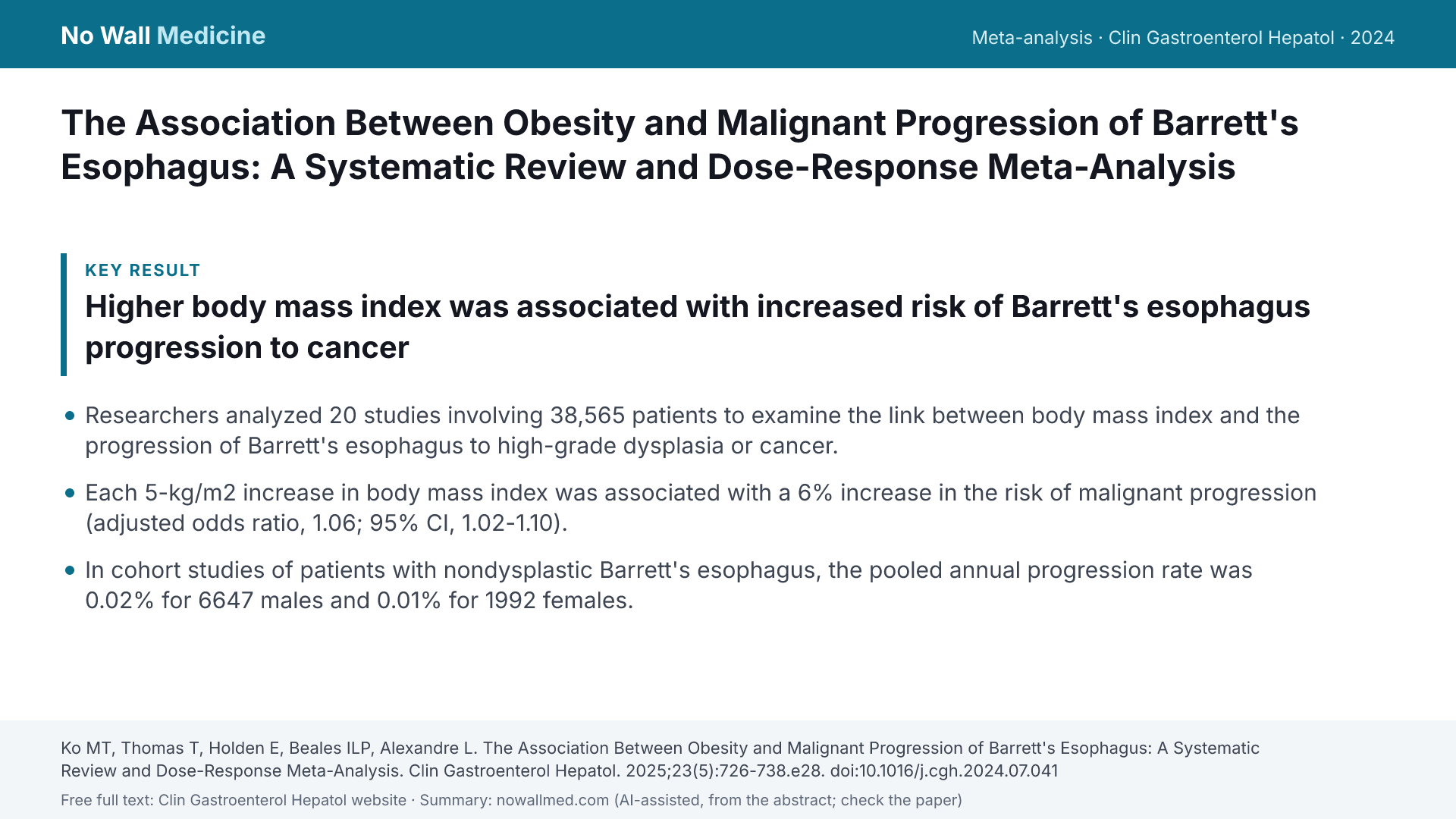
Higher body mass index was associated with increased risk of Barrett's esophagus progression to cancer
The Association Between Obesity and Malignant Progression of Barrett's Esophagus: A Systematic Review and Dose-Response Meta-Analysis
Why it matters: It was unclear whether obesity drives the progression of Barrett's esophagus to high-grade dysplasia or esophageal cancer.
Key points
- Researchers analyzed 20 studies involving 38,565 patients to examine the link between body mass index and the progression of Barrett's esophagus to high-grade dysplasia or cancer.
- Each 5-kg/m2 increase in body mass index was associated with a 6% increase in the risk of malignant progression (adjusted odds ratio, 1.06; 95% CI, 1.02-1.10).
- In cohort studies of patients with nondysplastic Barrett's esophagus, the pooled annual progression rate was 0.02% for 6647 males and 0.01% for 1992 females.
Headline and key points written with AI from the paper’s abstract, with every number checked against it. Read the paper before relying on them.
Was this summary helpful?
Subject terms
Cite this article
Ko MT, Thomas T, Holden E, Beales ILP, Alexandre L. The Association Between Obesity and Malignant Progression of Barrett's Esophagus: A Systematic Review and Dose-Response Meta-Analysis. Clin Gastroenterol Hepatol. 2024. doi:10.1016/j.cgh.2024.07.041
Spotted a mistake? Suggest a correction