Patient-ventilator asynchrony was associated with longer mechanical ventilation and longer intensive care stays
The Association Between Patient-Ventilator Asynchrony and Clinical Outcomes in Mechanically Ventilated Patients: A Systematic Review
Systematic review and meta-analysisHarm found
Is patient-ventilator asynchrony associated with clinical outcomes in mechanically ventilated patients?
Who
2672
Mechanically ventilated patients
Compared
Patient-ventilator asynchrony
No asynchrony
Main outcome
mechanical ventilation duration, ICU length of stay, and mortality
Result: mean difference 3.29 d (95% CI 0.13-6.44 d) for ventilation duration
Bottom line: Patient-ventilator asynchrony is associated with longer mechanical ventilation and longer intensive care unit stay.
Crit Care Med · 2025-08-12Download image
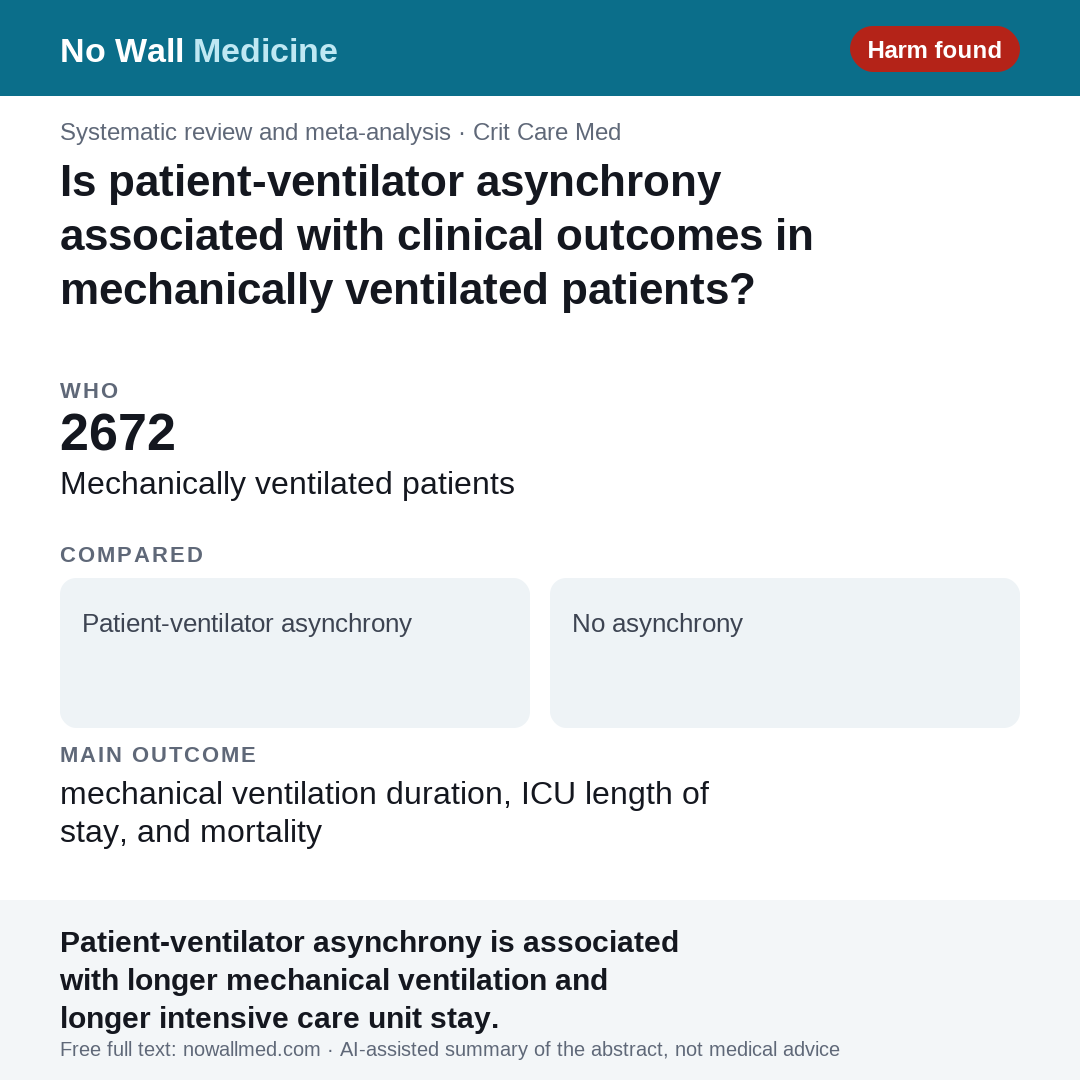
Clinical question: Is patient-ventilator asynchrony associated with clinical outcomes in mechanically ventilated patients?
Why it matters: Clinicians need to understand how different types of coordination issues between patients and breathing machines affect recovery times and survival.
Key points
- Researchers conducted a systematic review and meta-analysis of 19 studies involving 2672 patients to evaluate how patient-ventilator asynchrony, or lack of coordination between a patient and a breathing machine, affects outcomes.
- Ineffective triggering and double triggering were associated with a mean difference of 3.29 d for mechanical ventilation duration and 3.65 d for intensive care unit length of stay.
- The analysis found no association between patient-ventilator asynchrony and mortality.
Headline and key points written with AI from the paper’s abstract, with every number checked against it. Read the paper before relying on them.
Was this summary helpful?
Subject terms
Cite this article
de Bie MJ, Rietveld PJ, van der Velde-Quist F, van Geloven N, Snoep JWM, de Jonge E. The Association Between Patient-Ventilator Asynchrony and Clinical Outcomes in Mechanically Ventilated Patients: A Systematic Review. Crit Care Med. 2025. doi:10.1097/CCM.0000000000006816
Spotted a mistake? Suggest a correction
Top studies every Monday
The week’s key trials and guidelines in your specialties, plus any topics you follow. By email, free.
Get the weekly digest