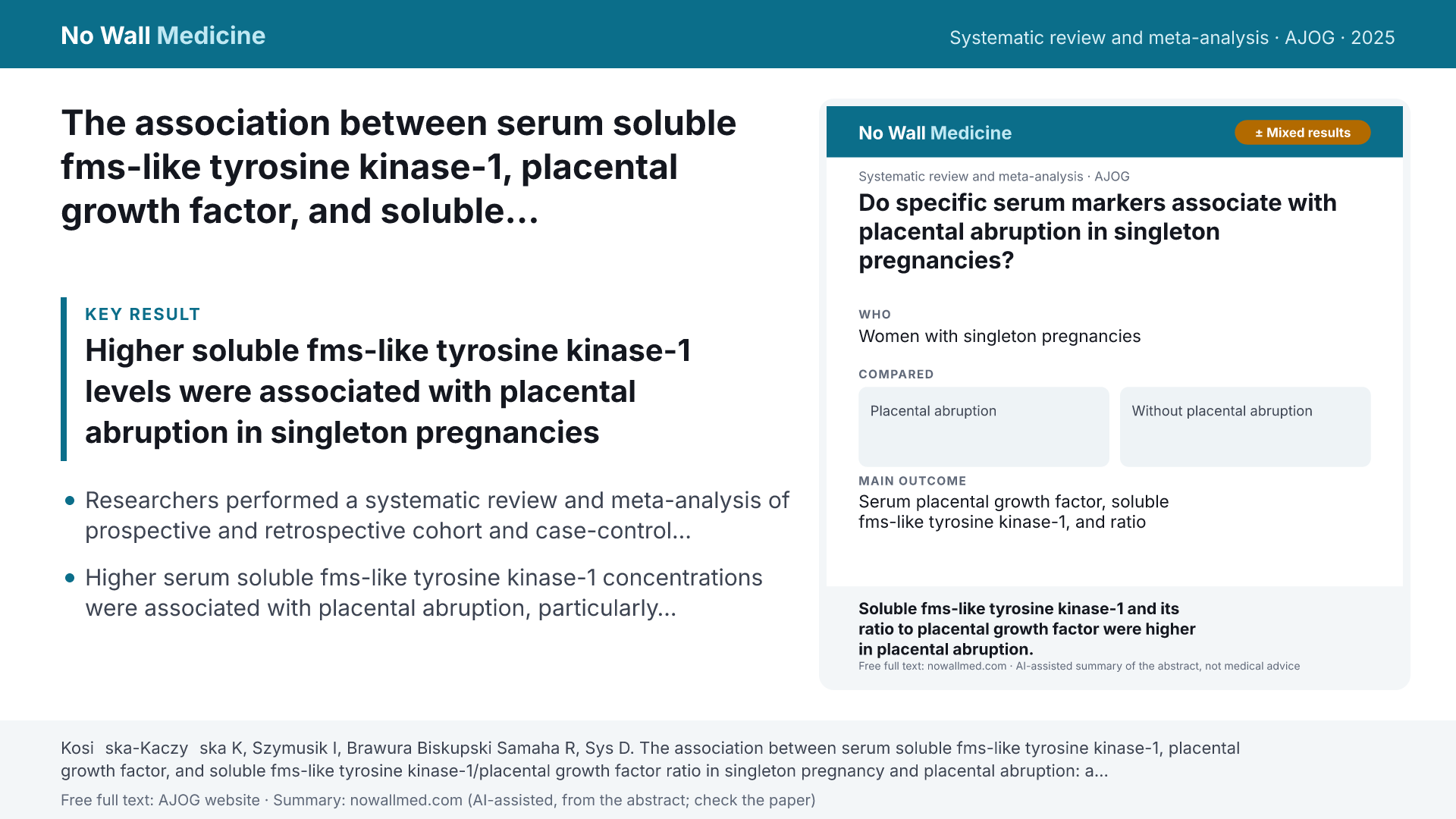
Higher soluble fms-like tyrosine kinase-1 levels were associated with placental abruption in singleton pregnancies
The association between serum soluble fms-like tyrosine kinase-1, placental growth factor, and soluble fms-like tyrosine kinase-1/placental growth factor ratio in singleton pregnancy and placental abruption: a systematic review and meta-analysis
Systematic review and meta-analysisMixed results
Do specific serum markers associate with placental abruption in singleton pregnancies?
Who
Women with singleton pregnancies
Compared
Placental abruption
Without placental abruption
Main outcome
Serum placental growth factor, soluble fms-like tyrosine kinase-1, and ratio
Bottom line: Soluble fms-like tyrosine kinase-1 and its ratio to placental growth factor were higher in placental abruption.
AJOG · 2025-04-15 · Save PNG
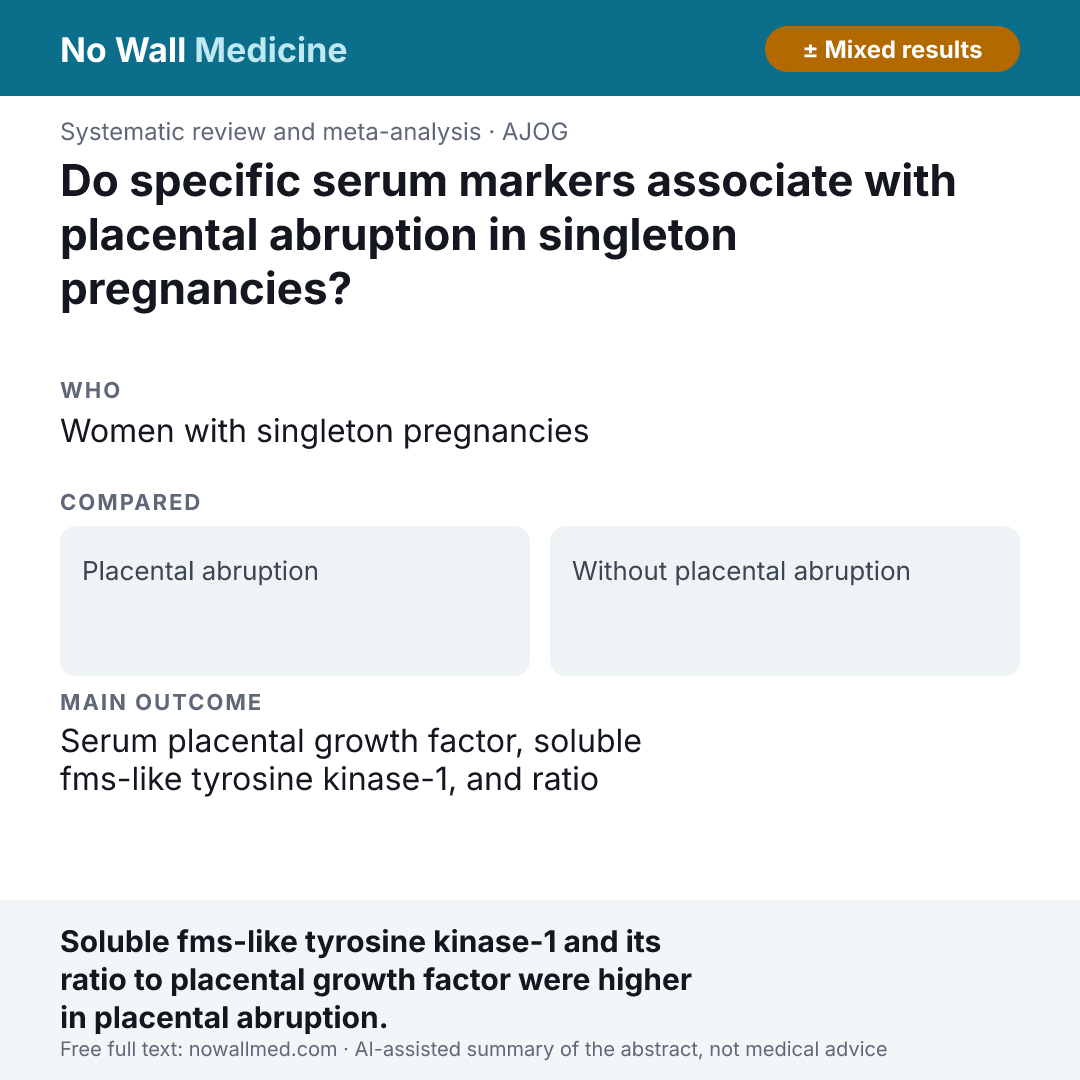
Clinical question: Do specific serum markers associate with placental abruption in singleton pregnancies?
Key points
- Researchers performed a systematic review and meta-analysis of prospective and retrospective cohort and case-control studies to examine blood markers in singleton pregnancies.
- Higher serum soluble fms-like tyrosine kinase-1 concentrations were associated with placental abruption, particularly during the second half of pregnancy.
- A higher ratio of soluble fms-like tyrosine kinase-1 to placental growth factor was associated with placental abruption, though this was not significant in women with preeclampsia.
Headline and key points written with AI from the paper’s abstract, with every number checked against it. Read the paper before relying on them.
Was this summary helpful?
Subject terms
Headline, design, result, key points, caveat and citation as plain text.
Cite this article
Kosińska-Kaczyńska K, Szymusik I, Brawura Biskupski Samaha R, Sys D. The association between serum soluble fms-like tyrosine kinase-1, placental growth factor, and soluble fms-like tyrosine kinase-1/placental growth factor ratio in singleton pregnancy and placental abruption: a systematic review and meta-analysis. Am J Obstet Gynecol. 2025;233(4):263.e1-263.e18. doi:10.1016/j.ajog.2025.04.020
Spotted a mistake? Suggest a correction