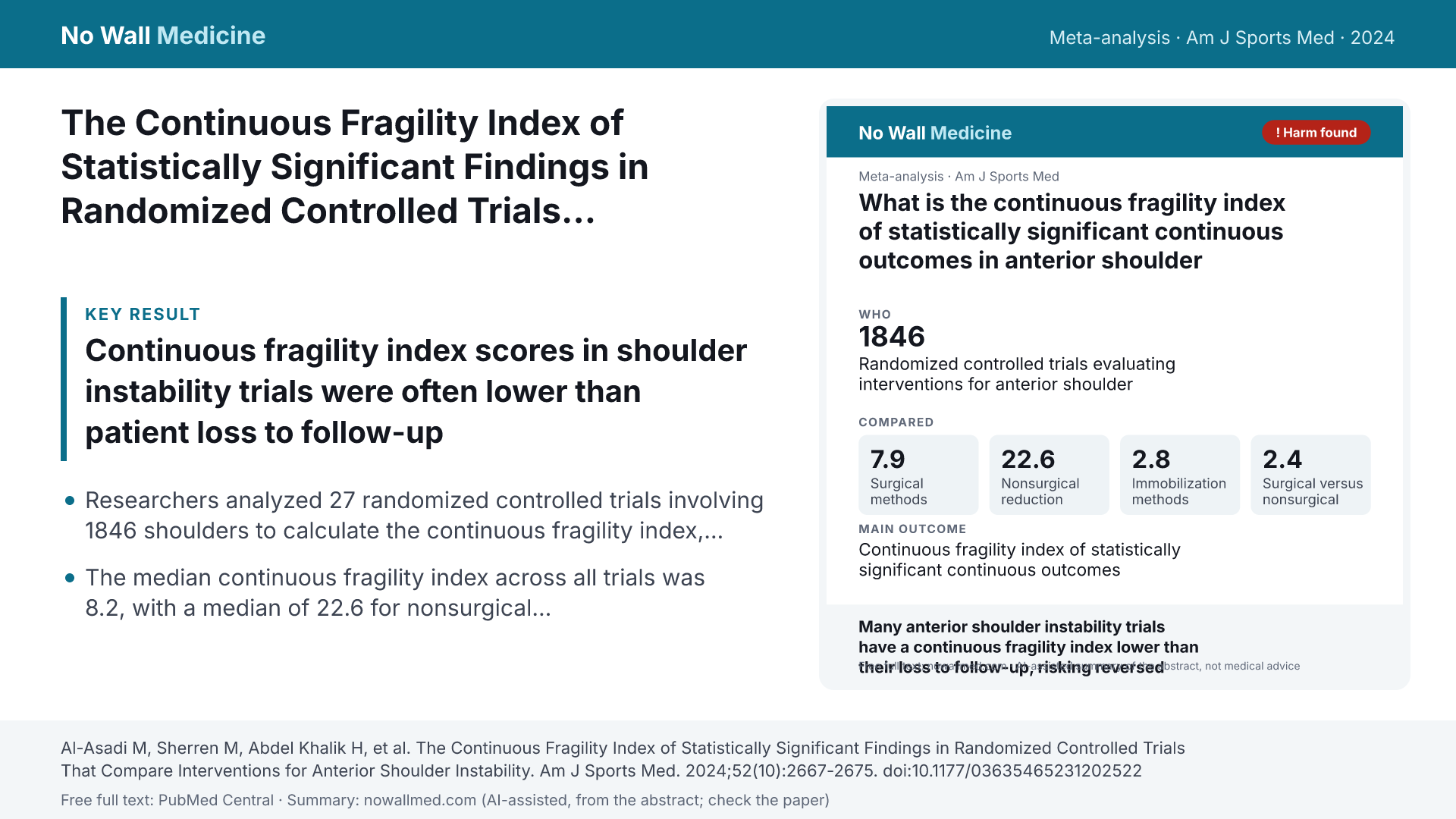
Continuous fragility index scores in shoulder instability trials were often lower than patient loss to follow-up
The Continuous Fragility Index of Statistically Significant Findings in Randomized Controlled Trials That Compare Interventions for Anterior Shoulder Instability
Meta-analysisHarm found
What is the continuous fragility index of statistically significant continuous outcomes in anterior shoulder instability trials?
Who
1846
Randomized controlled trials evaluating interventions for anterior shoulder instability · MEDLINE, Embase, and CENTRAL databases
Compared
7.9Surgical methods (IQR, 21; 95% CI, 1-22)
22.6Nonsurgical reduction interventions (IQR, 16; 95% CI, 8.2-30.4)
2.8Immobilization methods
2.4Surgical versus nonsurgical interventions
Main outcome
Continuous fragility index of statistically significant continuous outcomes
Result: median CFI 8.2 (IQR, 17.2; 95% CI, 3.6-15.4)
Bottom line: Many anterior shoulder instability trials have a continuous fragility index lower than their loss to follow-up, risking reversed findings.
Am J Sports Med · 2024-01-23 · Save PNG
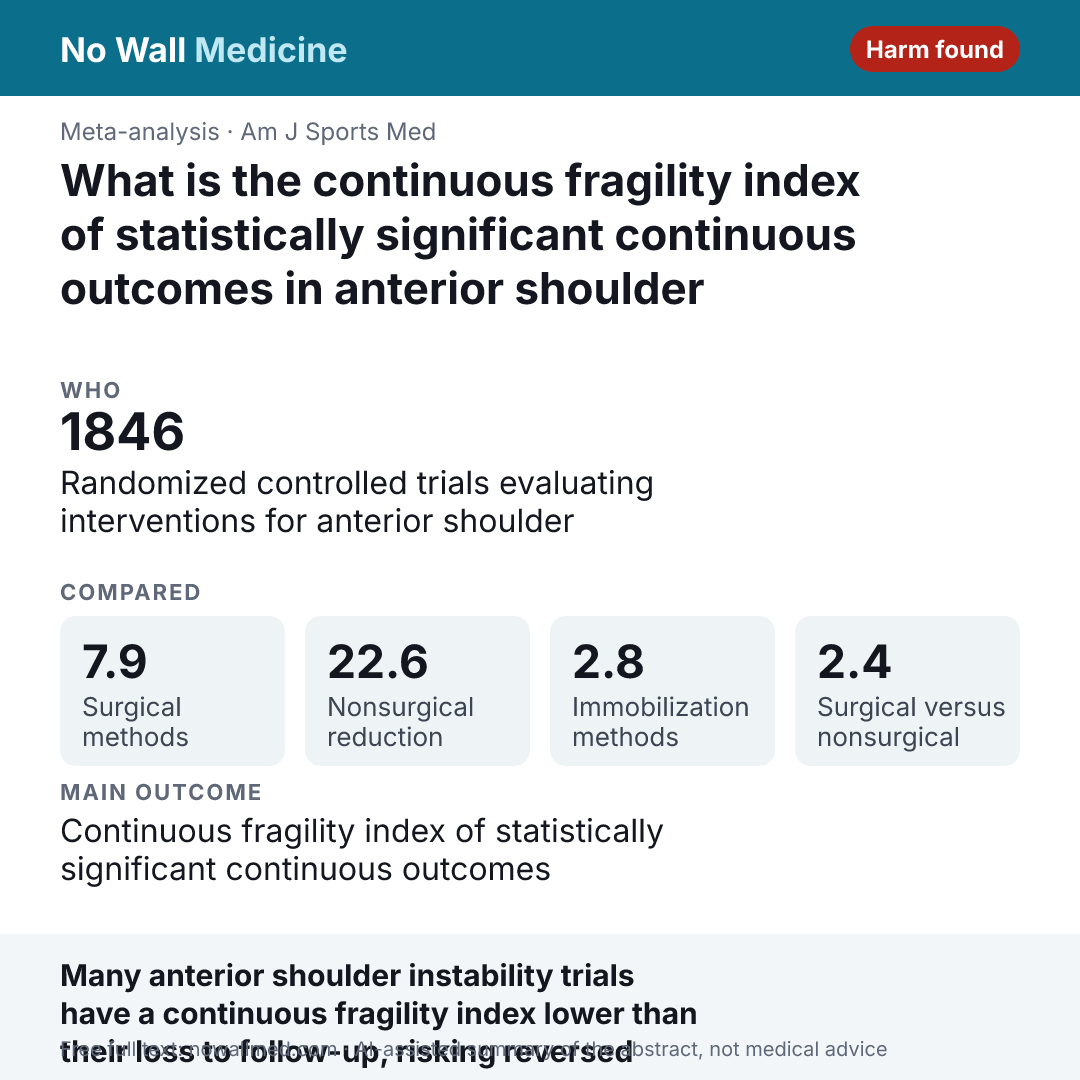
Clinical question: What is the continuous fragility index of statistically significant continuous outcomes in anterior shoulder instability trials?
Key points
- Researchers analyzed 27 randomized controlled trials involving 1846 shoulders to calculate the continuous fragility index, a tool measuring how many patients must change outcomes to reverse a result.
- The median continuous fragility index across all trials was 8.2, with a median of 22.6 for nonsurgical reduction interventions and 2.4 for surgical versus nonsurgical interventions.
- In 38.6% of outcomes with completed follow-up data, the number of patients lost to follow-up exceeded the continuous fragility index.
Headline and key points written with AI from the paper’s abstract, with every number checked against it. Read the paper before relying on them.
Was this summary helpful?
Subject terms
Headline, design, result, key points, caveat and citation as plain text.
Cite this article
Al-Asadi M, Sherren M, Abdel Khalik H, et al. The Continuous Fragility Index of Statistically Significant Findings in Randomized Controlled Trials That Compare Interventions for Anterior Shoulder Instability. Am J Sports Med. 2024;52(10):2667-2675. doi:10.1177/03635465231202522
Spotted a mistake? Suggest a correction