Tranexamic acid and care bundles show supportive cost-effectiveness for managing postpartum haemorrhage
The cost-effectiveness of preventing, diagnosing, and treating postpartum haemorrhage: A systematic review of economic evaluations
Systematic review of economic evaluationsBenefit found
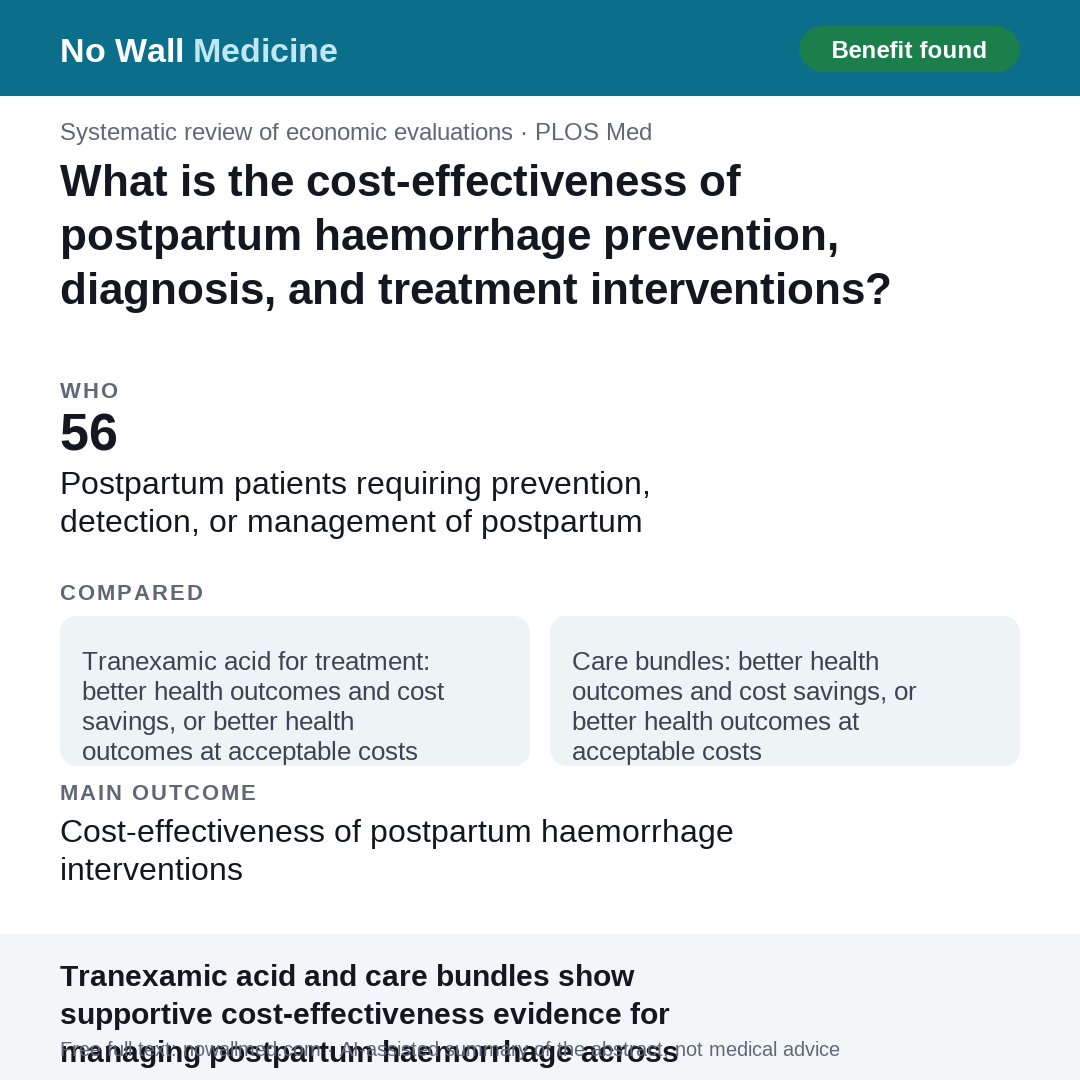
What is the cost-effectiveness of postpartum haemorrhage prevention, diagnosis, and treatment interventions?
Who
56
Postpartum patients requiring prevention, detection, or management of postpartum haemorrhage · High, middle, and low-income countries
Compared
Tranexamic acid for treatment: better health outcomes and cost savings, or better health outcomes at acceptable costs
Care bundles: better health outcomes and cost savings, or better health outcomes at acceptable costs
Main outcome
Cost-effectiveness of postpartum haemorrhage interventions
Bottom line: Tranexamic acid and care bundles show supportive cost-effectiveness evidence for managing postpartum haemorrhage across various settings.
Limitation: No ideal setting was chosen, so a transferability assessment was not undertaken.
PLOS Med · 2024-09-13Download image
Clinical question: What is the cost-effectiveness of postpartum haemorrhage prevention, diagnosis, and treatment interventions?
Why it matters: It is unknown which specific interventions for preventing, diagnosing, or treating postpartum haemorrhage provide the best value across different global resource settings.
Key points
- Researchers reviewed 56 economic studies involving 16 different interventions for preventing, diagnosing, or treating postpartum haemorrhage, which is heavy bleeding after childbirth.
- The use of tranexamic acid for treatment and the use of care bundles were associated with better health outcomes and cost savings or acceptable costs.
- High-priority interventions like uterine balloon tamponade or non-pneumatic anti-shock garments currently lack robust economic evaluations across different resource settings.
Limitation the authors note: The authors stated that no ideal setting was chosen, so a transferability assessment was not performed.
Headline and key points written with AI from the paper’s abstract, with every number checked against it. Read the paper before relying on them.
Was this summary helpful?
Subject terms
Cite this article
Ginnane JF, Aziz S, Sultana S, Allen CL, McDougall A, Eddy KE. The cost-effectiveness of preventing, diagnosing, and treating postpartum haemorrhage: A systematic review of economic evaluations. PLOS Med. 2024. doi:10.1371/journal.pmed.1004461
Spotted a mistake? Suggest a correction
Top studies every Monday
The week’s key trials and guidelines in your specialties, plus any topics you follow. By email, free.
Get the weekly digest