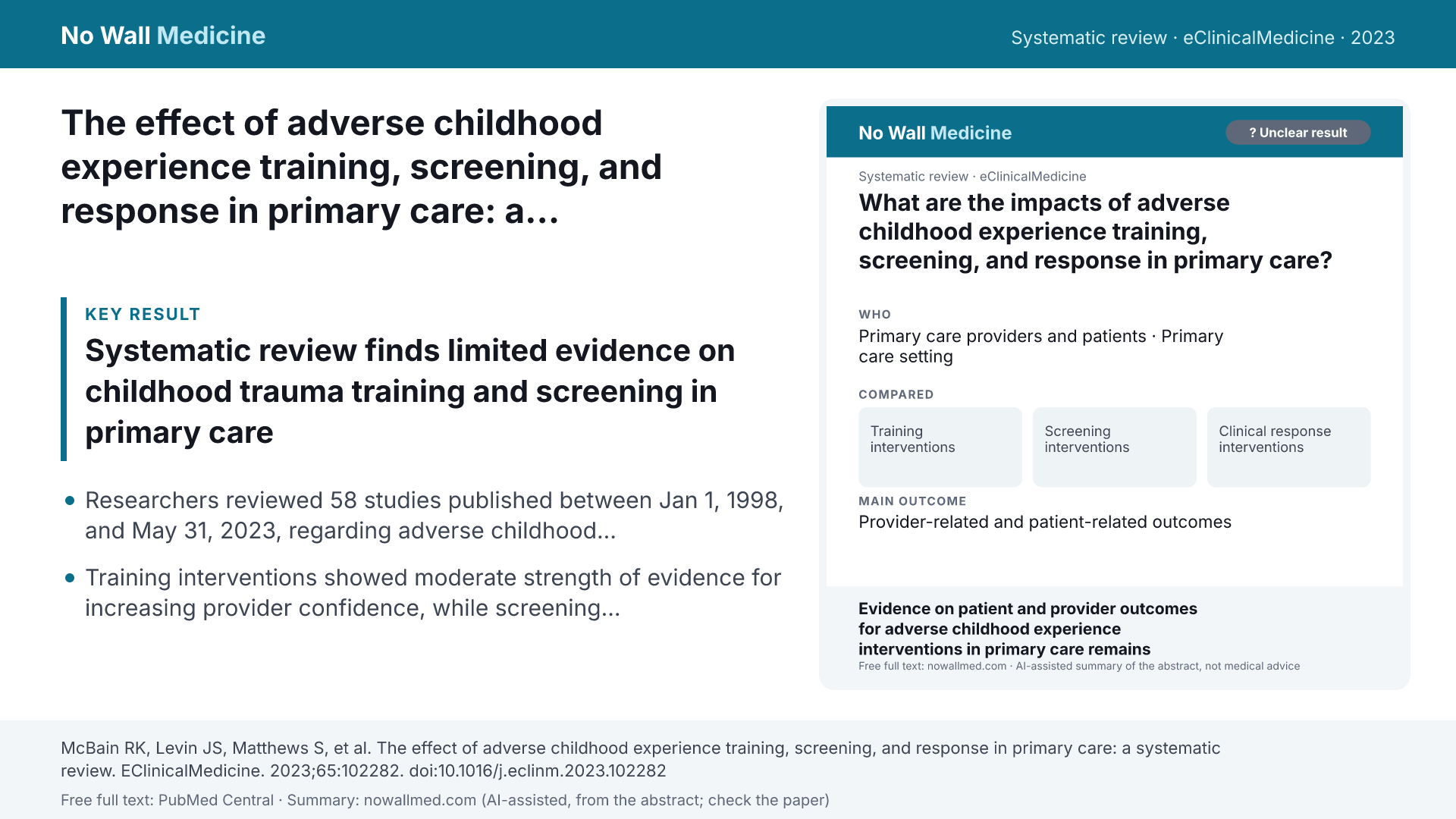
Systematic review finds limited evidence on childhood trauma training and screening in primary care
The effect of adverse childhood experience training, screening, and response in primary care: a systematic review
Systematic reviewUnclear result
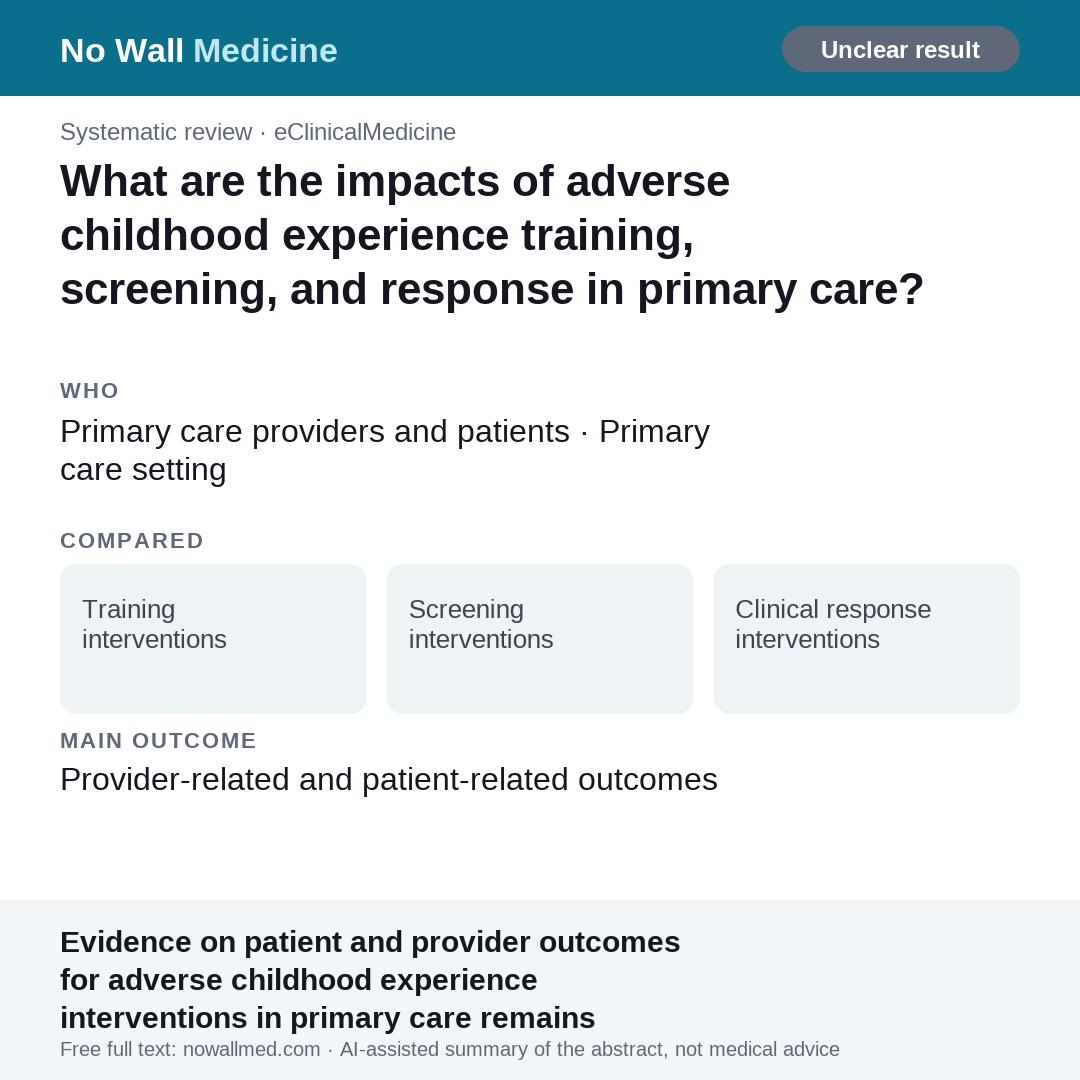
What are the impacts of adverse childhood experience training, screening, and response in primary care?
Who
Primary care providers and patients · Primary care setting
Compared
Training interventions
Screening interventions
Clinical response interventions
Main outcome
Provider-related and patient-related outcomes
Bottom line: Evidence on patient and provider outcomes for adverse childhood experience interventions in primary care remains scarce.
Limitation: Low strength of evidence due to observational evidence, small samples, and self-report measures.
Funded by: California Department of Health Care Services and Office of the California Surgeon General
eClinicalMedicine · 2023-10-24Download image
Clinical question: What are the impacts of adverse childhood experience training, screening, and response in primary care?
Why it matters: It was unknown how training, screening, and response for adverse childhood experiences impacts provider behavior and patient outcomes in primary care settings.
Key points
- Researchers reviewed 58 studies published between Jan 1, 1998, and May 31, 2023, regarding adverse childhood experiences training, screening, and response in primary care.
- Training interventions showed moderate strength of evidence for increasing provider confidence, while screening interventions were linked to moderate evidence for screening uptake and patient satisfaction.
- The majority of the 58 studies focused on pediatric populations, with 50 studies involving children and 12 involving adults.
Limitation the authors note: The strength of evidence was generally low due to reliance on observational evidence, small samples, and self-report measures for heterogeneous outcomes.
Headline and key points written with AI from the paper’s abstract, with every number checked against it. Read the paper before relying on them.
Was this summary helpful?
Cite this article
McBain RK, Levin JS, Matthews S, et al. The effect of adverse childhood experience training, screening, and response in primary care: a systematic review. eClinicalMedicine. 2023. doi:10.1016/j.eclinm.2023.102282
Spotted a mistake? Suggest a correction