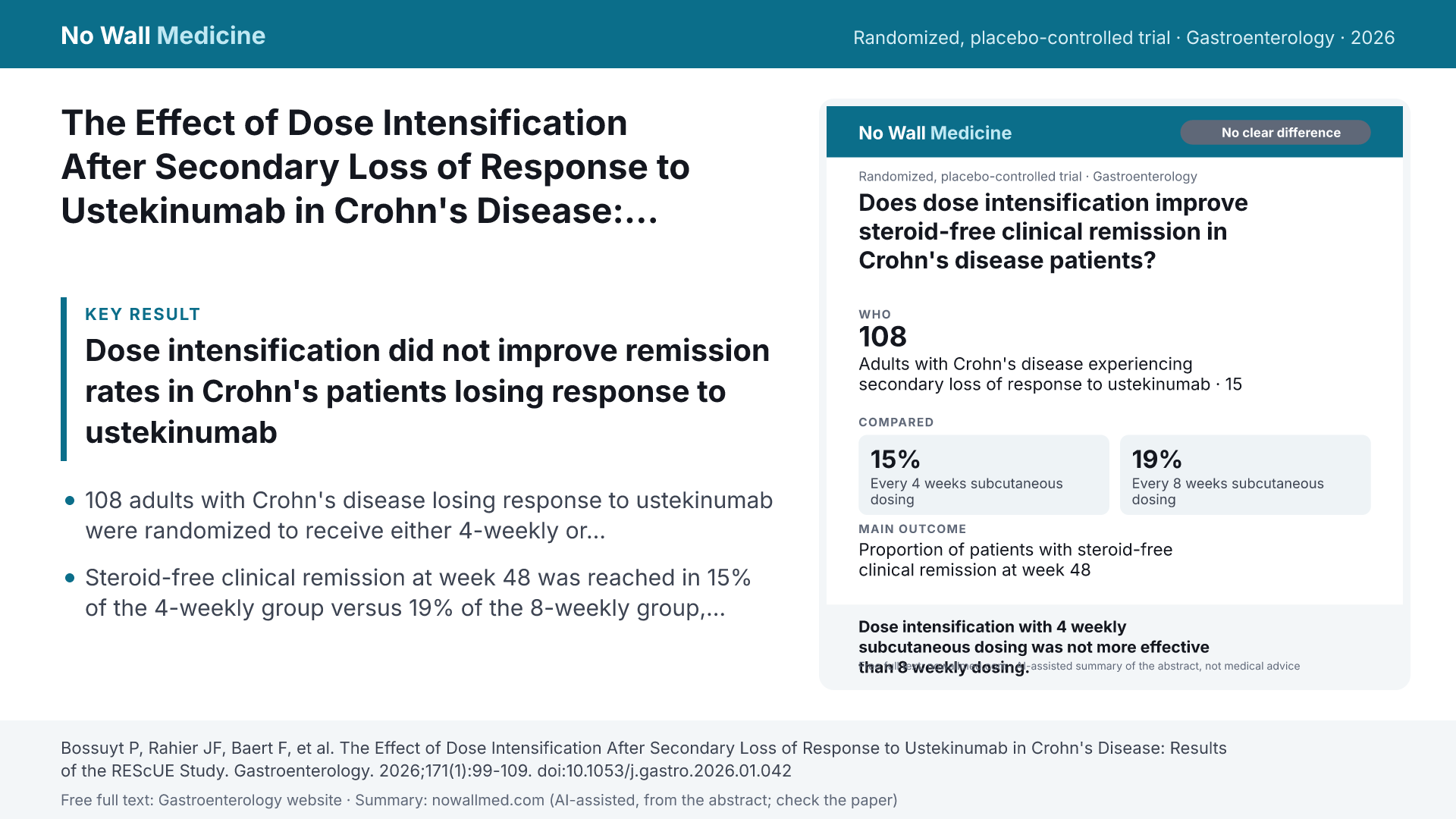
Dose intensification did not improve remission rates in Crohn's patients losing response to ustekinumab
The Effect of Dose Intensification After Secondary Loss of Response to Ustekinumab in Crohn's Disease: Results of the REScUE Study
Randomized, placebo-controlled trialNo clear difference
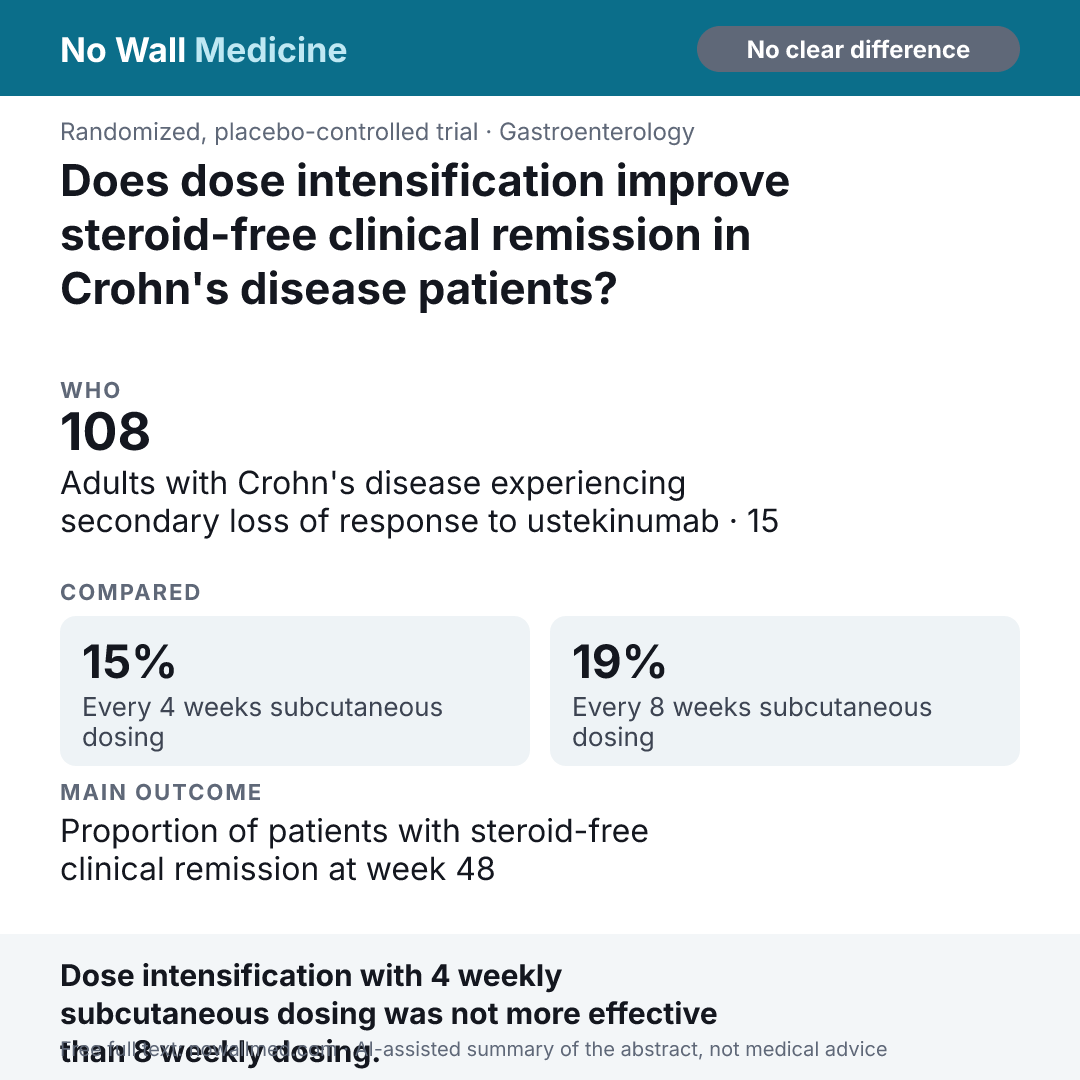
Does dose intensification improve steroid-free clinical remission in Crohn's disease patients?
Who
108
Adults with Crohn's disease experiencing secondary loss of response to ustekinumab · 15 hospitals in Belgium
Compared
15%Every 4 weeks subcutaneous dosing
19%Every 8 weeks subcutaneous dosing
Main outcome
Proportion of patients with steroid-free clinical remission at week 48
Result: difference 4%; P = 0.5
Bottom line: Dose intensification with 4 weekly subcutaneous dosing was not more effective than 8 weekly dosing.
Gastroenterology · 2026-02-24 · Save PNG
Clinical question: Does dose intensification improve steroid-free clinical remission in Crohn's disease patients?
Why it matters: Multiple dose-intensification regimens have been proposed for secondary loss of response, but their relative effectiveness was not tested prospectively.
Key points
- 108 adults with Crohn's disease losing response to ustekinumab were randomized to receive either 4-weekly or 8-weekly subcutaneous dosing after an IV reinduction.
- Steroid-free clinical remission at week 48 was reached in 15% of the 4-weekly group versus 19% of the 8-weekly group, a difference that was not significant.
- Serious adverse events occurred in 17% of patients in the 4-weekly group and 13% in the 8-weekly group.
Headline and key points written with AI from the paper’s abstract, with every number checked against it. Read the paper before relying on them.
Was this summary helpful?
Subject terms
Headline, design, result, key points, caveat and citation as plain text.
Cite this article
Bossuyt P, Rahier JF, Baert F, et al. The Effect of Dose Intensification After Secondary Loss of Response to Ustekinumab in Crohn's Disease: Results of the REScUE Study. Gastroenterology. 2026;171(1):99-109. doi:10.1053/j.gastro.2026.01.042
Spotted a mistake? Suggest a correction