Fampridine did not significantly change working memory performance in healthy young adults
The effect of fampridine on working memory: a randomized controlled trial based on a genome-guided repurposing approach
Double-blind, randomized, placebo-controlled, crossover trialMixed results
Does fampridine affect working memory in healthy young adults?
Who
43
Healthy young adults
Compared
Fampridine
Placebo
Main outcome
Working memory 3-back d-prime
Bottom line: Fampridine showed no significant main effect on working memory but may benefit low-performing individuals.
Mol Psychiatry · 2024-11-08Download image
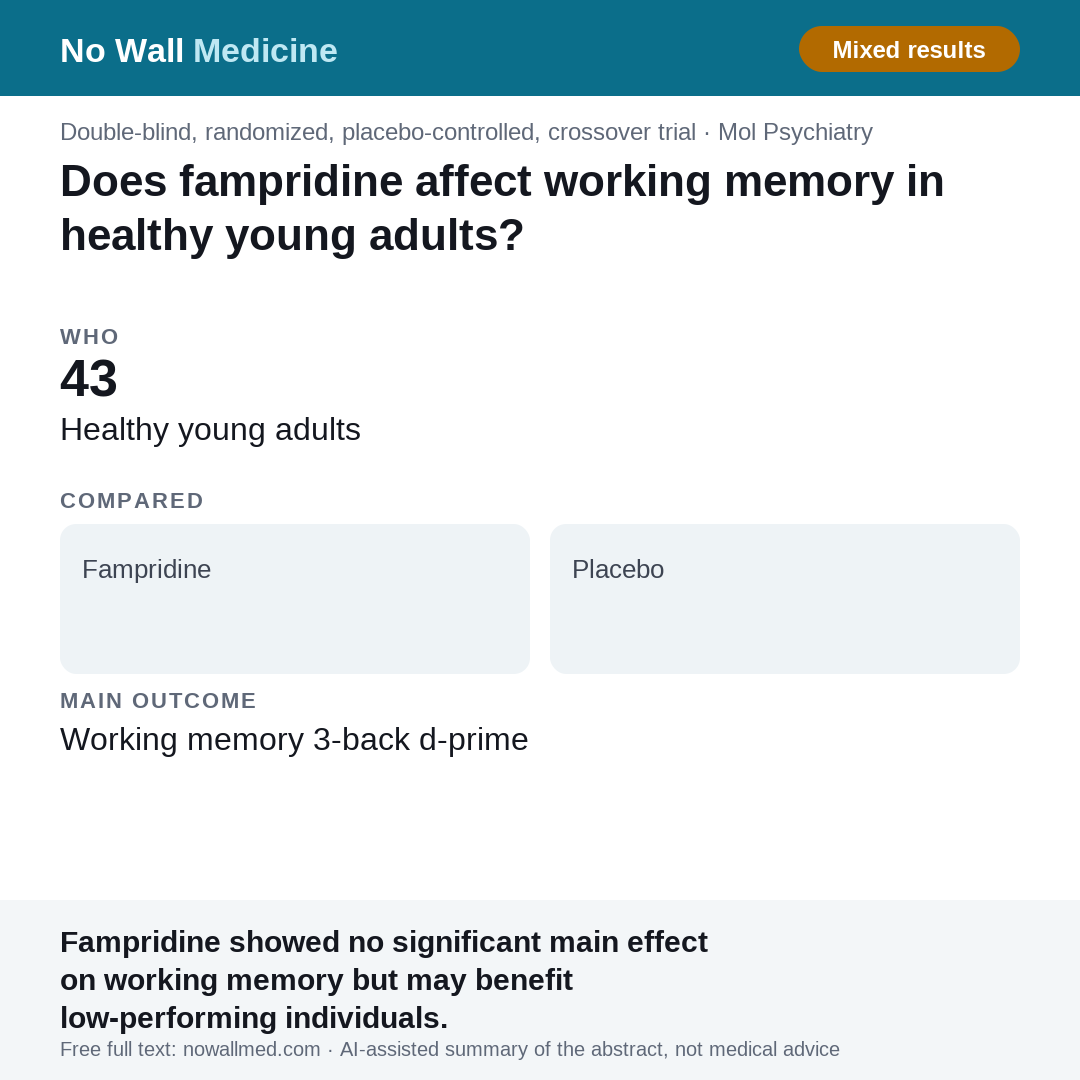
Clinical question: Does fampridine affect working memory in healthy young adults?
Why it matters: It was unknown if fampridine, a potassium channel blocker used for multiple sclerosis, could modulate working memory through a genome-guided drug repurposing approach.
Key points
- Researchers conducted a double-blind, randomized, placebo-controlled, crossover trial with 43 healthy young adults to test the effect of fampridine on working memory.
- No significant main effect on the primary working memory outcome was observed after 3.5 days of taking 10 mg of fampridine twice daily (P = 0.87).
- Lower baseline performance was associated with higher working memory performance after repeated intake of fampridine compared to placebo (P = 0.014).
Headline and key points written with AI from the paper’s abstract, with every number checked against it. Read the paper before relying on them.
Topics
Cite this article
Papassotiropoulos A, Freytag V, Schicktanz N, Gerhards C, Aerni A, Faludi T. The effect of fampridine on working memory: a randomized controlled trial based on a genome-guided repurposing approach. Mol Psychiatry. 2024. doi:10.1038/s41380-024-02820-1
Spotted a mistake? Suggest a correction
Top studies every Monday
The week’s key trials and guidelines in your specialties, by email. Free.
Get the weekly digest