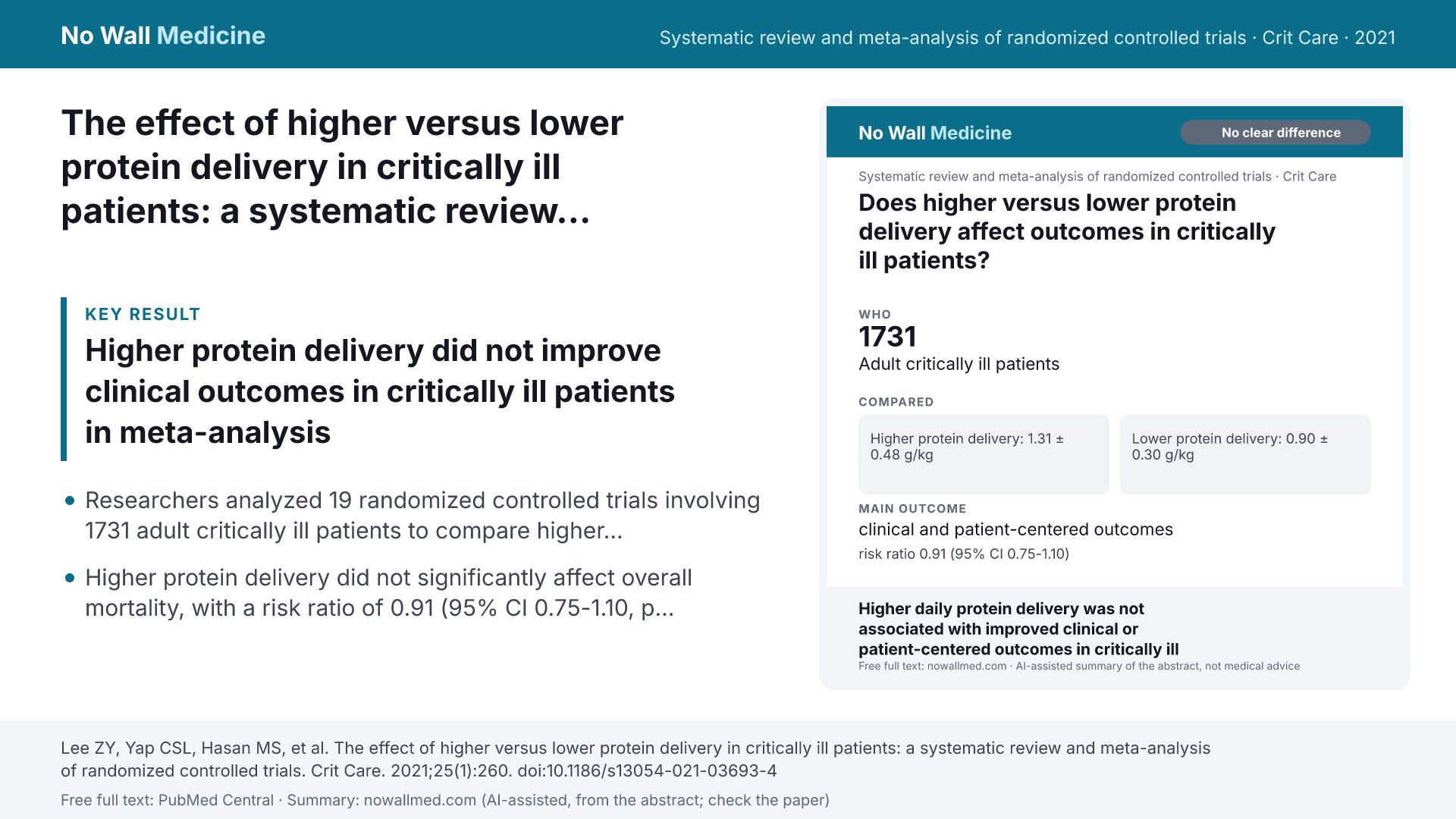
Higher protein delivery did not improve clinical outcomes in critically ill patients in meta-analysis
The effect of higher versus lower protein delivery in critically ill patients: a systematic review and meta-analysis of randomized controlled trials
Systematic review and meta-analysis of randomized controlled trialsNo clear difference
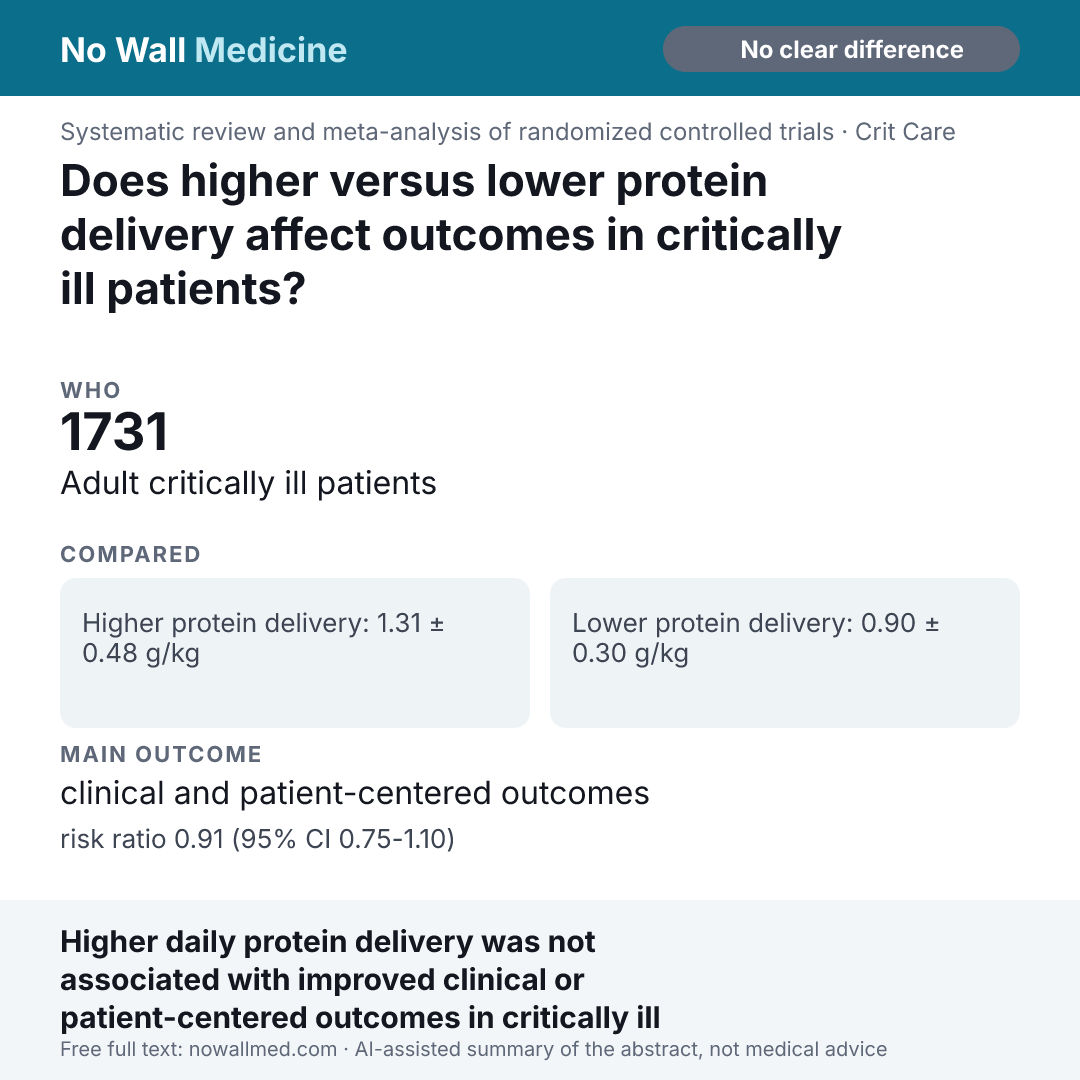
Does higher versus lower protein delivery affect outcomes in critically ill patients?
Who
1731
Adult critically ill patients
Compared
Higher protein delivery: 1.31 ± 0.48 g/kg
Lower protein delivery: 0.90 ± 0.30 g/kg
Main outcome
clinical and patient-centered outcomes
Result: risk ratio 0.91 (95% CI 0.75-1.10)
Bottom line: Higher daily protein delivery was not associated with improved clinical or patient-centered outcomes in critically ill patients.
Crit Care · 2021-07-23 · PROSPERO CRD42021237530
Limitation the authors note: Larger and more definitive randomized controlled trials are needed to confirm the effect on muscle loss.
Headline and visual abstract written with AI from the paper’s abstract, with every number checked against it. Read the paper before relying on them.
Was this summary helpful?
Abstract
Background
The optimal protein dose in critical illness is unknown. We aim to conduct a systematic review of randomized controlled trials (RCTs) to compare the effect of higher versus lower protein delivery (with similar energy delivery between groups) on clinical and patient-centered outcomes in critically ill patients. Methods
We searched MEDLINE, EMBASE, CENTRAL and CINAHL from database inception through April 1, 2021.We included RCTs of (1) adult (age ≥ 18) critically ill patients that (2) compared higher vs lower protein with (3) similar energy intake between groups, and (4) reported clinical and/or patient-centered outcomes. We excluded studies on immunonutrition. Two authors screened and conducted quality assessment independently and in duplicate. Random-effect meta-analyses were conducted to estimate the pooled risk ratio (dichotomized outcomes) or mean difference (continuous outcomes). Results
Nineteen RCTs were included (n = 1731). Sixteen studies used primarily the enteral route to deliver protein. Intervention was started within 72 h of ICU admission in sixteen studies. The intervention lasted between 3 and 28 days. In 11 studies that reported weight-based nutrition delivery, the pooled mean protein and energy received in higher and lower protein groups were 1.31 ± 0.48 vs 0.90 ± 0.30 g/kg and 19.9 ± 6.9 versus 20.1 ± 7.1 kcal/kg, respectively. Higher vs lower protein did not significantly affect overall mortality [risk ratio 0.91, 95% confidence interval (CI) 0.75-1.10, p = 0.34] or other clinical or patient-centered outcomes. In 5 small studies, higher protein significantly attenuated muscle loss (MD -3.44% per week, 95% CI -4.99 to -1.90; p < 0.0001). Conclusion
In critically ill patients, a higher daily protein delivery was not associated with any improvement in clinical or patient-centered outcomes. Larger, and more definitive RCTs are needed to confirm the effect of muscle loss attenuation associated with higher protein delivery. PROSPERO registration number: CRD42021237530.
Abstract reproduced under the article’s CC BY licence.
Subject terms
Cite this article
Lee ZY, Yap CSL, Hasan MS, et al. The effect of higher versus lower protein delivery in critically ill patients: a systematic review and meta-analysis of randomized controlled trials. Crit Care. 2021;25(1):260. doi:10.1186/s13054-021-03693-4
Spotted a mistake? Suggest a correction