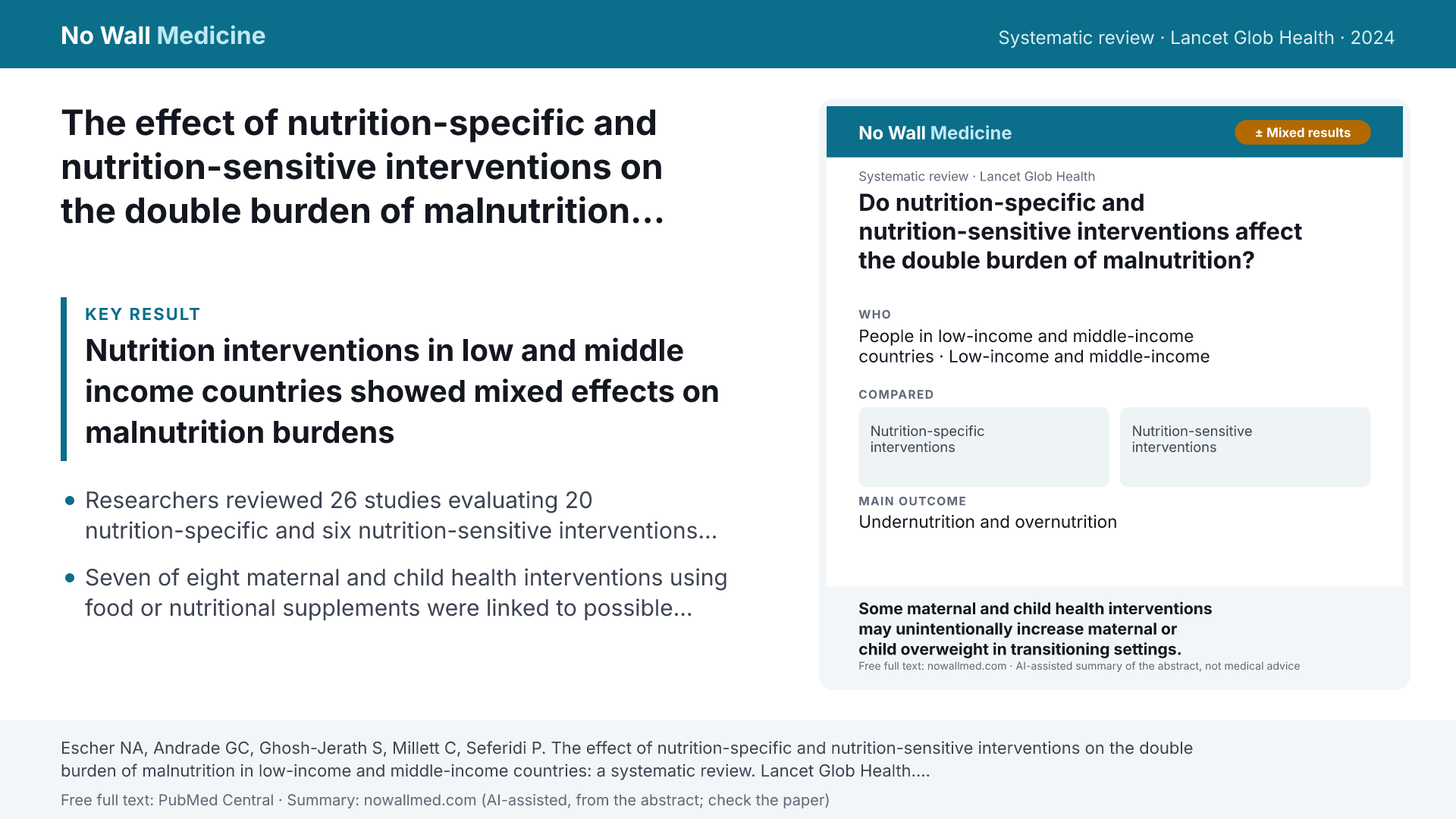
Nutrition interventions in low and middle income countries showed mixed effects on malnutrition burdens
The effect of nutrition-specific and nutrition-sensitive interventions on the double burden of malnutrition in low-income and middle-income countries: a systematic review
Systematic reviewMixed results
Do nutrition-specific and nutrition-sensitive interventions affect the double burden of malnutrition?
Who
People in low-income and middle-income countries · Low-income and middle-income countries
Compared
Nutrition-specific interventions
Nutrition-sensitive interventions
Main outcome
Undernutrition and overnutrition
Bottom line: Some maternal and child health interventions may unintentionally increase maternal or child overweight in transitioning settings.
Funded by: President's Scholarship and National Institute for Health and Care Research
Lancet Glob Health · 2024-01-29Download image
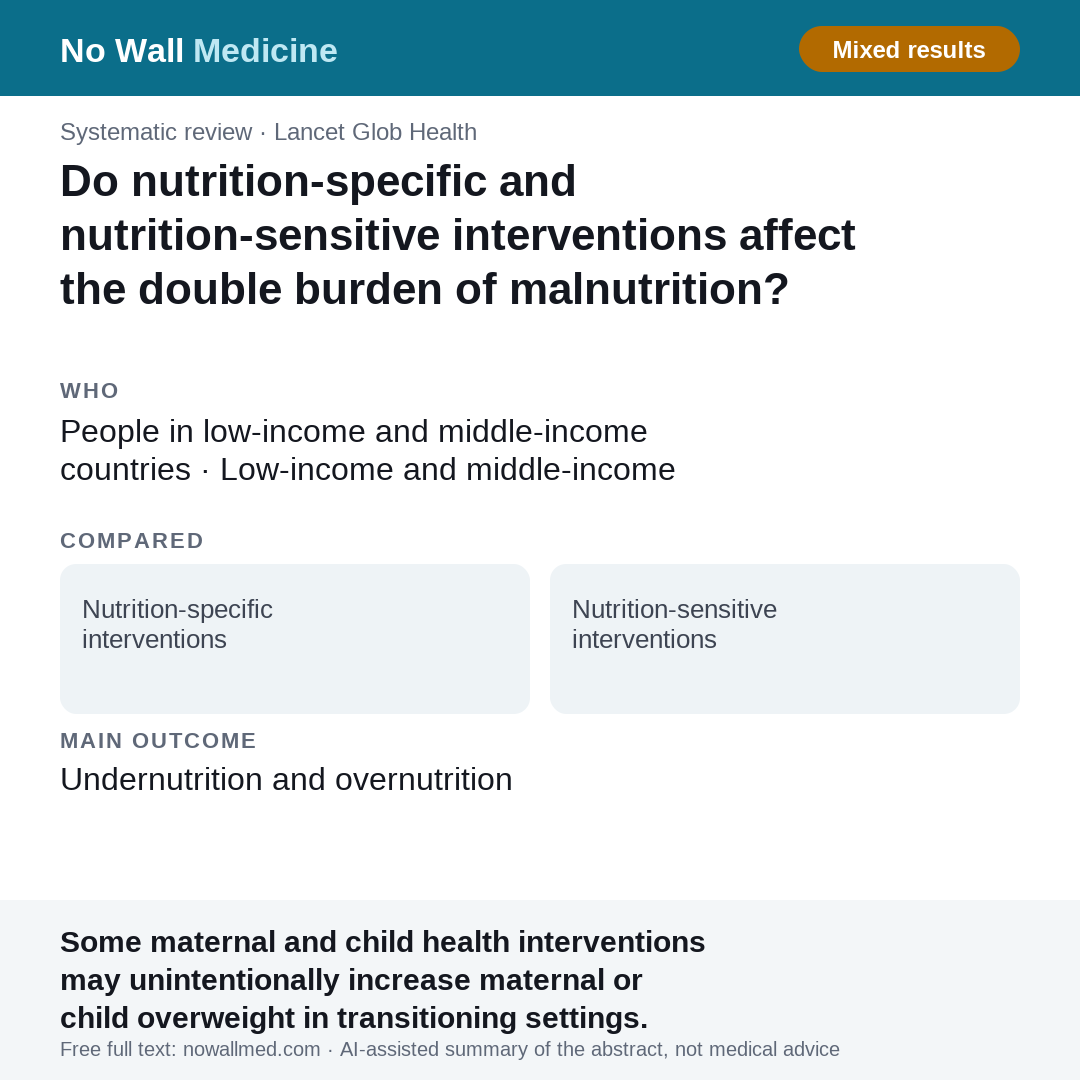
Clinical question: Do nutrition-specific and nutrition-sensitive interventions affect the double burden of malnutrition?
Why it matters: Robust evidence is missing regarding how nutrition-specific and nutrition-sensitive interventions affect both undernutrition and overnutrition simultaneously.
Key points
- Researchers reviewed 26 studies evaluating 20 nutrition-specific and six nutrition-sensitive interventions in low-income and middle-income countries.
- Seven of eight maternal and child health interventions using food or nutritional supplements were linked to possible harmful effects and increased maternal or child overweight.
- Most school-based programmes and maternal and child health interventions targeting behavioral change were considered potentially beneficial for the double burden of malnutrition.
Headline and key points written with AI from the paper’s abstract, with every number checked against it. Read the paper before relying on them.
Was this summary helpful?
Abstract
Background
Low-income and middle-income countries (LMICs) experiencing nutrition transition face an increasing double burden of malnutrition (DBM). WHO has urged the identification of risks and opportunities in nutrition interventions to mitigate the DBM, but robust evidence is missing. This review summarises the effect of nutrition-specific and nutrition-sensitive interventions on undernutrition and overnutrition in LMICs. Methods
We searched four major databases and grey literature for publications in English, French, Portuguese, and Spanish from Jan 1, 2000, to Aug 14, 2023. Eligible studies evaluated nutrition-specific or nutrition-sensitive interventions on both undernutrition and overnutrition, employing robust study designs (individually randomised, cluster randomised, and non-randomised trials; interrupted time series; controlled before-after; and prospective cohort studies). Studies were synthesised narratively, and classified as DBM-beneficial, potentially DBM-beneficial, DBM-neutral, potentially DBM-harmful, and DBM-harmful, using vote counting. This review is registered with PROSPERO (CRD42022320131). Findings
We identified 26 studies evaluating 20 nutrition-specific (maternal and child health [MCH] and school-based programmes) and six nutrition-sensitive (conditional cash transfers and other social policies) interventions. Seven of eight MCH interventions providing food-based or nutritional supplements indicated possible DBM-harmful effects, associated with increased maternal or child overweight. Most school-based programmes and MCH interventions that target behavioural change were considered potentially DBM-beneficial. Two studies of conditional cash transfers suggested DBM-beneficial effects in children, whereas one indicated potentially harmful effects on maternal overweight. A study on a family planning service and one on an education reform revealed possible long-term harmful effects on obesity. Interpretation
There is considerable scope to repurpose existing nutrition interventions to reduce the growing burden of the DBM in LMICs. In settings undergoing rapid nutrition transition, specific policy attention is required to ensure that food-based or supplement-based MCH programmes do not unintentionally increase maternal or child overweight. Consistent reporting of undernutrition and overnutrition outcomes in all nutrition interventions is essential to expand the evidence base to identify and promote interventions maximising benefits and minimising harms on the DBM. Funding
President's Scholarship (Imperial College London) and National Institute for Health and Care Research. Translations
For the Portuguese, Spanish and French translations of the abstract see Supplementary Materials section.
Abstract reproduced under the article’s CC BY licence.
Subject terms
Cite this article
Escher NA, Andrade GC, Ghosh-Jerath S, Millett C, Seferidi P. The effect of nutrition-specific and nutrition-sensitive interventions on the double burden of malnutrition in low-income and middle-income countries: a systematic review. Lancet Glob Health. 2024. doi:10.1016/S2214-109X(23)00562-4
Spotted a mistake? Suggest a correction