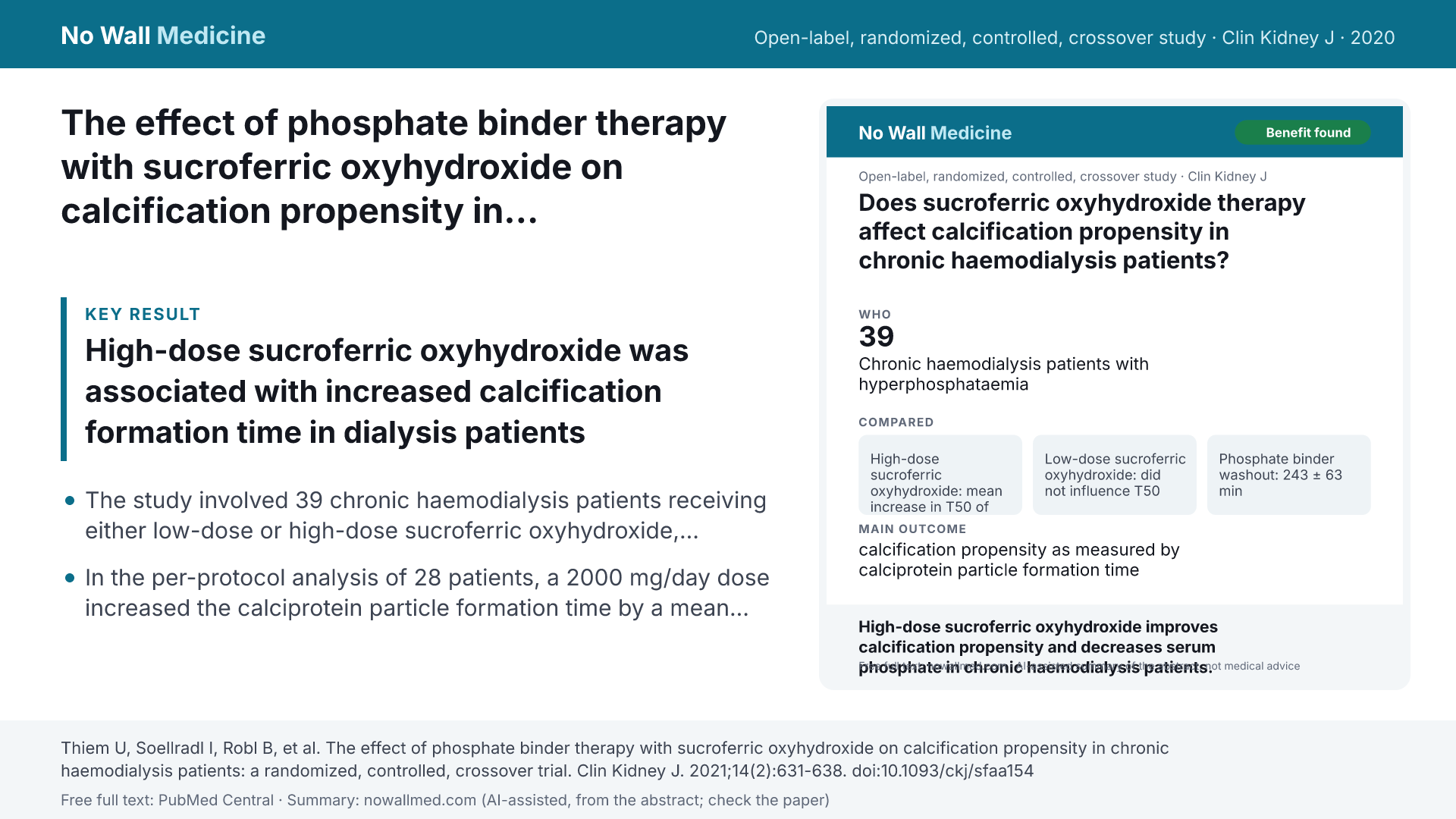
The effect of phosphate binder therapy with sucroferric oxyhydroxide on calcification propensity in chronic haemodialysis patients: a randomized, controlled, crossover trial
Key result: High-dose sucroferric oxyhydroxide was associated with increased calcification formation time in dialysis patients
Open-label, randomized, controlled, crossover studyBenefit found
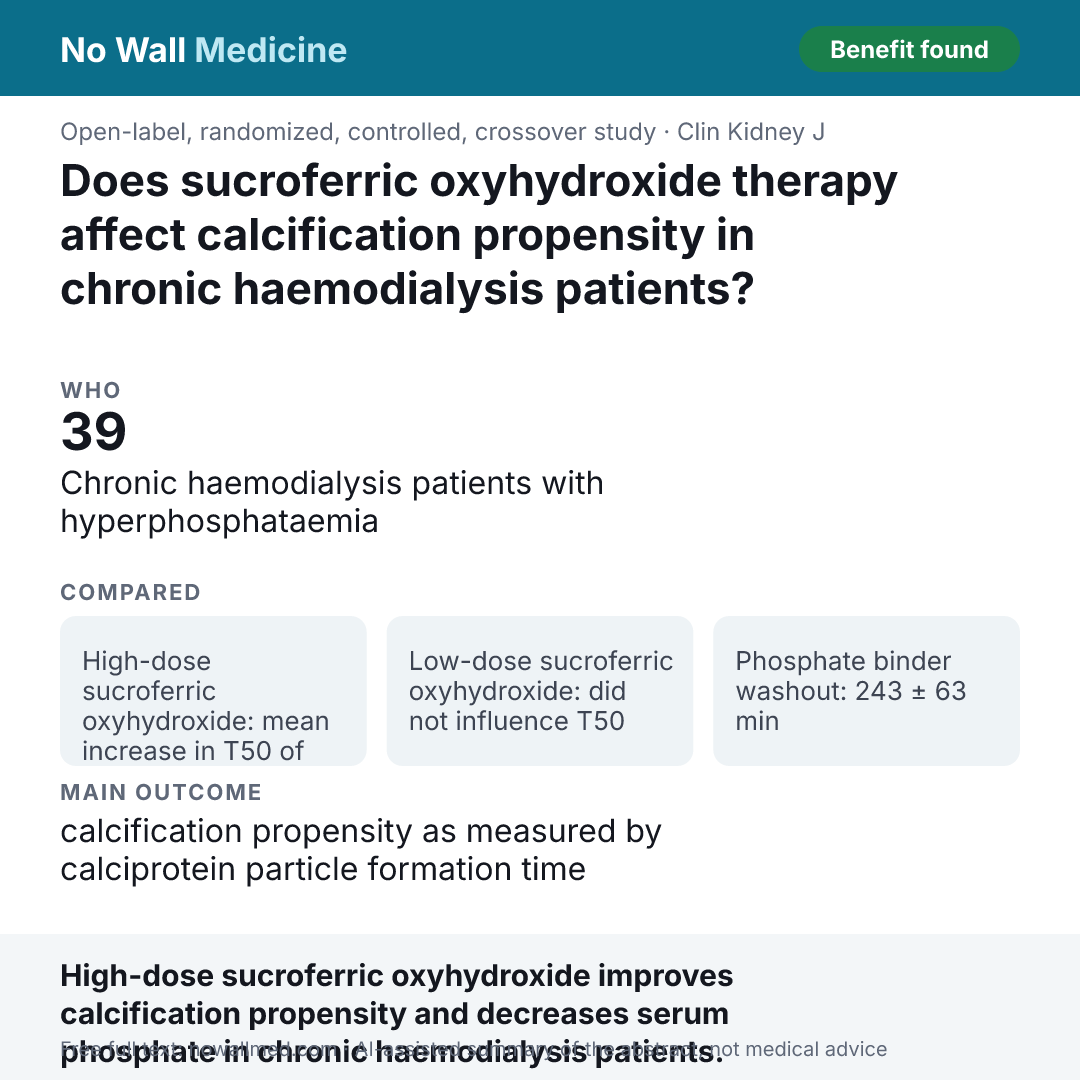
Does sucroferric oxyhydroxide therapy affect calcification propensity in chronic haemodialysis patients?
Who
39
Chronic haemodialysis patients with hyperphosphataemia
Compared
High-dose sucroferric oxyhydroxide: mean increase in T50 of 66 min (95% CI 49-84 min)
Low-dose sucroferric oxyhydroxide: did not influence T50
Phosphate binder washout: 243 ± 63 min
Main outcome
calcification propensity as measured by calciprotein particle formation time
Result: mean increase in T50 of 66 min (95% CI 49-84 min)
Bottom line: High-dose sucroferric oxyhydroxide improves calcification propensity and decreases serum phosphate in chronic haemodialysis patients.
Clin Kidney J · 2020-10-28 · Save PNG
Key points
- The study involved 39 chronic haemodialysis patients receiving either low-dose or high-dose sucroferric oxyhydroxide, a medication used to bind phosphate in the gut.
- In the per-protocol analysis of 28 patients, a 2000 mg/day dose increased the calciprotein particle formation time by a mean of 66 min compared to washout.
- High-dose treatment was associated with a decrease in serum phosphate from 2.28 ± 0.5 to 1.63 ± 0.43 mmol/L.
Discussion prompts
- Would these patients look like yours? Who was left out?
- Is the main outcome one that matters to patients?
- Is the difference large enough to change what you do?
Cite: Thiem U, Soellradl I, Robl B, et al. The effect of phosphate binder therapy with sucroferric oxyhydroxide on calcification propensity in chronic haemodialysis patients: a randomized, controlled, crossover trial. Clin Kidney J. 2021;14(2):631-638. doi:10.1093/ckj/sfaa154
Free full text: PubMed Central · Summary and visual abstract: nowallmed.com/a/the-effect-of-phosphate-binder-therapy-with-sucroferric-oxyhydroxide-rovrj4/ (AI-assisted from the abstract; check the paper before relying on it).