The effect of post-oral bitter compound interventions on the postprandial glycemia response: A systematic review and meta-analysis of randomised controlled trials
Systematic review and meta-analysis of randomised controlled trialsMixed results
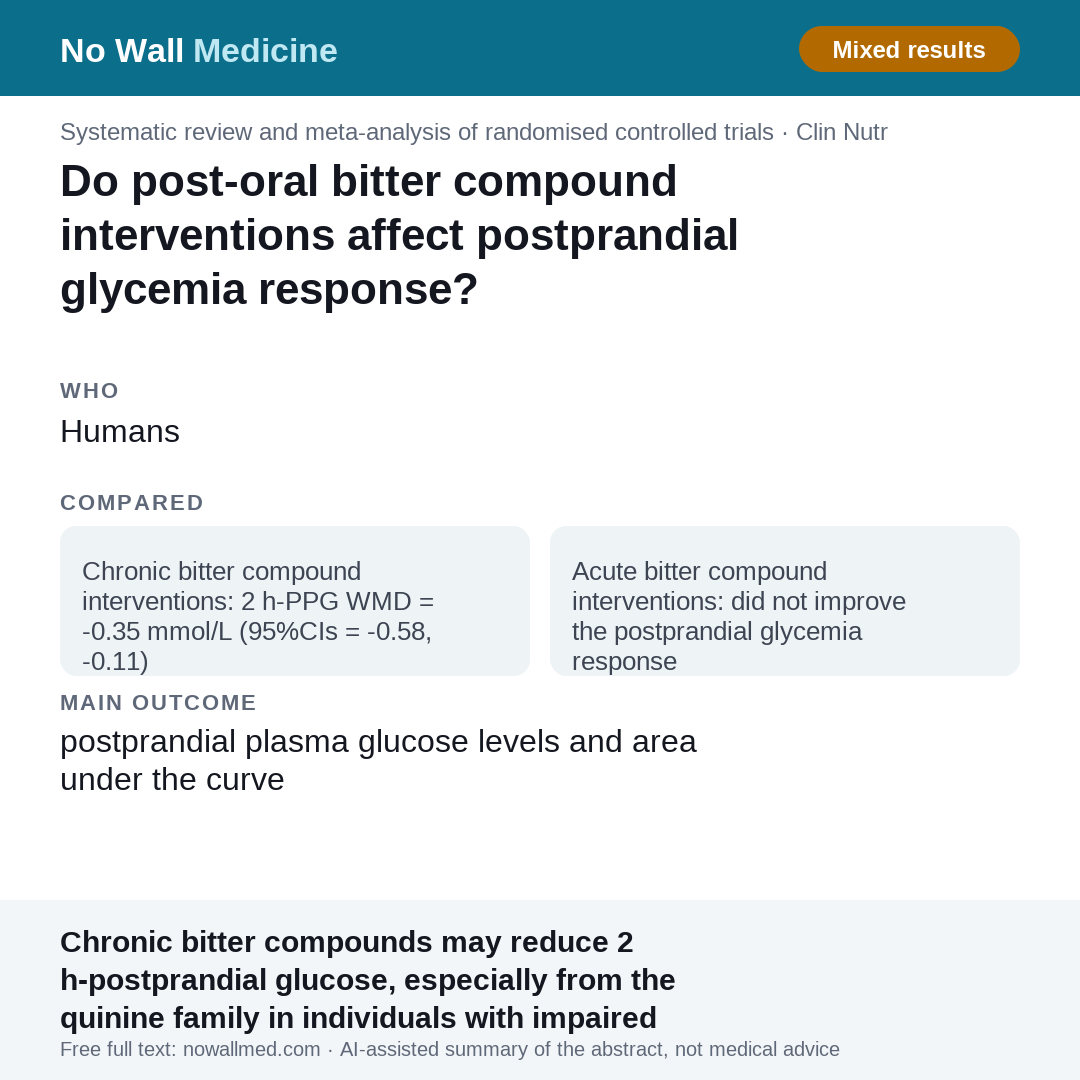
Do post-oral bitter compound interventions affect postprandial glycemia response?
Who
Humans
Compared
Chronic bitter compound interventions: 2 h-PPG WMD = -0.35 mmol/L (95%CIs = -0.58, -0.11)
Acute bitter compound interventions: did not improve the postprandial glycemia response
Main outcome
postprandial plasma glucose levels and area under the curve
Bottom line: Chronic bitter compounds may reduce 2 h-postprandial glucose, especially from the quinine family in individuals with impaired glycemia.
Limitation: the very low quality of the evidence
Clin Nutr · 2024-09-14Download image
Clinical question: Do post-oral bitter compound interventions affect postprandial glycemia response?
Abstract
Background & aims
The post-oral sensing of bitter compounds by a family of bitter taste receptors (TAS2Rs) is suggested to regulate postprandial glycemia in humans. However, reports are inconsistent. This systematic review used meta-analysis to synthesise the impact of bitter compound interventions on the postprandial glycaemic response in humans. Methods
Electronic databases (Medline, PubMed, and Web of Science) were systematically searched from inception to April 2024 to identify randomised controlled trials reporting the effect of interventions utilising post-oral bitter compounds vs. placebo on postprandial plasma glucose levels at t = 2 h (2 h-PPG), and area under the curve (AUC) of glucose, insulin, and c-peptide. The random-effect and subgroup analysis were performed to calculate pooled weighted mean differences (WMD), overall and by predefined criteria. Results
Forty-six studies (within 34 articles) were identified; 29 and 17 studies described chronic and acute interventions, respectively. The chronic interventions reduced 2 h-PPG (n = 21, WMD = -0.35 mmol/L, 95%CIs = -0.58, -0.11) but not AUC for glucose or insulin. Subgroup analysis showed the former was particularly evident in individuals with impaired glycemia, interventions longer than three months, or quinine family administration. The acute interventions did not improve the postprandial glycemia response, but subgroup analysis revealed a decrease in AUC-glucose after quinine family administration (n = 4 WMD = -90.40 (nmol × time/L), 95%CIs = -132.70, -48.10). Conclusion
Chronic bitter compound interventions, particularly those from the quinine family, may have therapeutic potential in those with glycemia dysregulation. Acute intervention of the quinine family may also improve postprandial glucose. Given the very low quality of the evidence, further investigations with more rigorous methods are still required.
Subject terms
Cite this article
Mohammadpour Z, Heshmati E, Heilbronn LK, Hendrie GA, Brooker PG, Page AJ. The effect of post-oral bitter compound interventions on the postprandial glycemia response: A systematic review and meta-analysis of randomised controlled trials. Clin Nutr. 2024. doi:10.1016/j.clnu.2024.09.027
Spotted a mistake? Suggest a correction
Top studies every Monday
The week’s key trials and guidelines in your specialties, plus any topics you follow. By email, free.
Get the weekly digest