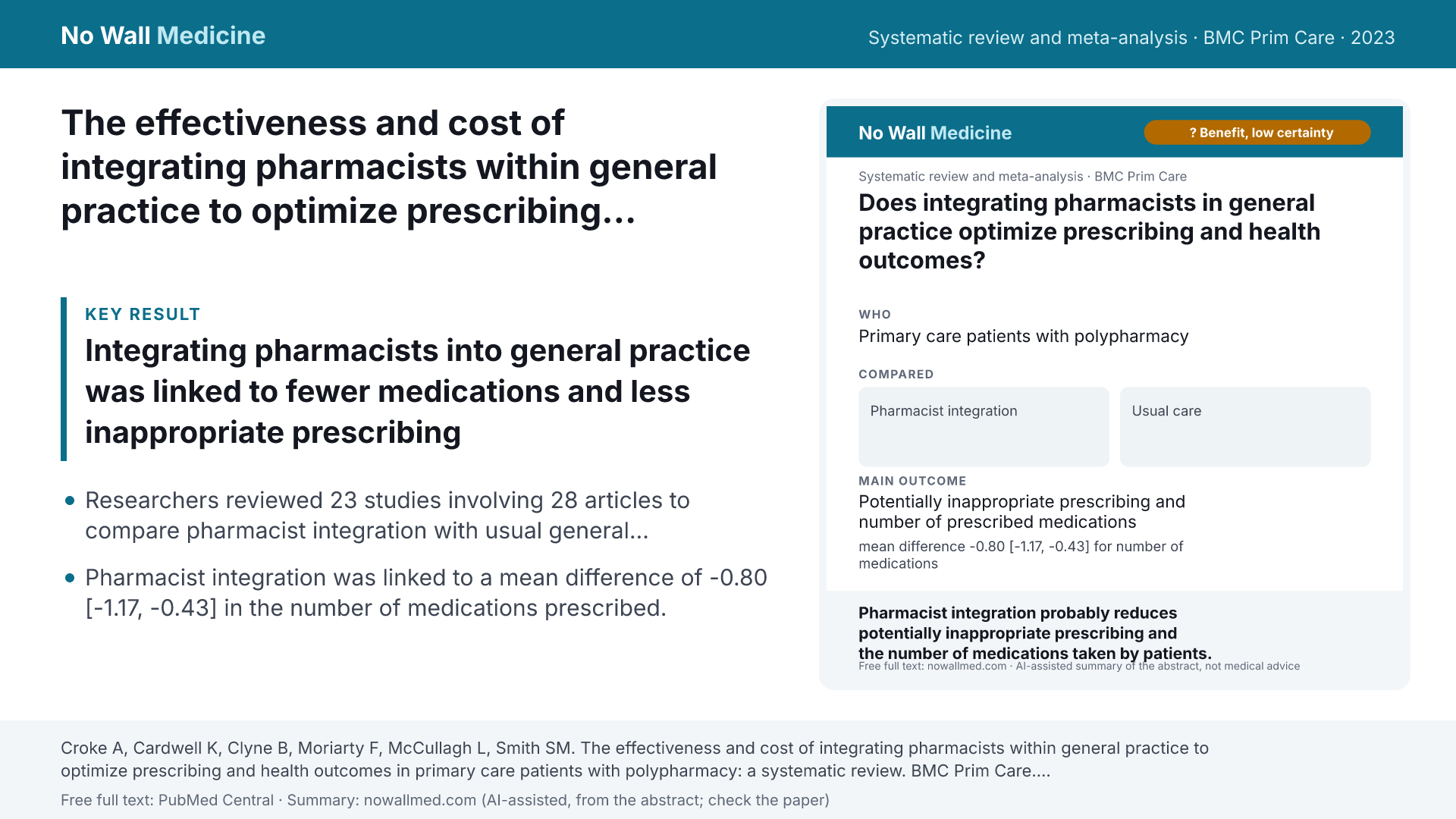
Integrating pharmacists into general practice was linked to fewer medications and less inappropriate prescribing
The effectiveness and cost of integrating pharmacists within general practice to optimize prescribing and health outcomes in primary care patients with polypharmacy: a systematic review
Systematic review and meta-analysisBenefit found
Does integrating pharmacists in general practice optimize prescribing and health outcomes?
Who
Primary care patients with polypharmacy
Compared
Pharmacist integration
Usual care
Main outcome
Potentially inappropriate prescribing and number of prescribed medications
Result: mean difference -0.80 [-1.17, -0.43] for number of medications
Bottom line: Pharmacist integration probably reduces potentially inappropriate prescribing and the number of medications taken by patients.
Limitation: Differing outcomes across studies limited comparisons and cost-effectiveness conclusions.
BMC Prim Care · 2023-02-06Download image
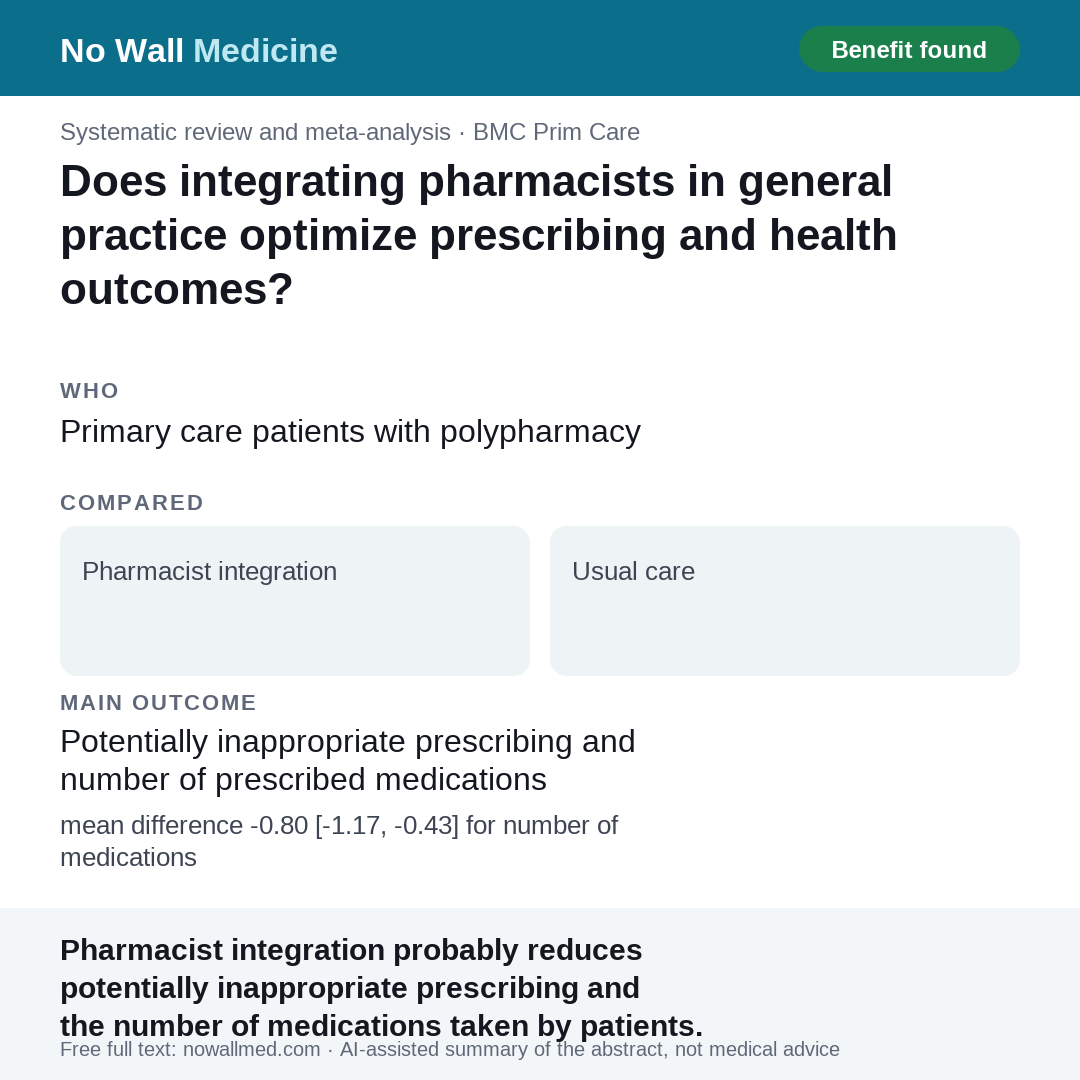
Clinical question: Does integrating pharmacists in general practice optimize prescribing and health outcomes?
Why it matters: It is unknown if adding pharmacists to general practice effectively optimizes medication use and improves patient health outcomes or cost-effectiveness.
Key points
- Researchers reviewed 23 studies involving 28 articles to compare pharmacist integration with usual general practitioner care.
- Pharmacist integration was linked to a mean difference of -0.80 [-1.17, -0.43] in the number of medications prescribed.
- The review found no clear effect on health-related quality of life or other patient outcomes due to low certainty of evidence.
Limitation the authors note: The outcome measured differed across studies limiting comparisons and making it difficult to make conclusions on cost effectiveness.
Headline and key points written with AI from the paper’s abstract, with every number checked against it. Read the paper before relying on them.
Was this summary helpful?
Subject terms
Cite this article
Croke A, Cardwell K, Clyne B, Moriarty F, McCullagh L, Smith SM. The effectiveness and cost of integrating pharmacists within general practice to optimize prescribing and health outcomes in primary care patients with polypharmacy: a systematic review. BMC Prim Care. 2023. doi:10.1186/s12875-022-01952-z
Spotted a mistake? Suggest a correction