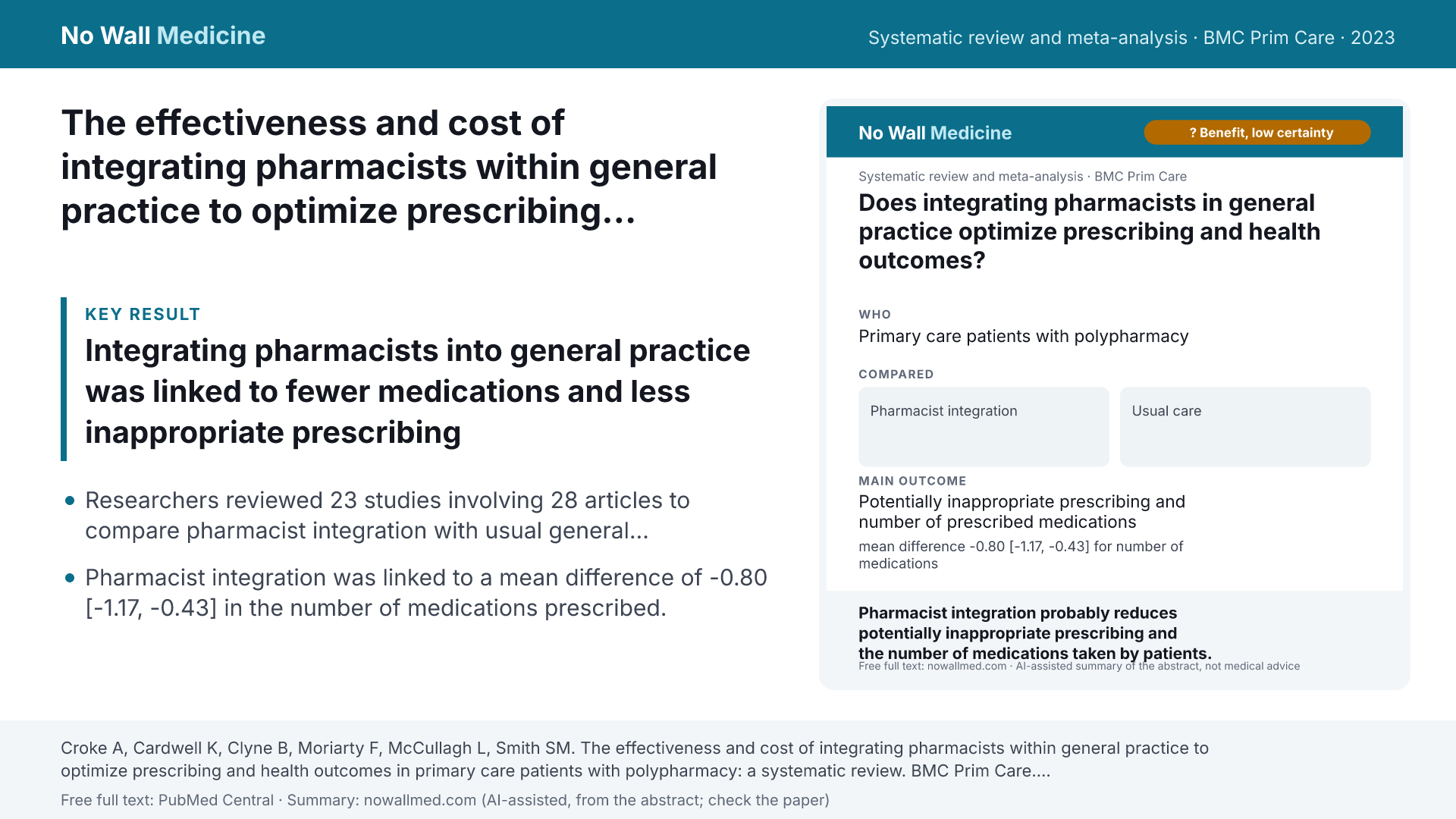
The effectiveness and cost of integrating pharmacists within general practice to optimize prescribing and health outcomes in primary care patients with polypharmacy: a systematic review
Key result: Integrating pharmacists into general practice was linked to fewer medications and less inappropriate prescribing
Key points
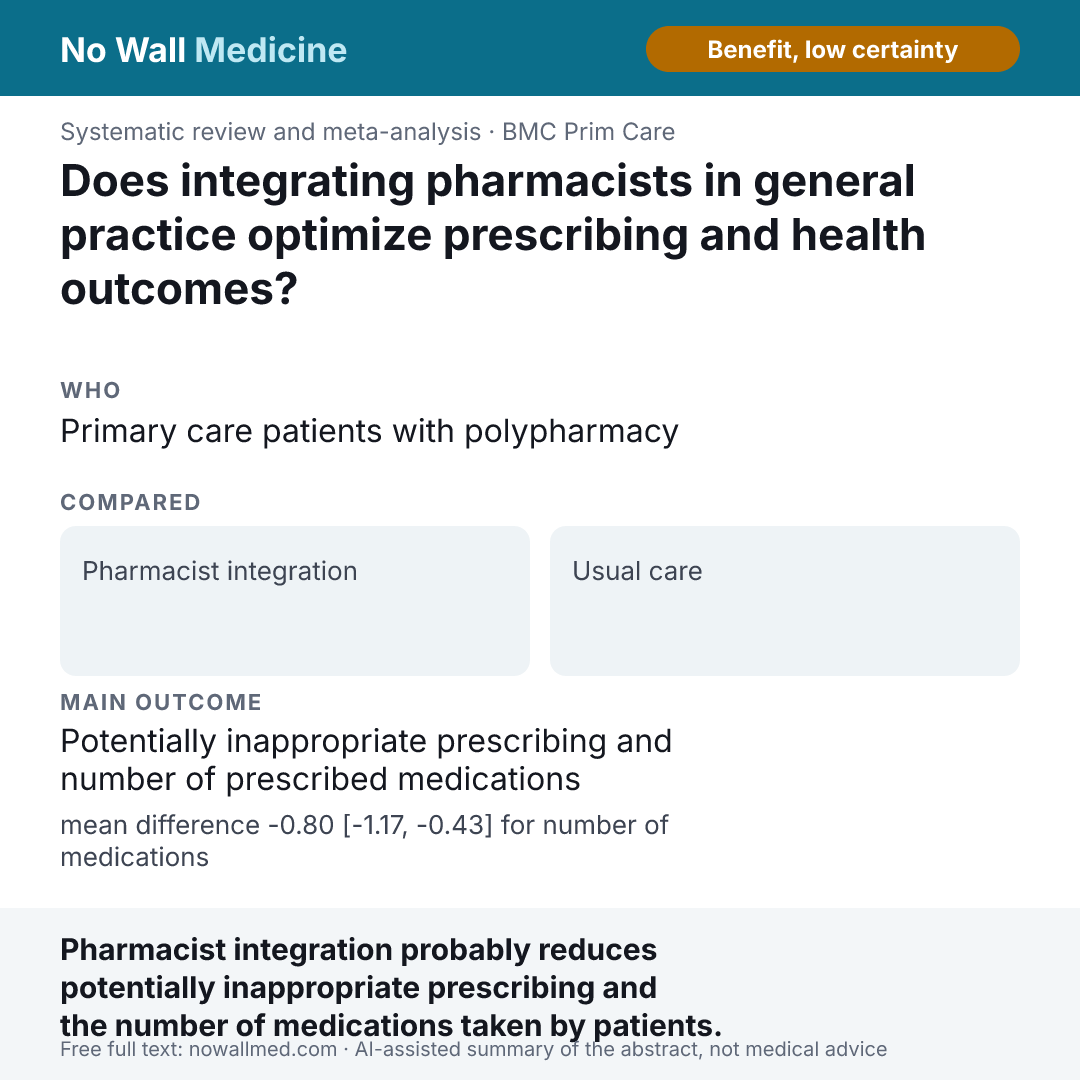
- Researchers reviewed 23 studies involving 28 articles to compare pharmacist integration with usual general practitioner care.
- Pharmacist integration was linked to a mean difference of -0.80 [-1.17, -0.43] in the number of medications prescribed.
- The review found no clear effect on health-related quality of life or other patient outcomes due to low certainty of evidence.
Limitation the authors note: The outcome measured differed across studies limiting comparisons and making it difficult to make conclusions on cost effectiveness.
Discussion prompts
- Would these patients look like yours? Who was left out?
- Is the main outcome one that matters to patients?
- Is the difference large enough to change what you do?
Cite: Croke A, Cardwell K, Clyne B, Moriarty F, McCullagh L, Smith SM. The effectiveness and cost of integrating pharmacists within general practice to optimize prescribing and health outcomes in primary care patients with polypharmacy: a systematic review. BMC Prim Care. 2023;24(1):41. doi:10.1186/s12875-022-01952-z
Free full text: PubMed Central · Summary and visual abstract: nowallmed.com/a/the-effectiveness-and-cost-of-integrating-pharmacists-within-general-15vx8rb/ (AI-assisted from the abstract; check the paper before relying on it).