Computerized cognitive training improves general cognitive function and attention in patients with poststroke cognitive impairment
The Effectiveness of Computerized Cognitive Training in Patients With Poststroke Cognitive Impairment: Systematic Review and Meta-Analysis
Systematic review and meta-analysisBenefit found
Does computerized cognitive training improve cognitive function in patients with poststroke cognitive impairment?
Who
875
Patients with poststroke cognitive impairment
Compared
Computerized cognitive training
Usual care or routine rehabilitation
Main outcome
Cognitive function
Result: standardized mean difference 0.46 (95% CI 0.21 to 0.71)
Bottom line: Computerized cognitive training significantly enhances general cognitive function, attention, executive function, and quality of life in patients with poststroke cognitive impairment.
Limitation: Results vary due to differing intervention programs and computerized cognitive training systems.
J Med Internet Res · 2025-06-12Download image
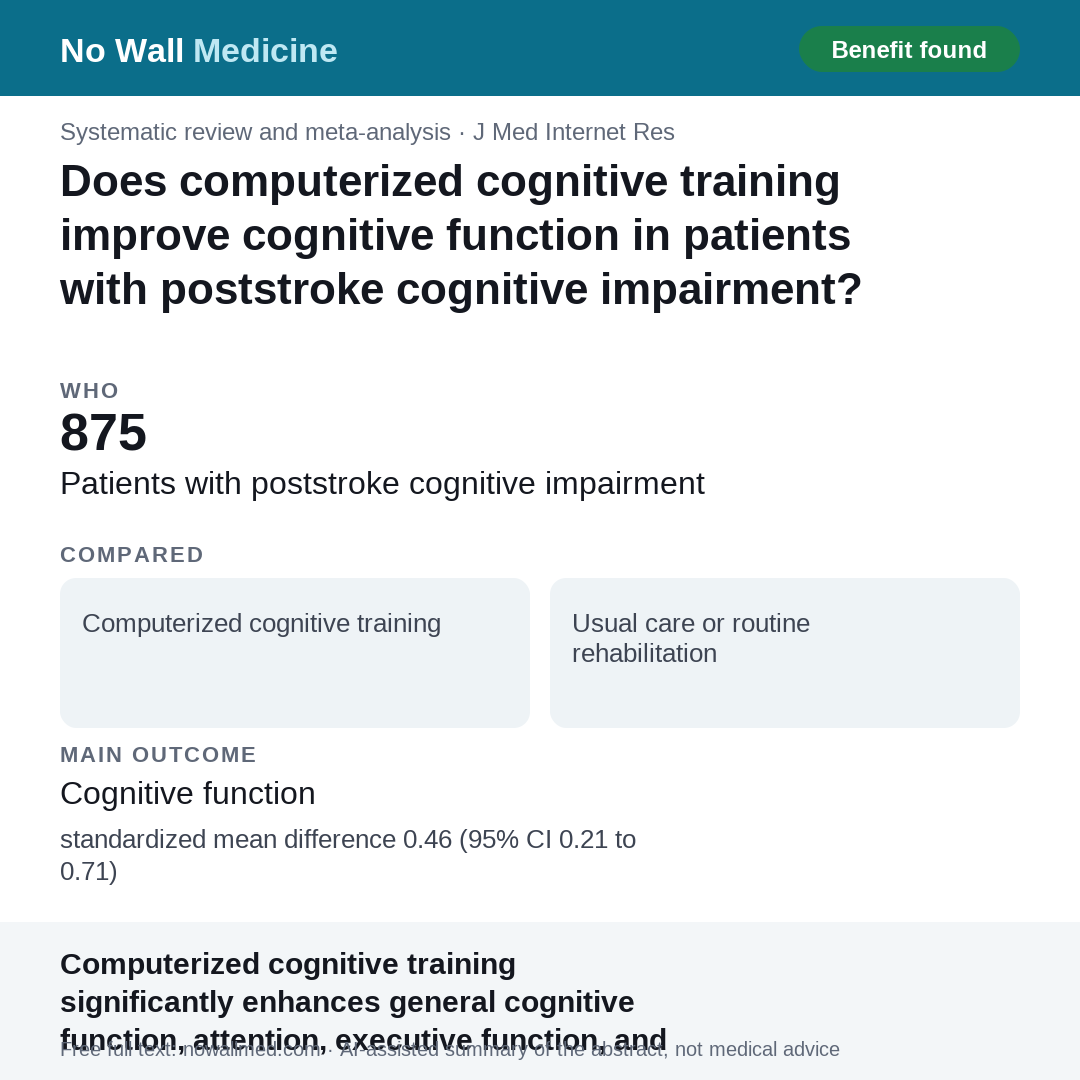
Clinical question: Does computerized cognitive training improve cognitive function in patients with poststroke cognitive impairment?
Why it matters: Clinicians need to know if computerized cognitive training is an effective therapeutic option for improving cognitive function in patients with poststroke cognitive impairment.
Key points
- Researchers analyzed 19 randomized controlled trials involving 875 participants to compare computerized cognitive training against usual care or routine rehabilitation.
- The training was associated with improvements in general cognitive function (SMD=0.46), attention (SMD=-0.45), executive function (SMD=0.39), and quality of life (SMD=0.34).
- Evidence was low- to very low-quality regarding improvements in memory, language function, and motor function.
Limitation the authors note: Results vary due to differing intervention programs and computerized cognitive training systems.
Headline and key points written with AI from the paper’s abstract, with every number checked against it. Read the paper before relying on them.
Topics
Cite this article
Gao M, Huang L, Yi J, Zhang T, Zhu G, Zhang Q. The Effectiveness of Computerized Cognitive Training in Patients With Poststroke Cognitive Impairment: Systematic Review and Meta-Analysis. J Med Internet Res. 2025. doi:10.2196/73140
Spotted a mistake? Suggest a correction
Top studies every Monday
The week’s key trials and guidelines in your specialties, plus any topics you follow. By email, free.
Get the weekly digest