Computer-assisted cognitive therapy and robot-assisted therapy show efficacy for cognitive function after stroke
Digital Interventions for Cognitive Dysfunction in Patients With Stroke: Systematic Review and Meta-Analysis
Network meta-analysis of 27 randomized controlled trialsBenefit found
Do digital interventions improve cognitive function in patients after stroke?
Who
Adults aged 18 years or older with poststroke cognitive impairment
Compared
Computer-assisted cognitive therapy: MD=3.03 (95% CI 1.69 to 4.38) for MoCA
Cognitive training: MD=0.70 (95% CI -0.88 to 2.28) for MoCA
Robot-assisted therapy: MD=5.99 (95% CI 3.20 to 8.79) for MMSE
Virtual reality: MD=1.34 (95% CI -0.94 to 3.62) for MMSE
Main outcome
Montreal Cognitive Assessment or Mini-Mental State Examination scores
Bottom line: Digital therapies improve poststroke cognition, with computer-assisted therapy best for MoCA and robot-assisted therapy best for MMSE.
Limitation: Heterogeneity of included studies, risk of bias, and limited sample sizes in some studies.
J Med Internet Res · 2025-07-24Download image
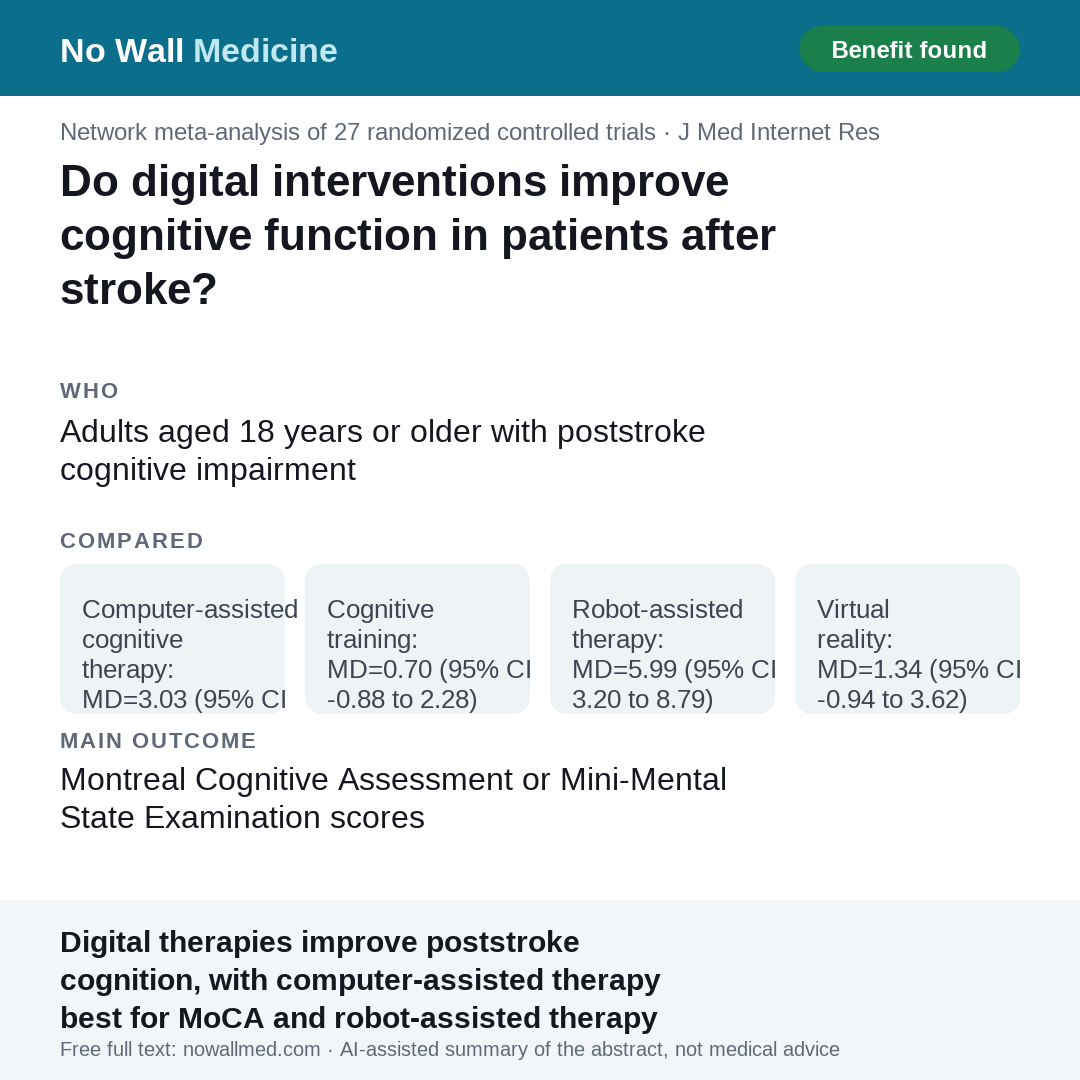
Clinical question: Do digital interventions improve cognitive function in patients after stroke?
Why it matters: The optimal digital treatment for improving cognitive function after a stroke remains unclear due to varying effectiveness and contradictory evidence.
Key points
- Researchers analyzed 27 randomized controlled trials to compare digital interventions like virtual reality, computer-assisted cognitive therapy, and robot-assisted therapy against conventional rehabilitation.
- Computer-assisted cognitive therapy was superior for Montreal Cognitive Assessment scores with a mean difference of 3.03, while robot-assisted therapy ranked highest for Mini-Mental State Examination scores with a mean difference of 5.99.
- Cognitive training showed no statistical difference in Montreal Cognitive Assessment scores and virtual reality showed no significant improvement in Mini-Mental State Examination scores.
Limitation the authors note: The authors noted caution is warranted due to heterogeneity of the included studies, risk of bias, and limited sample sizes in some studies.
Headline and key points written with AI from the paper’s abstract, with every number checked against it. Read the paper before relying on them.
Topics
Cite this article
Wang C, Liu M. Digital Interventions for Cognitive Dysfunction in Patients With Stroke: Systematic Review and Meta-Analysis. J Med Internet Res. 2025. doi:10.2196/73687
Spotted a mistake? Suggest a correction
Top studies every Monday
The week’s key trials and guidelines in your specialties, by email. Free.
Get the weekly digest