Enhanced evidence-based care models improved response and remission rates for people with depression
The effectiveness of enhanced evidence-based care for depressive disorders: a meta-analysis of randomized controlled trials
Meta-analysis of randomized controlled trialsBenefit found
Is enhanced evidence-based care effective for depressive disorders compared to usual care?
Who
15255
Participants with depressive disorders
Compared
Enhanced evidence-based care
Usual care
Main outcome
Response, remission, symptom reduction, and all-cause discontinuations
Result: pooled RR for response 1.30 (95%CI: 1.13-1.50), remission 1.35 (95%CI: 1.11-1.64), symptom reduction SMD -0.42 (95%CI: -0.61 to -0.23)
Bottom line: Enhanced evidence-based care improves response, remission, and symptom reduction for depressive disorders compared to usual care.
Transl Psychiatry · 2021-10-16Download image
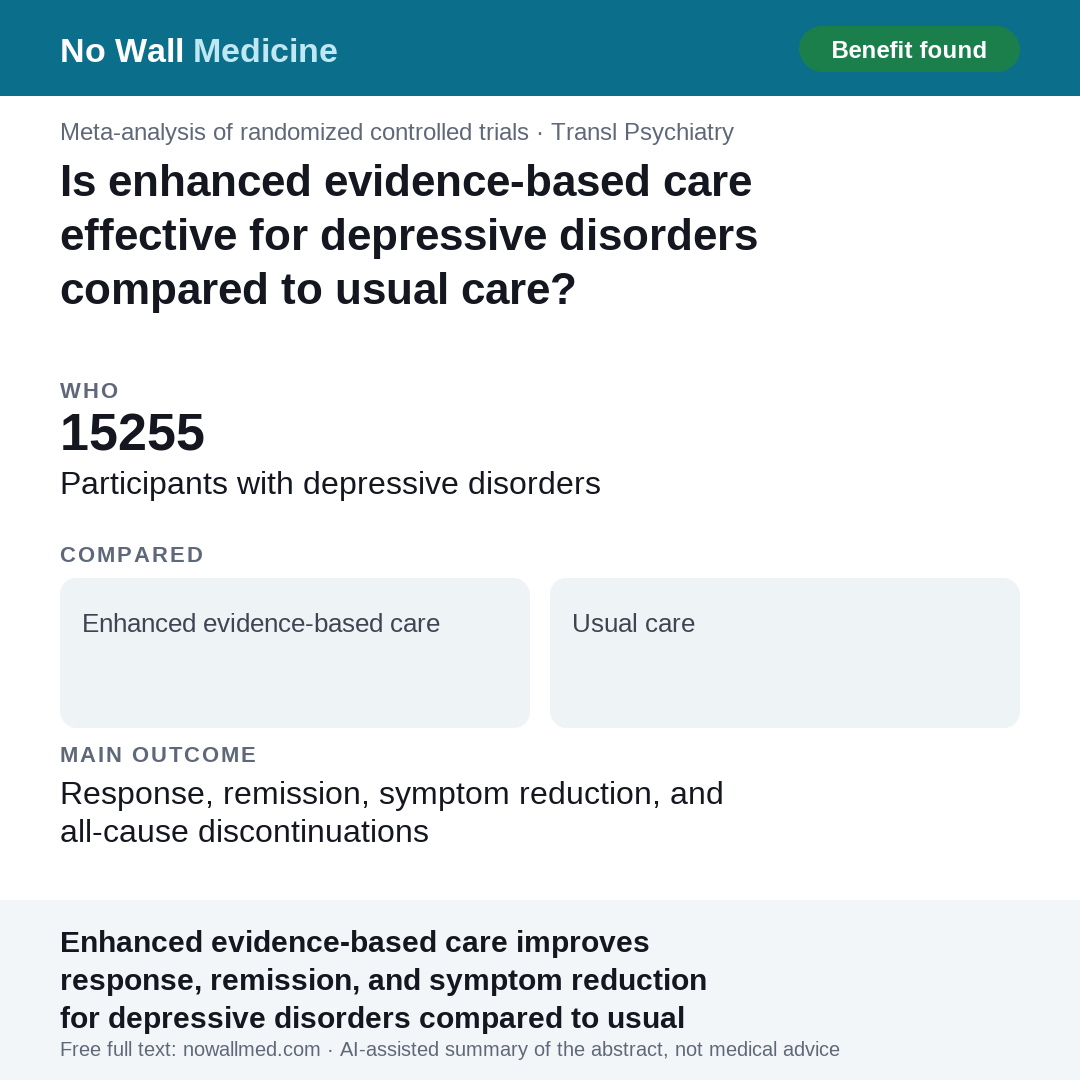
Clinical question: Is enhanced evidence-based care effective for depressive disorders compared to usual care?
Key points
- Researchers analyzed 29 studies involving 15,255 participants to compare enhanced evidence-based care against usual care for depressive disorders.
- Enhanced care was associated with a response risk ratio of 1.30 and a remission risk ratio of 1.35 compared to usual care.
- Symptom reduction showed a standardized mean difference of -0.42, while all-cause discontinuations were similar between the two groups with a risk ratio of 1.08.
Headline and key points written with AI from the paper’s abstract, with every number checked against it. Read the paper before relying on them.
Was this summary helpful?
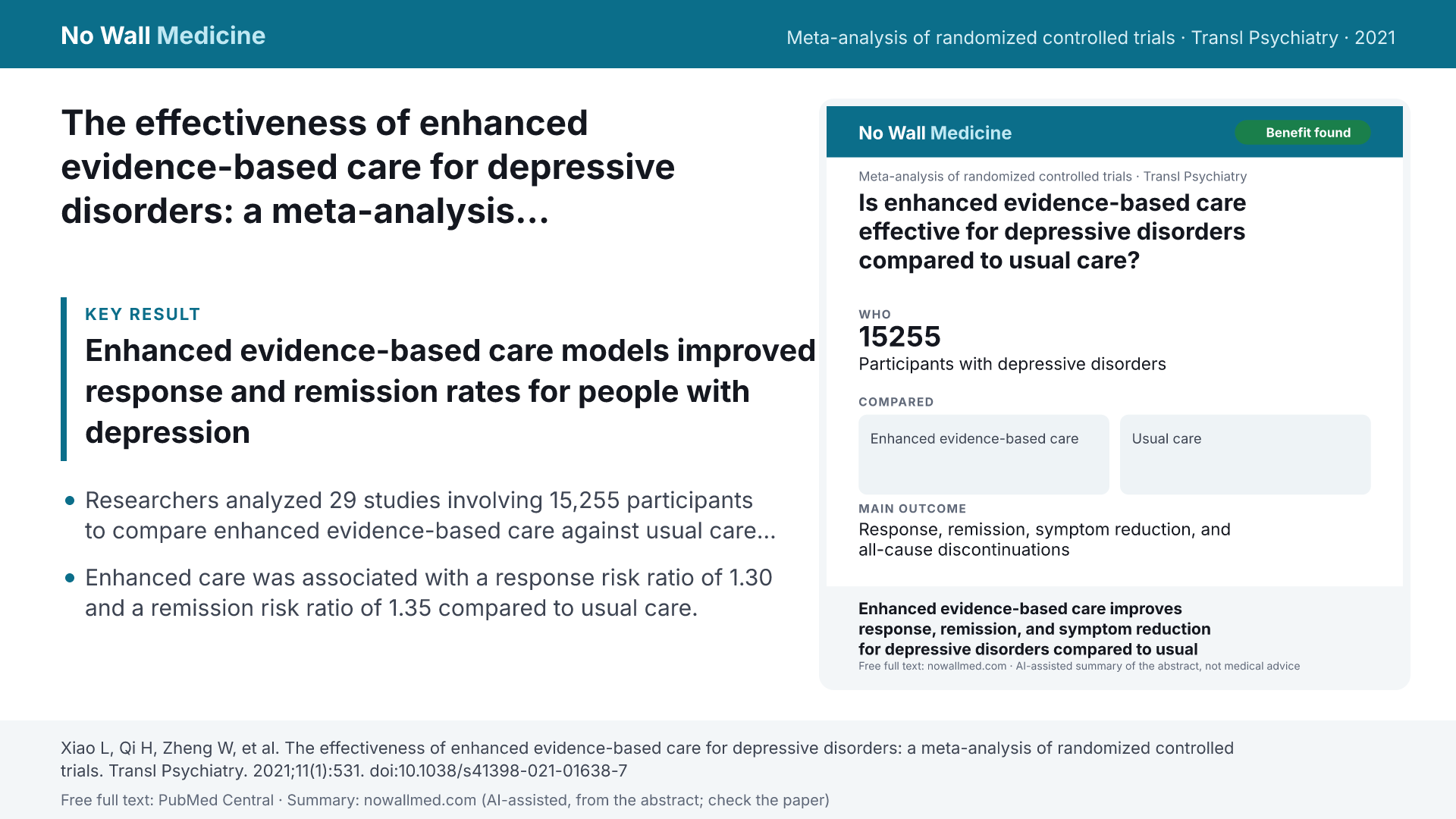
Subject terms
Headline, design, result, key points, caveat and citation as plain text.
Cite this article
Xiao L, Qi H, Zheng W, et al. The effectiveness of enhanced evidence-based care for depressive disorders: a meta-analysis of randomized controlled trials. Transl Psychiatry. 2021. doi:10.1038/s41398-021-01638-7
Spotted a mistake? Suggest a correction