The effectiveness of enhanced evidence-based care for depressive disorders: a meta-analysis of randomized controlled trials
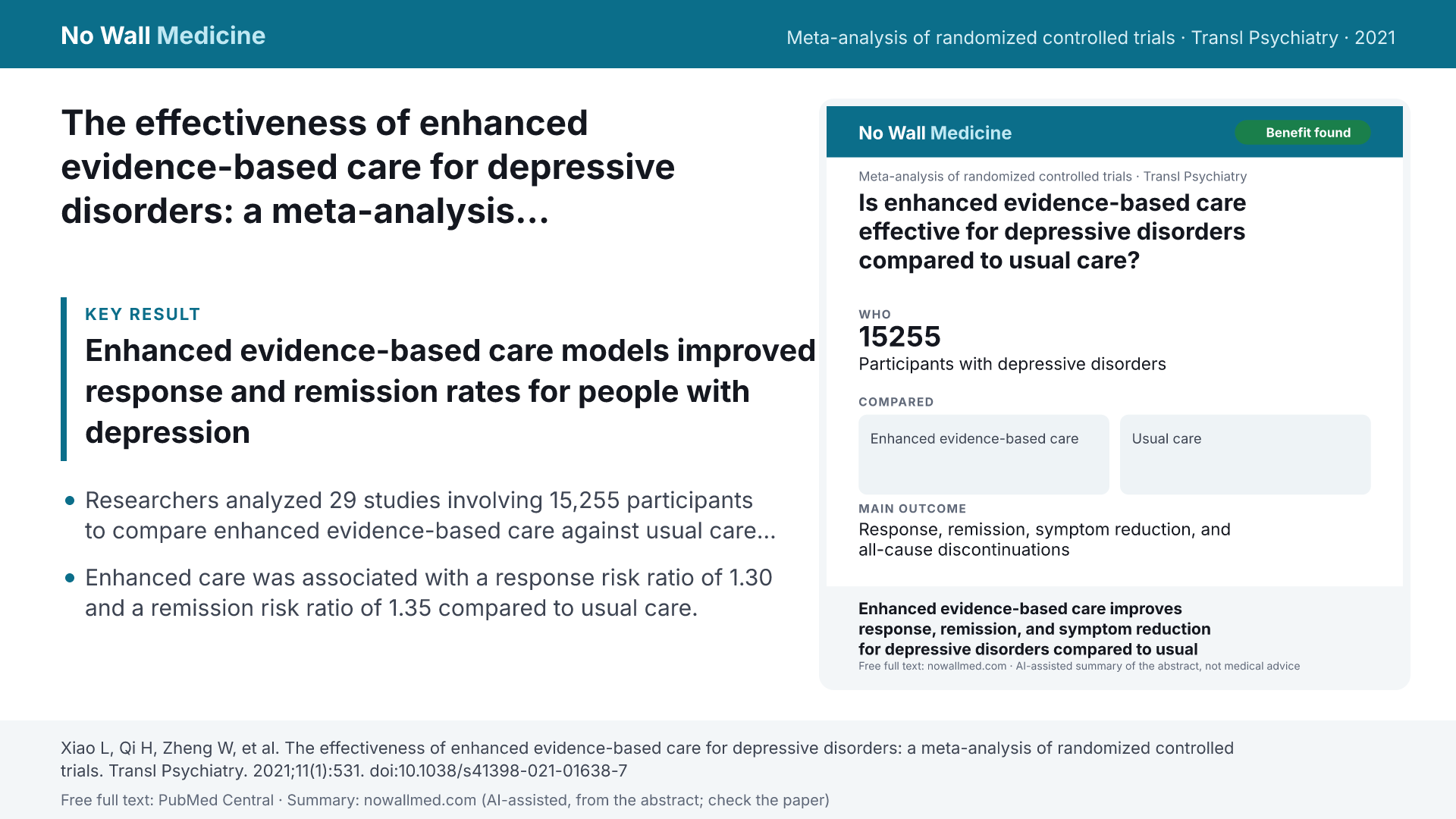
Key result: Enhanced evidence-based care models improved response and remission rates for people with depression
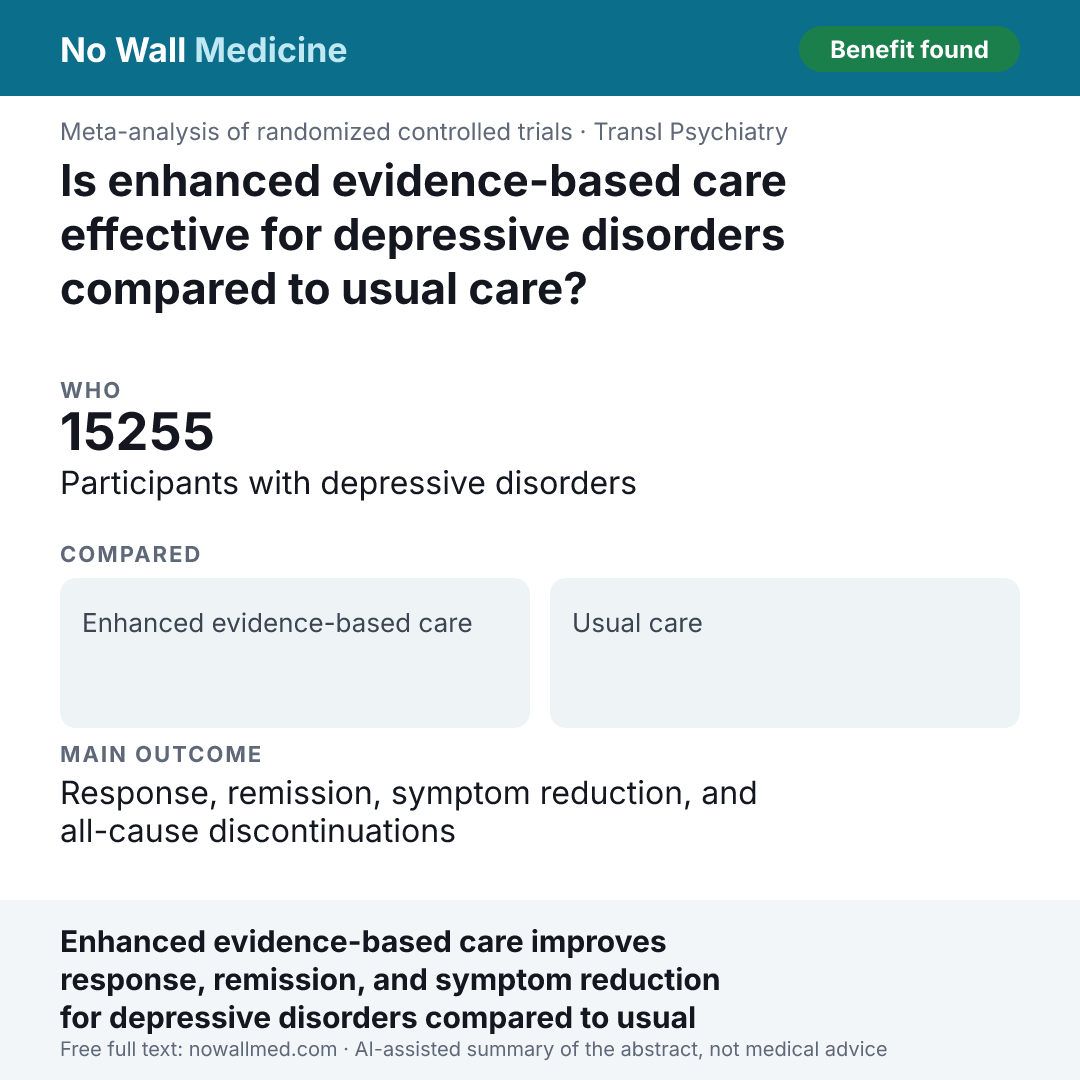
Meta-analysis of randomized controlled trialsBenefit found
Is enhanced evidence-based care effective for depressive disorders compared to usual care?
Who
15255
Participants with depressive disorders
Compared
Enhanced evidence-based care
Usual care
Main outcome
Response, remission, symptom reduction, and all-cause discontinuations
Result: pooled RR for response 1.30 (95%CI: 1.13-1.50), remission 1.35 (95%CI: 1.11-1.64), symptom reduction SMD -0.42 (95%CI: -0.61 to -0.23)
Bottom line: Enhanced evidence-based care improves response, remission, and symptom reduction for depressive disorders compared to usual care.
Transl Psychiatry · 2021-10-16 · Save PNG
Key points
- Researchers analyzed 29 studies involving 15,255 participants to compare enhanced evidence-based care against usual care for depressive disorders.
- Enhanced care was associated with a response risk ratio of 1.30 and a remission risk ratio of 1.35 compared to usual care.
- Symptom reduction showed a standardized mean difference of -0.42, while all-cause discontinuations were similar between the two groups with a risk ratio of 1.08.
Discussion prompts
- Would these patients look like yours? Who was left out?
- Is the main outcome one that matters to patients?
- Is the difference large enough to change what you do?
Cite: Xiao L, Qi H, Zheng W, et al. The effectiveness of enhanced evidence-based care for depressive disorders: a meta-analysis of randomized controlled trials. Transl Psychiatry. 2021;11(1):531. doi:10.1038/s41398-021-01638-7
Free full text: PubMed Central · Summary and visual abstract: nowallmed.com/a/the-effectiveness-of-enhanced-evidence-based-care-for-depressive-108i1f6/ (AI-assisted from the abstract; check the paper before relying on it).