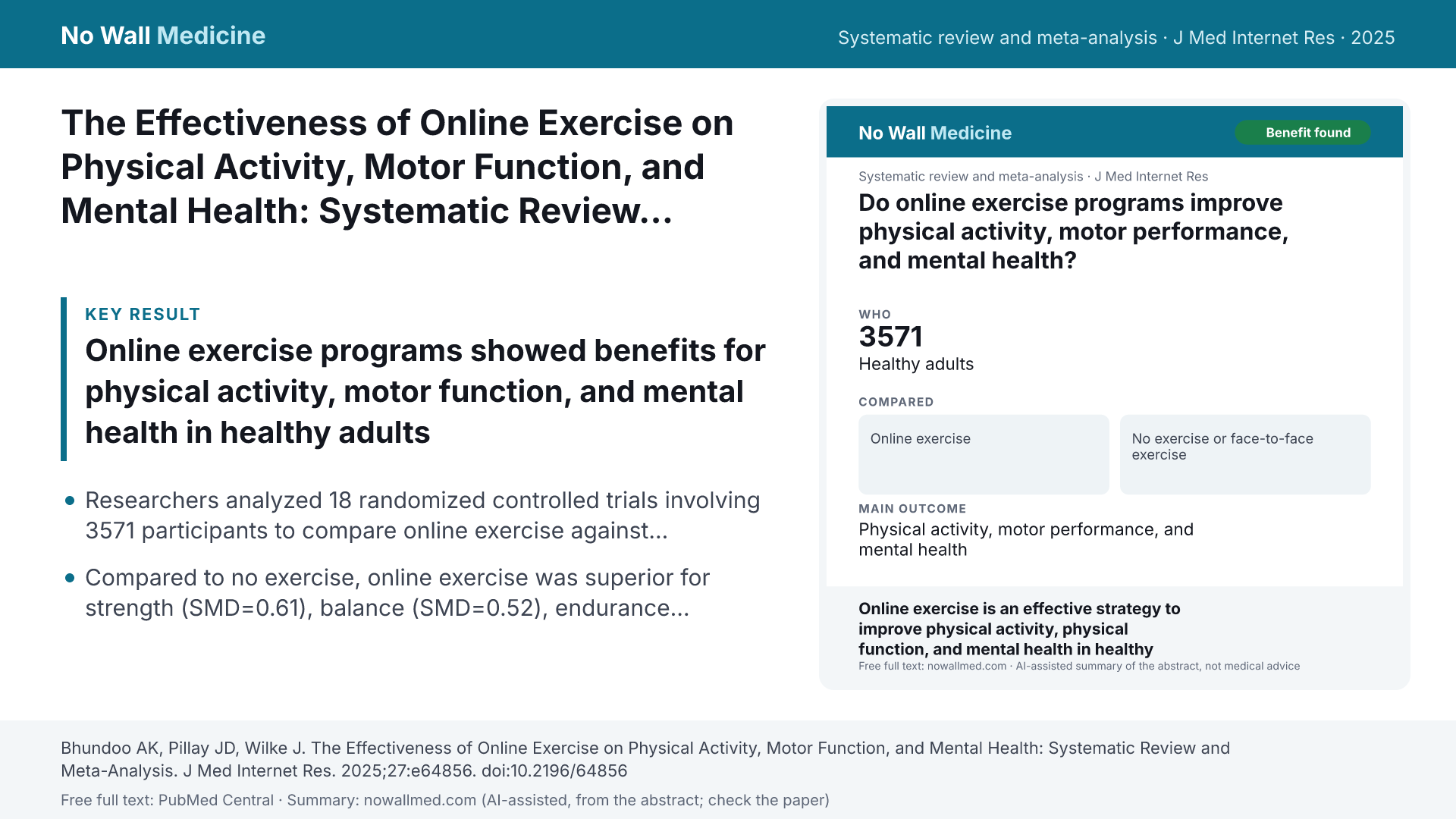
Online exercise programs showed benefits for physical activity, motor function, and mental health in healthy adults
The Effectiveness of Online Exercise on Physical Activity, Motor Function, and Mental Health: Systematic Review and Meta-Analysis
Systematic review and meta-analysisBenefit found
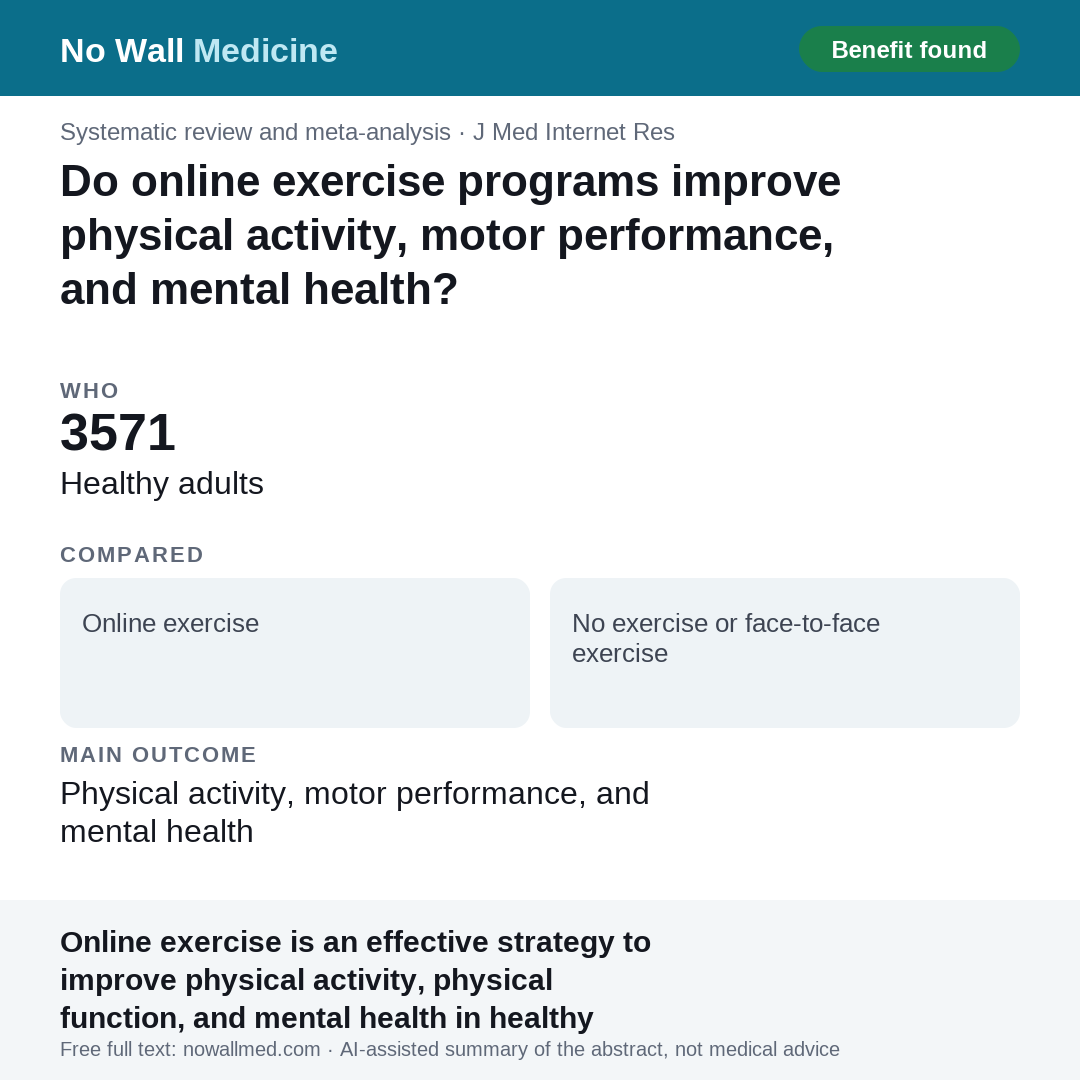
Do online exercise programs improve physical activity, motor performance, and mental health?
Who
3571
Healthy adults
Compared
Online exercise
No exercise or face-to-face exercise
Main outcome
Physical activity, motor performance, and mental health
Bottom line: Online exercise is an effective strategy to improve physical activity, physical function, and mental health in healthy adults.
Limitation: Small total number of studies and substantial between-trial heterogeneity for some outcomes.
J Med Internet Res · 2025-08-15Download image
Clinical question: Do online exercise programs improve physical activity, motor performance, and mental health?
Why it matters: The increasing use of digital devices and aging populations necessitate understanding how online exercise programs affect physical and mental health compared to traditional methods.
Key points
- Researchers analyzed 18 randomized controlled trials involving 3571 participants to compare online exercise against no exercise or face-to-face exercise.
- Compared to no exercise, online exercise was superior for strength (SMD=0.61), balance (SMD=0.52), endurance (SMD=0.85), physical activity (SMD=0.46), depression (SMD=1.08), mood (SMD=0.47), mental well-being (SMD=0.79), and self-efficacy (SMD=1.1).
- Online exercise was noninferior to face-to-face exercise for most outcomes, though face-to-face exercise showed more improvement in gait speed (SMD=0.25).
Limitation the authors note: The authors noted a small total number of studies and substantial between-trial heterogeneity for some outcomes.
Headline and key points written with AI from the paper’s abstract, with every number checked against it. Read the paper before relying on them.
Was this summary helpful?
Subject terms
Cite this article
Bhundoo AK, Pillay JD, Wilke J. The Effectiveness of Online Exercise on Physical Activity, Motor Function, and Mental Health: Systematic Review and Meta-Analysis. J Med Internet Res. 2025. doi:10.2196/64856
Spotted a mistake? Suggest a correction