The Effectiveness of Online Exercise on Physical Activity, Motor Function, and Mental Health: Systematic Review and Meta-Analysis
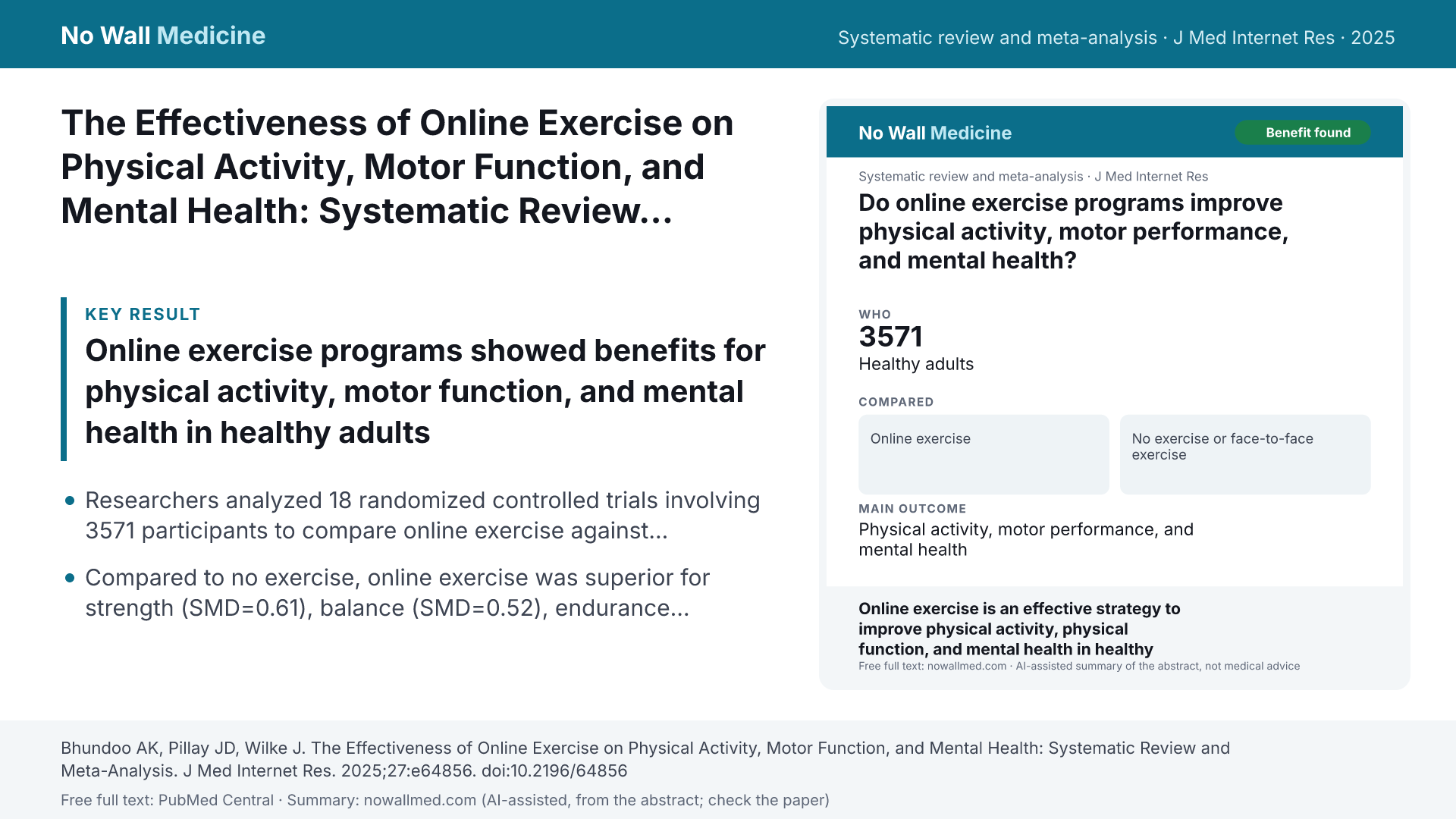
Key result: Online exercise programs showed benefits for physical activity, motor function, and mental health in healthy adults
Key points
- Researchers analyzed 18 randomized controlled trials involving 3571 participants to compare online exercise against no exercise or face-to-face exercise.
- Compared to no exercise, online exercise was superior for strength (SMD=0.61), balance (SMD=0.52), endurance (SMD=0.85), physical activity (SMD=0.46), depression (SMD=1.08), mood (SMD=0.47), mental well-being (SMD=0.79), and self-efficacy (SMD=1.1).
- Online exercise was noninferior to face-to-face exercise for most outcomes, though face-to-face exercise showed more improvement in gait speed (SMD=0.25).
Why it matters: The increasing use of digital devices and aging populations necessitate understanding how online exercise programs affect physical and mental health compared to traditional methods.
Limitation the authors note: The authors noted a small total number of studies and substantial between-trial heterogeneity for some outcomes.
Discussion prompts
- Would these patients look like yours? Who was left out?
- Is the main outcome one that matters to patients?
- Is the difference large enough to change what you do?
Cite: Bhundoo AK, Pillay JD, Wilke J. The Effectiveness of Online Exercise on Physical Activity, Motor Function, and Mental Health: Systematic Review and Meta-Analysis. J Med Internet Res. 2025;27:e64856. doi:10.2196/64856
Free full text: PubMed Central · Summary and visual abstract: nowallmed.com/a/the-effectiveness-of-online-exercise-on-physical-activity-motor-1hoes5y/ (AI-assisted from the abstract; check the paper before relying on it).