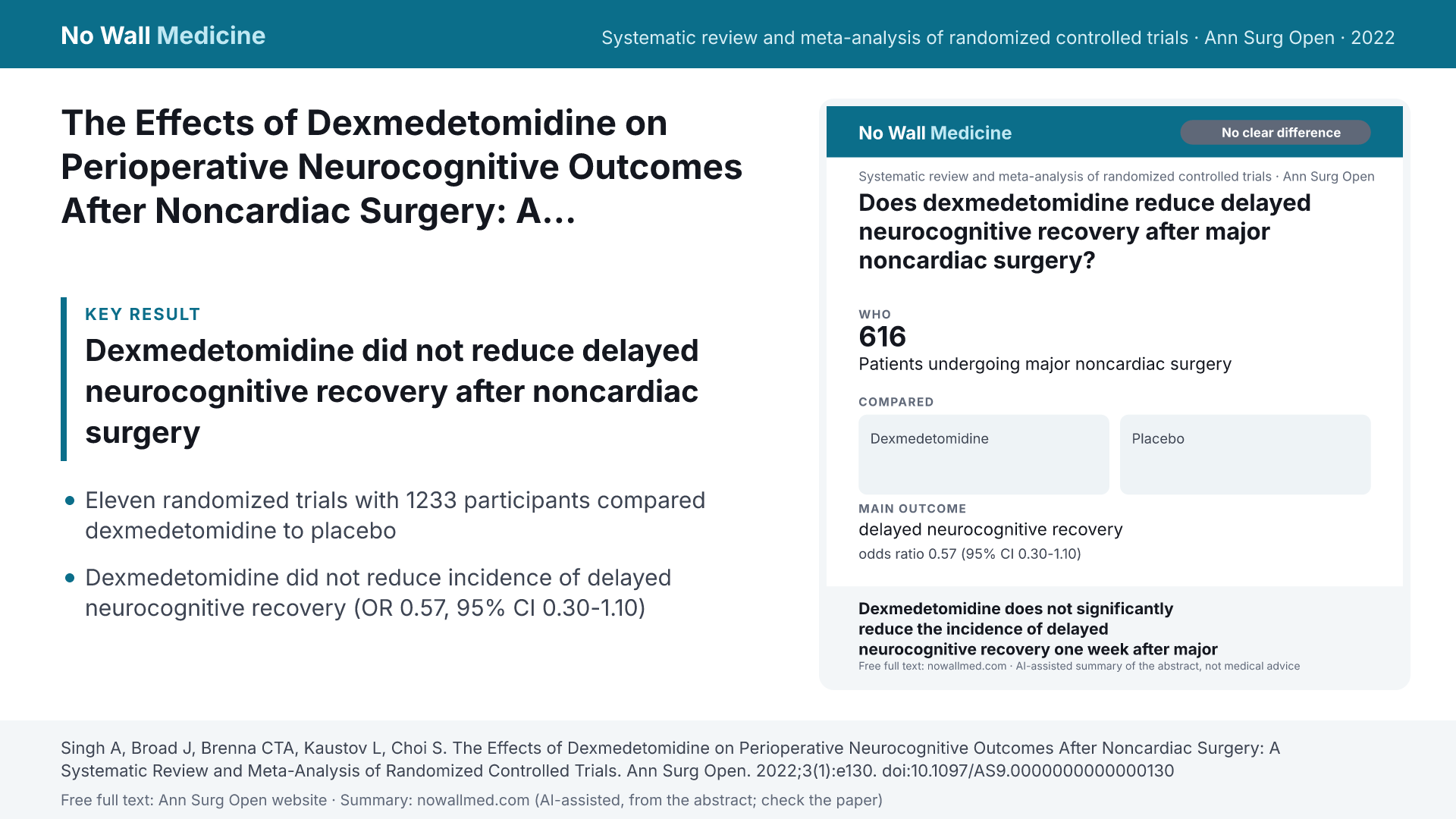
Dexmedetomidine did not reduce delayed neurocognitive recovery after noncardiac surgery
The Effects of Dexmedetomidine on Perioperative Neurocognitive Outcomes After Noncardiac Surgery: A Systematic Review and Meta-Analysis of Randomized Controlled Trials
Systematic review and meta-analysis of randomized controlled trialsNo clear difference
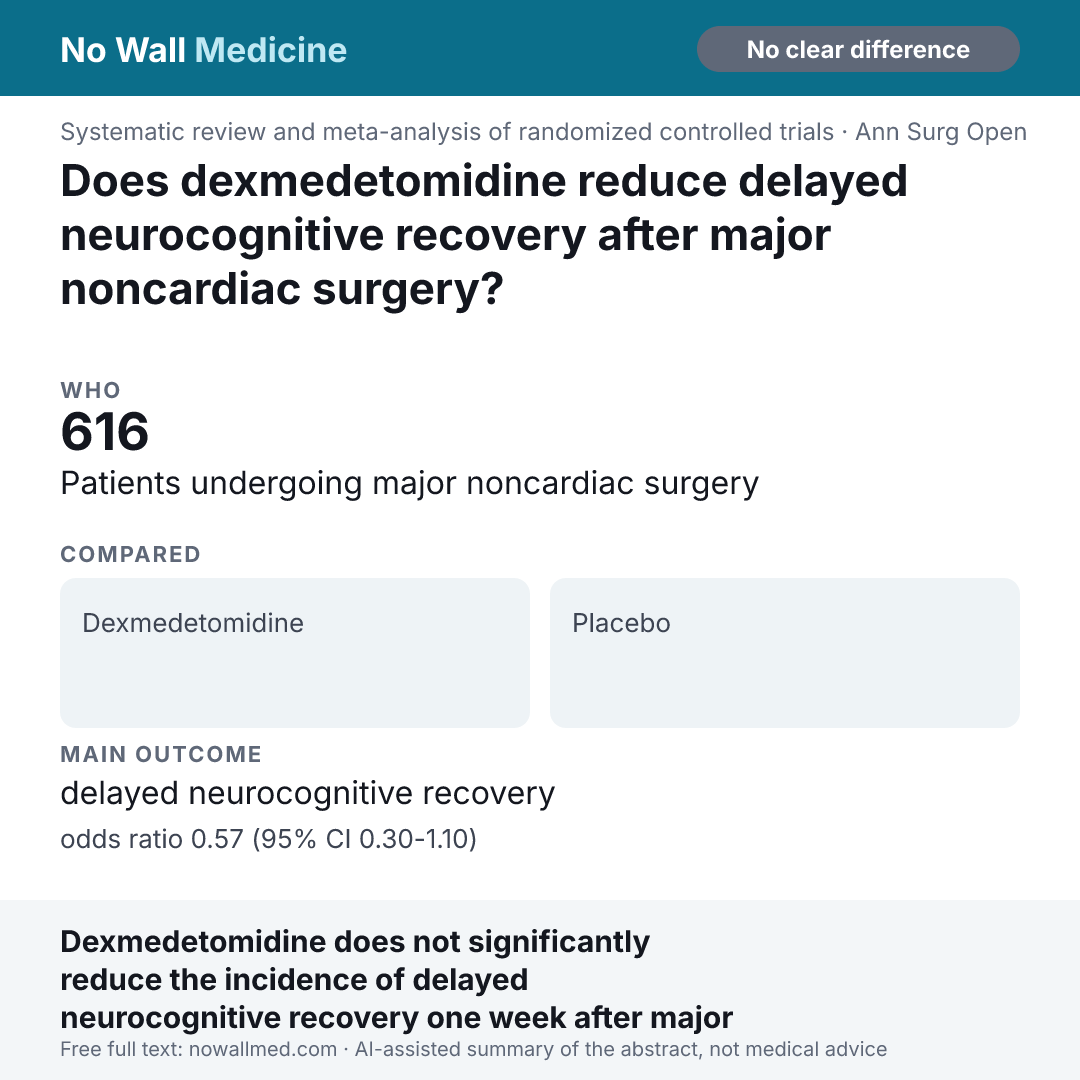
Does dexmedetomidine reduce delayed neurocognitive recovery after major noncardiac surgery?
Who
616
Patients undergoing major noncardiac surgery
Compared
Dexmedetomidine
Placebo
Main outcome
delayed neurocognitive recovery
Result: odds ratio 0.57 (95% CI 0.30-1.10)
Bottom line: Dexmedetomidine does not significantly reduce the incidence of delayed neurocognitive recovery one week after major noncardiac surgery.
Limitation: Larger trials are needed to refine the point estimate and examine long-term cognitive outcomes.
Ann Surg Open · 2022-02-01 · Save PNG
Clinical question: Does dexmedetomidine reduce delayed neurocognitive recovery after major noncardiac surgery?
Why it matters: Effect of dexmedetomidine on postoperative cognition was unclear due to limited studies
Key points
- Eleven randomized trials with 1233 participants compared dexmedetomidine to placebo.
- Dexmedetomidine did not reduce incidence of delayed neurocognitive recovery (OR 0.57, 95% CI 0.30-1.10).
- Dexmedetomidine was linked to a higher incidence of hemodynamic instability (OR 2.11, 95% CI 1.22-3.65).
Limitation the authors note: Larger trials are needed to refine the point estimate of effect and examine long-term cognitive outcomes
Headline and key points written with AI from the paper’s abstract, with every number checked against it. Read the paper before relying on them.
Was this summary helpful?
Abstract
Objective
The purpose of this review is to examine the effect of dexmedetomidine on delayed neurocognitive recovery (dNCR; cognitive dysfunction ≥1 week postoperative) after major noncardiac surgery.Background
Dexmedetomidine (DEX) effectively reduces delirium in the intensive care unit and reportedly attenuates cognitive decline following major noncardiac surgery. Ascertaining the true effect on postoperative cognition is difficult because studies are limited by suboptimal selection of cognitive assessment tools, timing of testing, and criteria for defining significant cognitive decline.Methods
Prospective randomized trials comparing perioperative DEX to placebo for major noncardiac surgery assessing cognitive function ≥1 week postoperative were included. Pediatric, nonhuman, and non-English trials, and those where executive function was not assessed were excluded. Data were abstracted by 3 reviewers independently and in parallel according to PRISMA guidelines. The a priori binary primary outcome is dNCR defined as cognitive function declining by the minimal clinically important difference or accepted alternate measure (eg, Reliable Change Index ≥1.96). Bias was assessed with the Cochrane Collaboration tool. Data were pooled using a random effects model.Results
Among 287 citations identified, 26 (9%) met criteria for full-text retrieval. Eleven randomized trials (1233 participants) were included for qualitative analysis, and 7 trials (616 participants) were included for meta-analysis of dNCR. Dexmedetomidine did not reduce the incidence of dNCR significantly (OR 0.57, 95% CI 0.30-1.10, P = 0.09) compared with placebo. There was no difference in the incidence of delirium (OR 0.94, 95% CI 0.55-1.63, P = 0.83) and a higher incidence of hemodynamic instability (OR 2.11, 95% CI 1.22-3.65, P = 0.008).Conclusions
Dexmedetomidine does not reduce dNCR 1 week after major noncardiac surgery. This meta-analysis does not yet support the use of perioperative DEX to improve short term cognitive outcomes at this time; trials underway may yet change this conclusion while larger trials are needed to refine the point estimate of effect and examine long-term cognitive outcomes.
Abstract reproduced under the article’s CC BY-NC-ND licence.
Headline, design, result, key points, caveat and citation as plain text.
Cite this article
Singh A, Broad J, Brenna CTA, Kaustov L, Choi S. The Effects of Dexmedetomidine on Perioperative Neurocognitive Outcomes After Noncardiac Surgery: A Systematic Review and Meta-Analysis of Randomized Controlled Trials. Ann Surg Open. 2022;3(1):e130. doi:10.1097/AS9.0000000000000130
Spotted a mistake? Suggest a correction