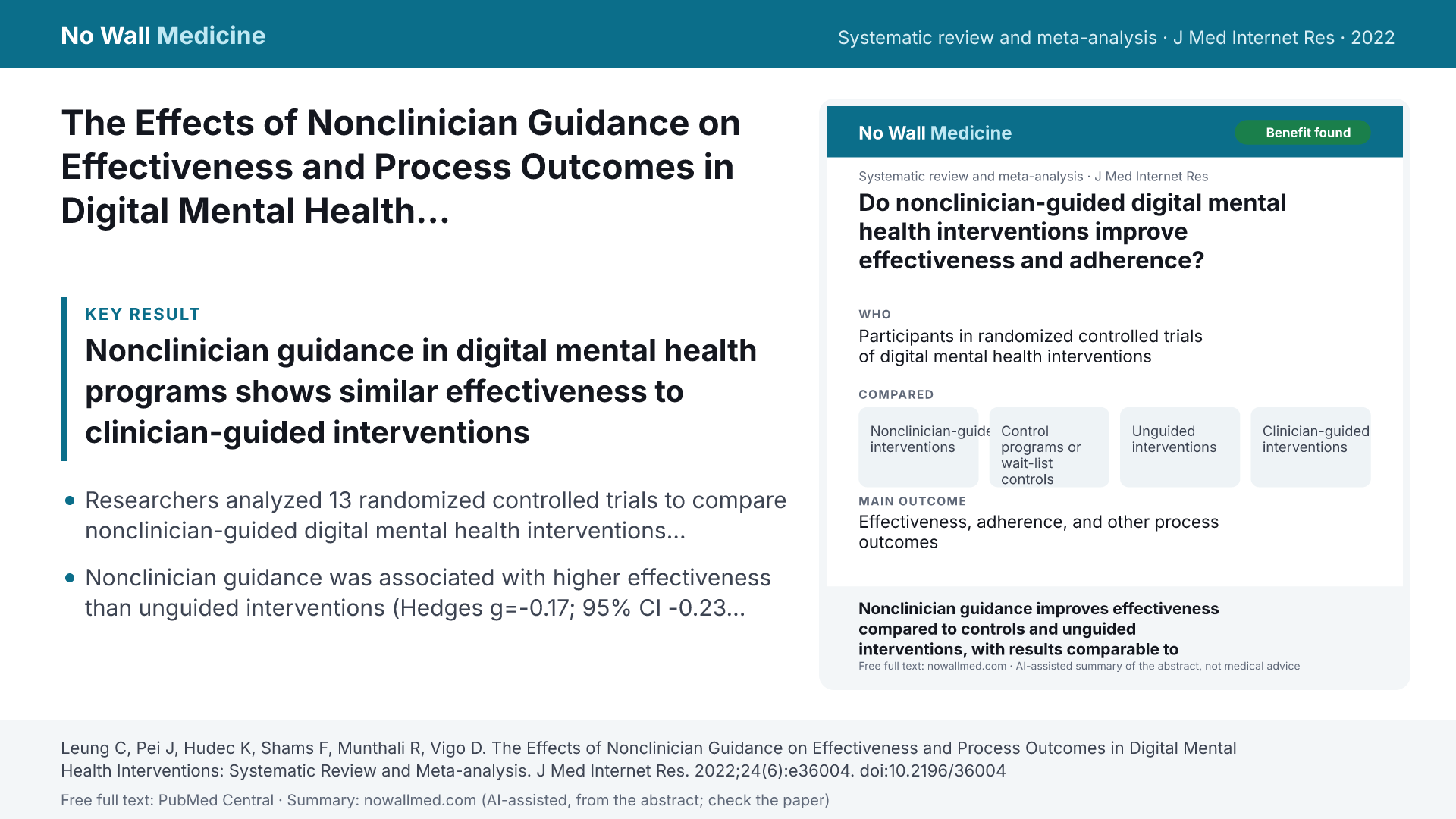
Nonclinician guidance in digital mental health programs shows similar effectiveness to clinician-guided interventions
The Effects of Nonclinician Guidance on Effectiveness and Process Outcomes in Digital Mental Health Interventions: Systematic Review and Meta-analysis
Systematic review and meta-analysisBenefit found
Do nonclinician-guided digital mental health interventions improve effectiveness and adherence?
Who
Participants in randomized controlled trials of digital mental health interventions
Compared
Nonclinician-guided interventions
Control programs or wait-list controls
Unguided interventions
Clinician-guided interventions
Main outcome
Effectiveness, adherence, and other process outcomes
Result: Hedges g=-0.73 (95% CI -1.08 to -0.38) vs controls; Hedges g=-0.17 (95% CI -0.23 to -0.11) vs unguided
Bottom line: Nonclinician guidance improves effectiveness compared to controls and unguided interventions, with results comparable to clinician guidance.
Limitation: Further research should focus on specific tasks paraprofessionals can successfully provide.
J Med Internet Res · 2022-06-15 · Save PNG
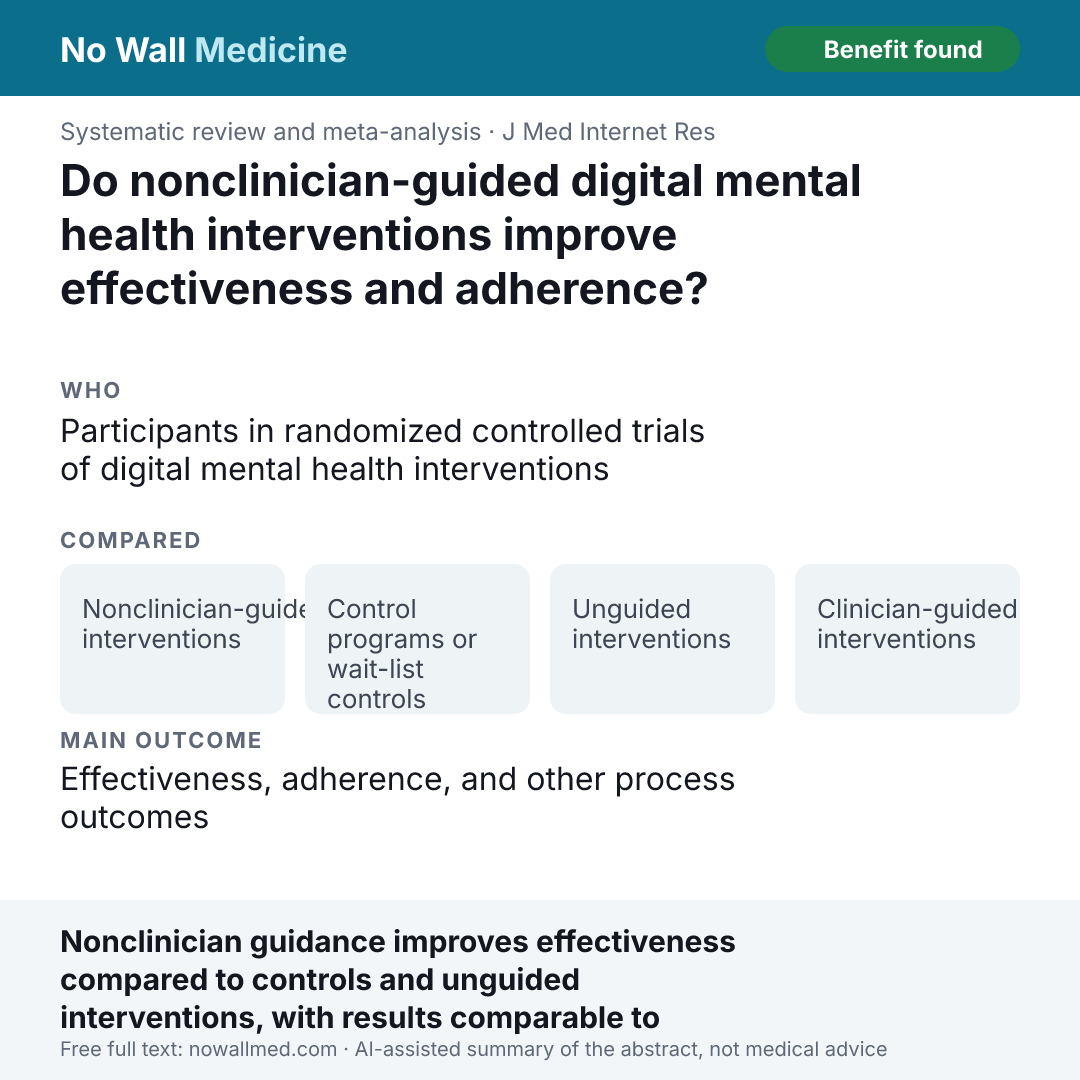
Clinical question: Do nonclinician-guided digital mental health interventions improve effectiveness and adherence?
Key points
- Researchers analyzed 13 randomized controlled trials to compare nonclinician-guided digital mental health interventions against clinician-guided, unguided, or control programs.
- Nonclinician guidance was associated with higher effectiveness than unguided interventions (Hedges g=-0.17; 95% CI -0.23 to -0.11) and control programs (Hedges g=-0.73; 95% CI -1.08 to -0.38).
- Nonclinician-guided interventions did not differ in effectiveness from clinician-guided interventions (Hedges g=0.08; 95% CI -0.01 to 0.17) or in adherence outcomes (odds ratio 1.58; 95% CI 0.51 to 4.92).
Headline and key points written with AI from the paper’s abstract, with every number checked against it. Read the paper before relying on them.
Was this summary helpful?
Subject terms
Headline, design, result, key points, caveat and citation as plain text.
Cite this article
Leung C, Pei J, Hudec K, Shams F, Munthali R, Vigo D. The Effects of Nonclinician Guidance on Effectiveness and Process Outcomes in Digital Mental Health Interventions: Systematic Review and Meta-analysis. J Med Internet Res. 2022;24(6):e36004. doi:10.2196/36004
Spotted a mistake? Suggest a correction