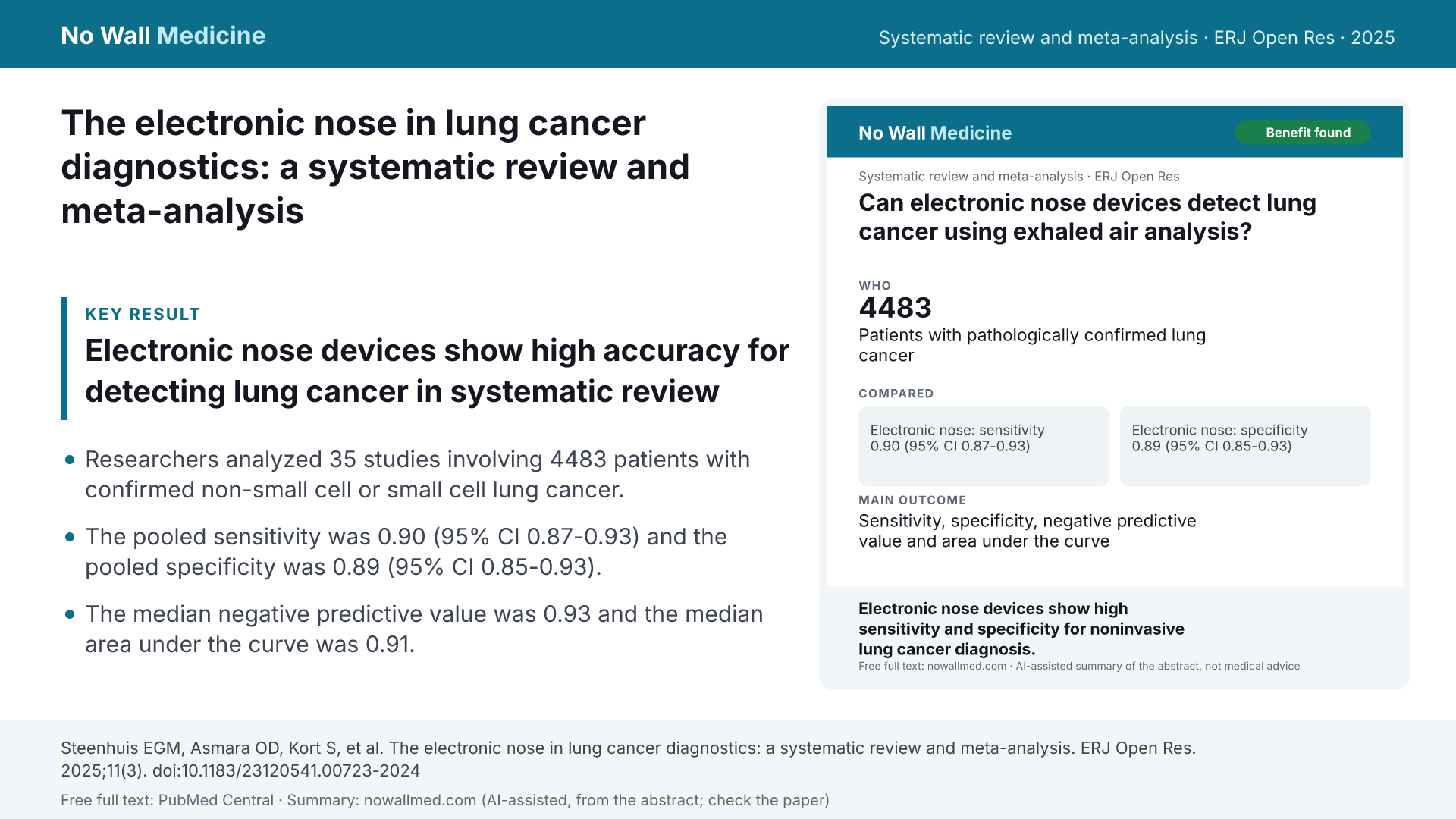
Electronic nose devices show high accuracy for detecting lung cancer in systematic review
The electronic nose in lung cancer diagnostics: a systematic review and meta-analysis
Systematic review and meta-analysisBenefit found
Can electronic nose devices detect lung cancer using exhaled air analysis?
Who
4483
Patients with pathologically confirmed lung cancer
Compared
Electronic nose: sensitivity 0.90 (95% CI 0.87-0.93)
Electronic nose: specificity 0.89 (95% CI 0.85-0.93)
Main outcome
Sensitivity, specificity, negative predictive value and area under the curve
Result: sensitivity 0.90 (95% CI 0.87-0.93), specificity 0.89 (95% CI 0.85-0.93)
Bottom line: Electronic nose devices show high sensitivity and specificity for noninvasive lung cancer diagnosis.
Limitation: Further research and validation efforts are critical to maximise impact.
ERJ Open Res · 2025-05-19Download image

Clinical question: Can electronic nose devices detect lung cancer using exhaled air analysis?
Why it matters: Most lung cancer cases are diagnosed at advanced stages, creating a need for noninvasive point-of-care diagnostic strategies to assist in early detection.
Key points
- Researchers analyzed 35 studies involving 4483 patients with confirmed non-small cell or small cell lung cancer.
- The pooled sensitivity was 0.90 (95% CI 0.87-0.93) and the pooled specificity was 0.89 (95% CI 0.85-0.93).
- The median negative predictive value was 0.93 and the median area under the curve was 0.91.
Headline and key points written with AI from the paper’s abstract, with every number checked against it. Read the paper before relying on them.
Was this summary helpful?
Cite this article
Steenhuis EGM, Asmara OD, Kort S, et al. The electronic nose in lung cancer diagnostics: a systematic review and meta-analysis. ERJ Open Res. 2025. doi:10.1183/23120541.00723-2024
Spotted a mistake? Suggest a correction