The electronic nose in lung cancer diagnostics: a systematic review and meta-analysis
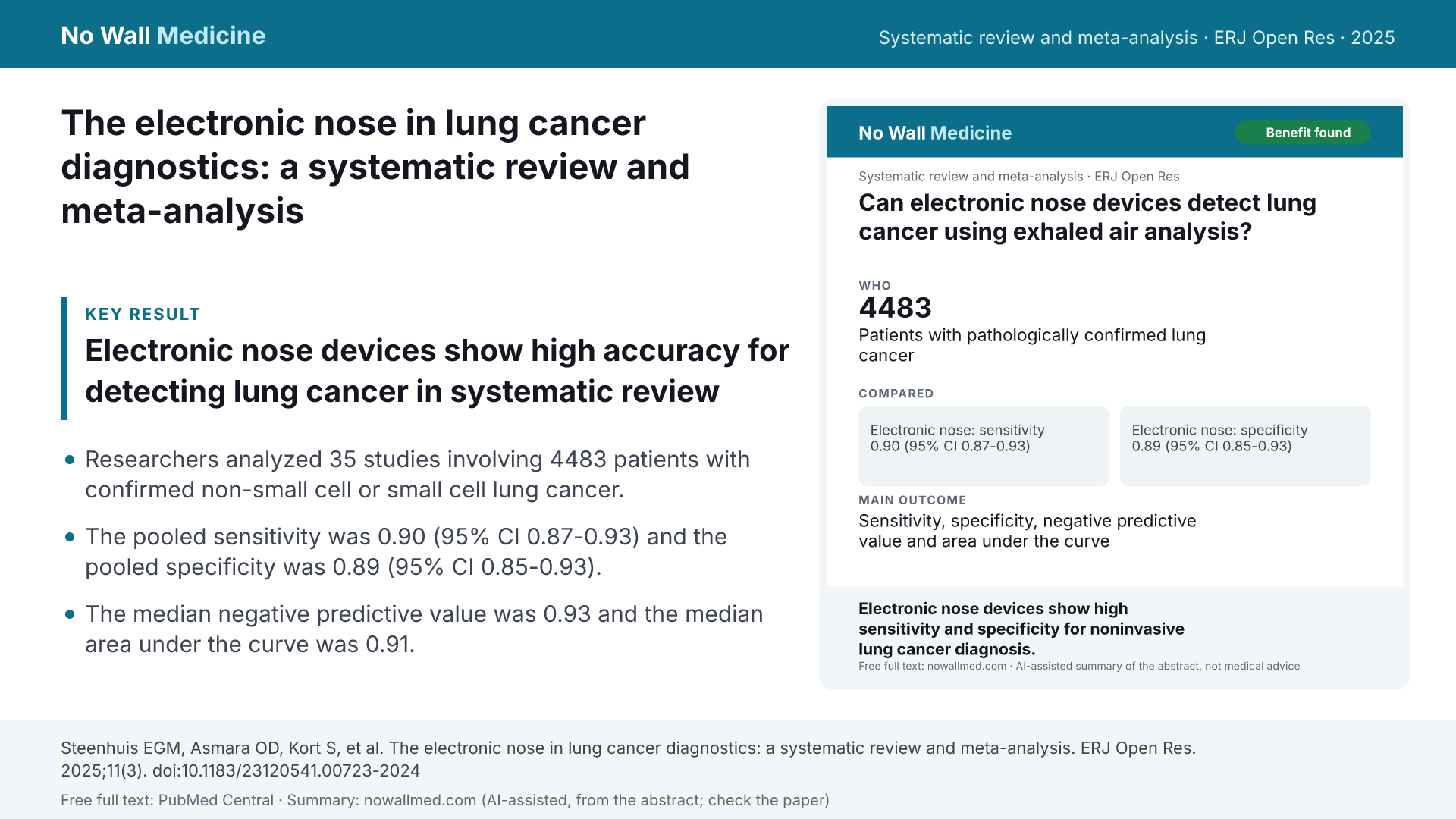
Key result: Electronic nose devices show high accuracy for detecting lung cancer in systematic review
Systematic review and meta-analysisBenefit found
Can electronic nose devices detect lung cancer using exhaled air analysis?
Who
4483
Patients with pathologically confirmed lung cancer
Compared
Electronic nose: sensitivity 0.90 (95% CI 0.87-0.93)
Electronic nose: specificity 0.89 (95% CI 0.85-0.93)
Main outcome
Sensitivity, specificity, negative predictive value and area under the curve
Result: sensitivity 0.90 (95% CI 0.87-0.93), specificity 0.89 (95% CI 0.85-0.93)
Bottom line: Electronic nose devices show high sensitivity and specificity for noninvasive lung cancer diagnosis.
Limitation: Further research and validation efforts are critical to maximise impact.
ERJ Open Res · 2025-05-19
Key points
- Researchers analyzed 35 studies involving 4483 patients with confirmed non-small cell or small cell lung cancer.
- The pooled sensitivity was 0.90 (95% CI 0.87-0.93) and the pooled specificity was 0.89 (95% CI 0.85-0.93).
- The median negative predictive value was 0.93 and the median area under the curve was 0.91.
Why it matters: Most lung cancer cases are diagnosed at advanced stages, creating a need for noninvasive point-of-care diagnostic strategies to assist in early detection.
Discussion prompts
- Would these patients look like yours? Who was left out?
- Is the main outcome one that matters to patients?
- Is the difference large enough to change what you do?
Cite: Steenhuis EGM, Asmara OD, Kort S, et al. The electronic nose in lung cancer diagnostics: a systematic review and meta-analysis. ERJ Open Res. 2025;11(3). doi:10.1183/23120541.00723-2024
Free full text: PubMed Central · Summary and visual abstract: nowallmed.com/a/the-electronic-nose-in-lung-cancer-diagnostics-a-systematic-review-3br0x1/ (AI-assisted from the abstract; check the paper before relying on it).