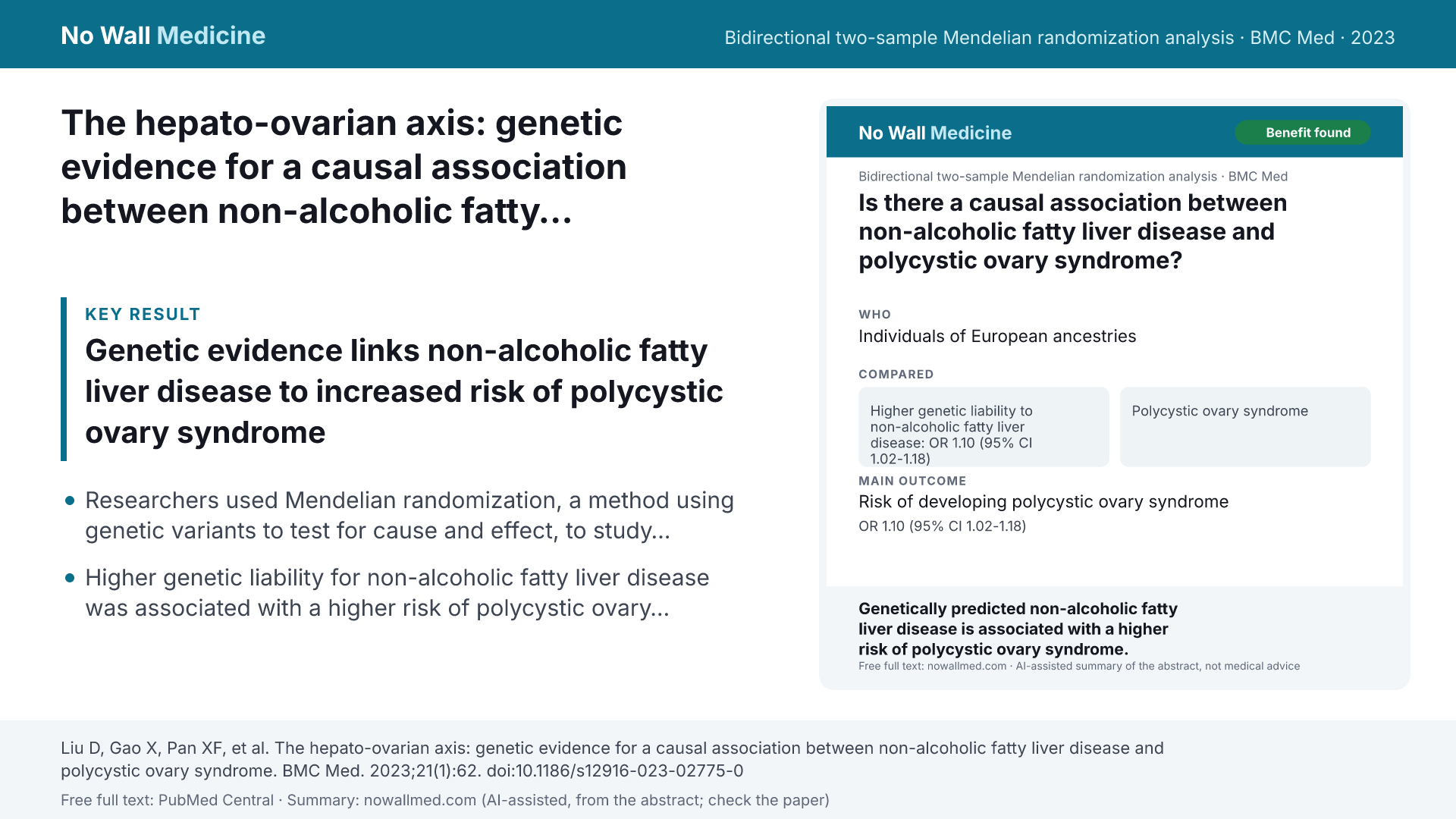
Genetic evidence links non-alcoholic fatty liver disease to increased risk of polycystic ovary syndrome
The hepato-ovarian axis: genetic evidence for a causal association between non-alcoholic fatty liver disease and polycystic ovary syndrome
Bidirectional two-sample Mendelian randomization analysisBenefit found
Is there a causal association between non-alcoholic fatty liver disease and polycystic ovary syndrome?
Who
Individuals of European ancestries
Compared
Higher genetic liability to non-alcoholic fatty liver disease: OR 1.10 (95% CI 1.02-1.18)
Polycystic ovary syndrome
Main outcome
Risk of developing polycystic ovary syndrome
Result: OR 1.10 (95% CI 1.02-1.18)
Bottom line: Genetically predicted non-alcoholic fatty liver disease is associated with a higher risk of polycystic ovary syndrome.
Limitation: Conditional F statistics were less than 10, suggesting likely weak instrument bias.
BMC Med · 2023-02-20 · Save PNG
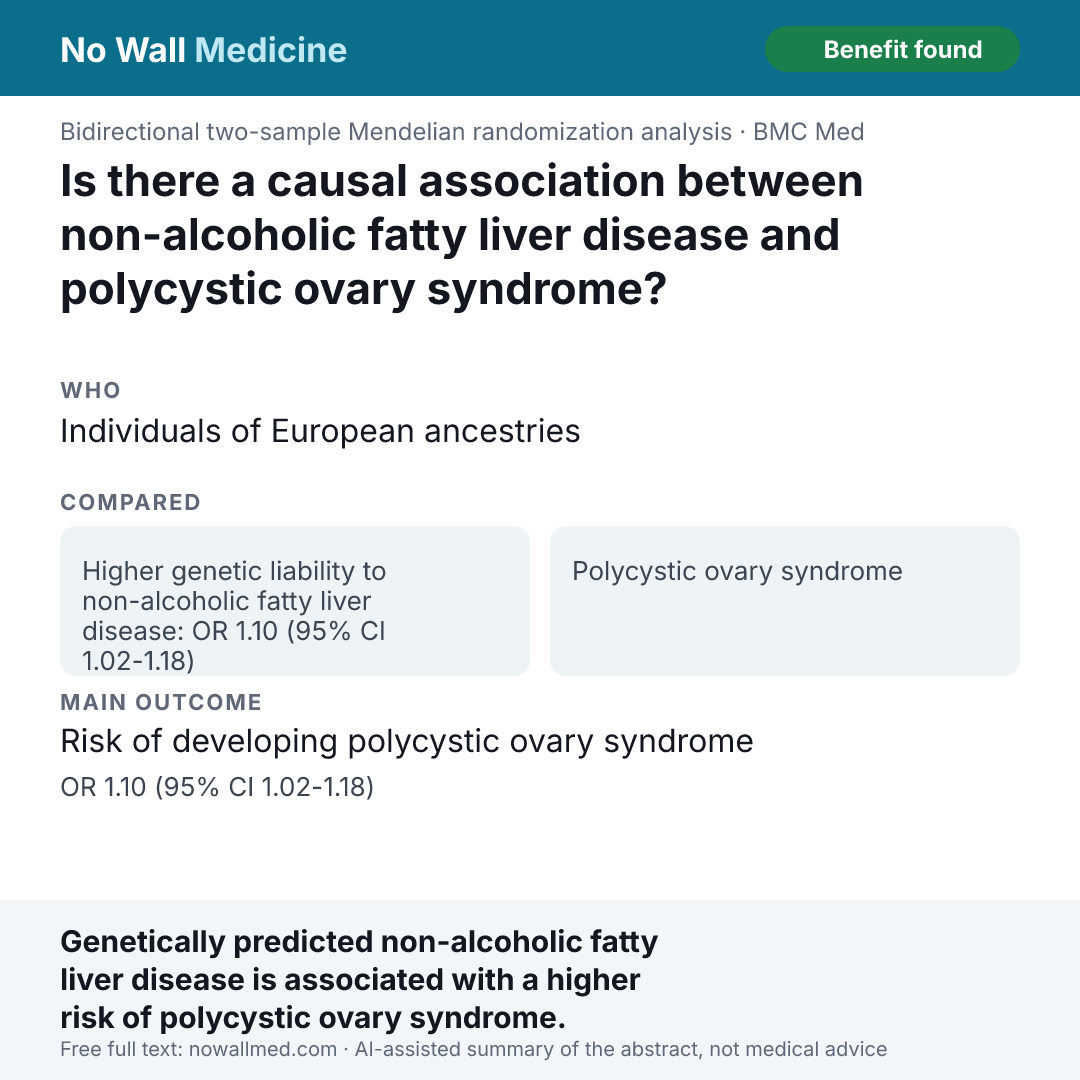
Clinical question: Is there a causal association between non-alcoholic fatty liver disease and polycystic ovary syndrome?
Why it matters: The causal nature of the association between non-alcoholic fatty liver disease and polycystic ovary syndrome is still uncertain.
Key points
- Researchers used Mendelian randomization, a method using genetic variants to test for cause and effect, to study the relationship between non-alcoholic fatty liver disease and polycystic ovary syndrome.
- Higher genetic liability for non-alcoholic fatty liver disease was associated with a higher risk of polycystic ovary syndrome (OR: 1.10, 95% CI: 1.02-1.18; P = 0.013).
- The link between these conditions was associated with fasting insulin levels and sex hormones.
Limitation the authors note: The conditional F statistics for non-alcoholic fatty liver disease and fasting insulin were less than 10, suggesting likely weak instrument bias.
Headline and key points written with AI from the paper’s abstract, with every number checked against it. Read the paper before relying on them.
Was this summary helpful?
Subject terms
Headline, design, result, key points, caveat and citation as plain text.
Cite this article
Liu D, Gao X, Pan XF, et al. The hepato-ovarian axis: genetic evidence for a causal association between non-alcoholic fatty liver disease and polycystic ovary syndrome. BMC Med. 2023;21(1):62. doi:10.1186/s12916-023-02775-0
Spotted a mistake? Suggest a correction