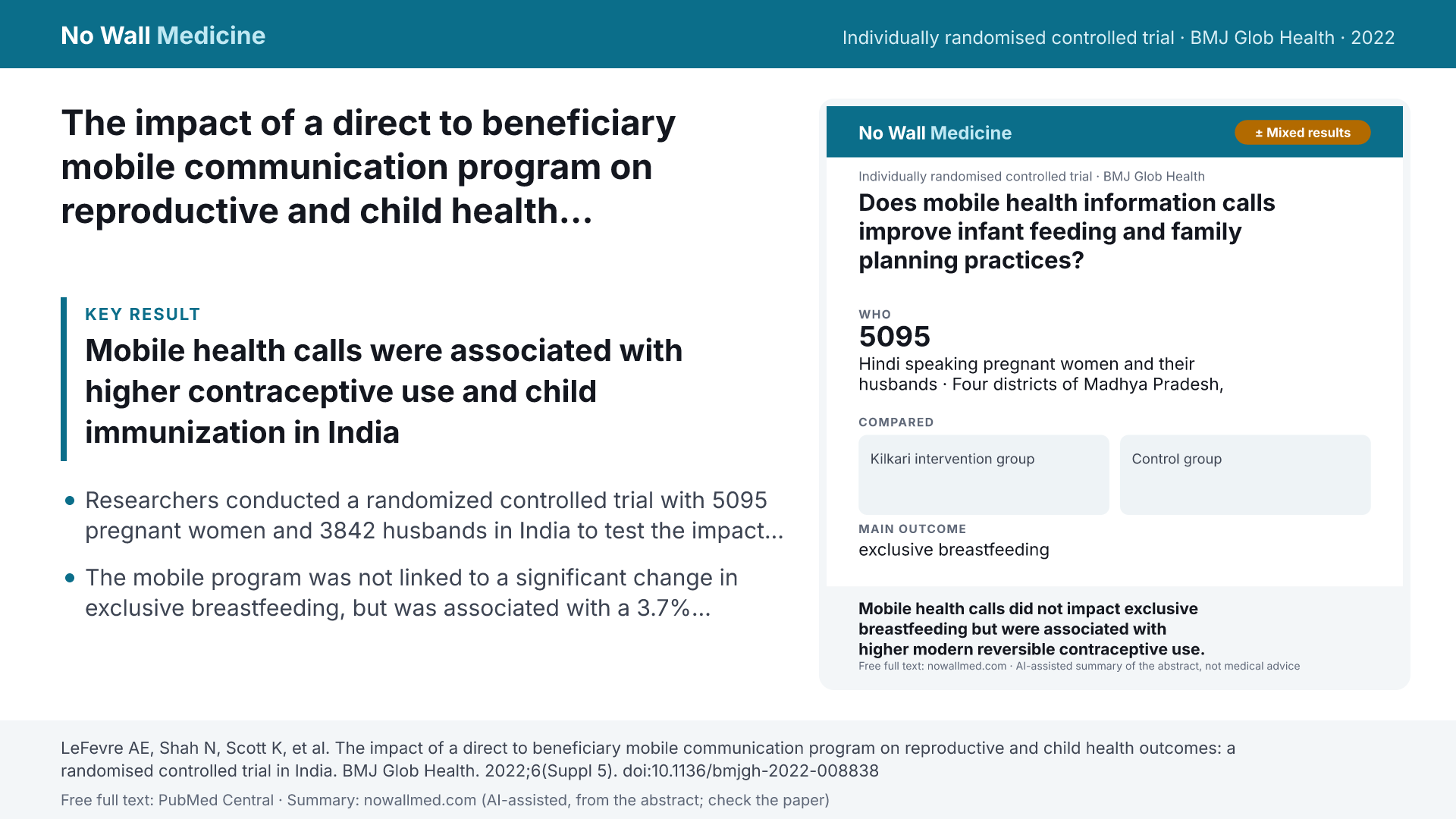
The impact of a direct to beneficiary mobile communication program on reproductive and child health outcomes: a randomised controlled trial in India
Key result: Mobile health calls were associated with higher contraceptive use and child immunization in India
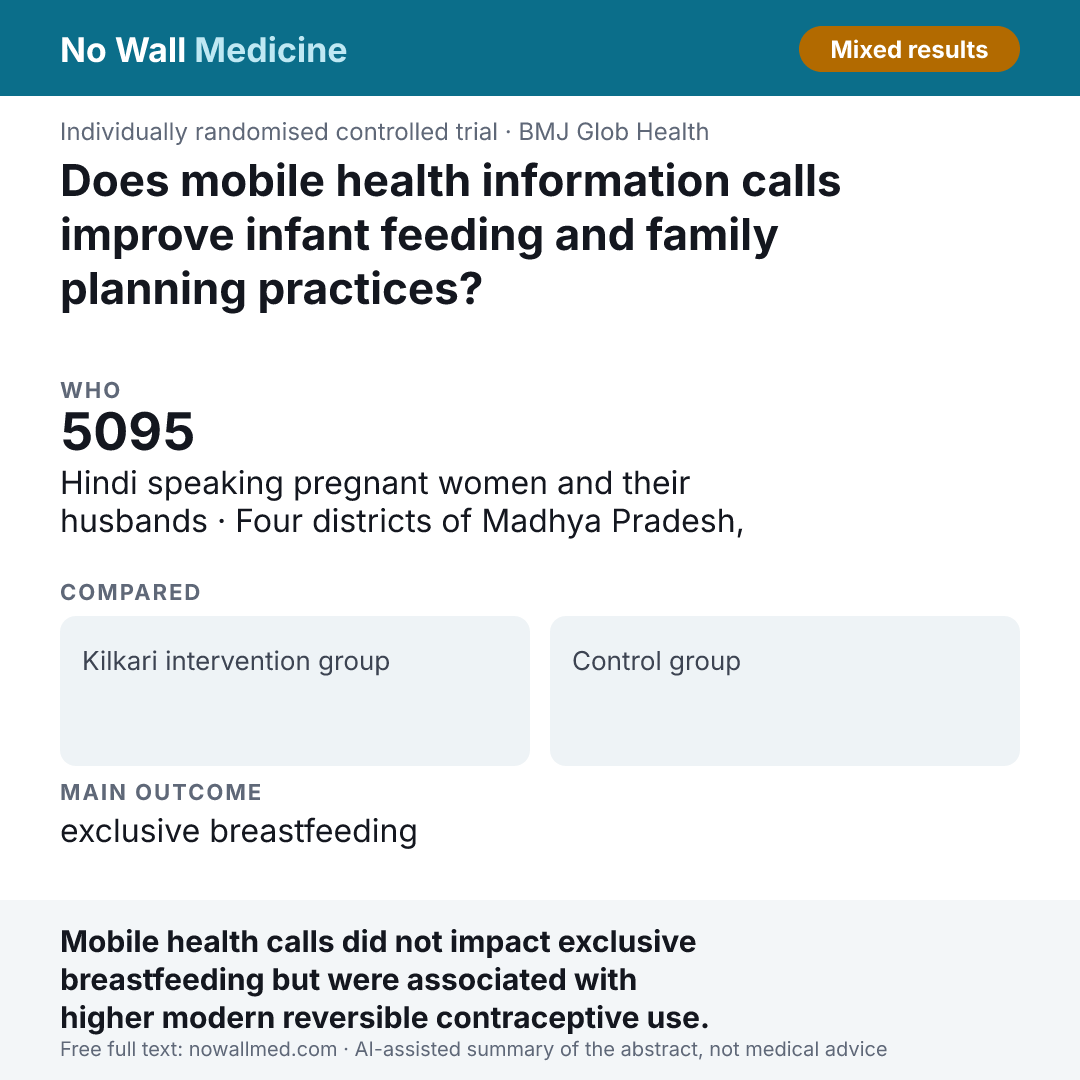
Individually randomised controlled trialMixed results
Does mobile health information calls improve infant feeding and family planning practices?
Who
5095
Hindi speaking pregnant women and their husbands · Four districts of Madhya Pradesh, India
Compared
Kilkari intervention group
Control group
Main outcome
exclusive breastfeeding
Result: relative risk 1.04 (95% CI 0.88 to 1.23)
Bottom line: Mobile health calls did not impact exclusive breastfeeding but were associated with higher modern reversible contraceptive use.
BMJ Glob Health · 2022-07-14 · Save PNG
Key points
- Researchers conducted a randomized controlled trial with 5095 pregnant women and 3842 husbands in India to test the impact of mobile health information calls.
- The mobile program was not linked to a significant change in exclusive breastfeeding, but was associated with a 3.7% higher use of modern reversible contraceptives.
- Children of women who listened to the calls had 2.8% higher immunization rates at 10 weeks of age.
Discussion prompts
- Would these patients look like yours? Who was left out?
- Is the main outcome one that matters to patients?
- Is the difference large enough to change what you do?
Cite: LeFevre AE, Shah N, Scott K, et al. The impact of a direct to beneficiary mobile communication program on reproductive and child health outcomes: a randomised controlled trial in India. BMJ Glob Health. 2022;6(Suppl 5). doi:10.1136/bmjgh-2022-008838
Free full text: PubMed Central · Summary and visual abstract: nowallmed.com/a/the-impact-of-a-direct-to-beneficiary-mobile-communication-program-on-1a96wtn/ (AI-assisted from the abstract; check the paper before relying on it).