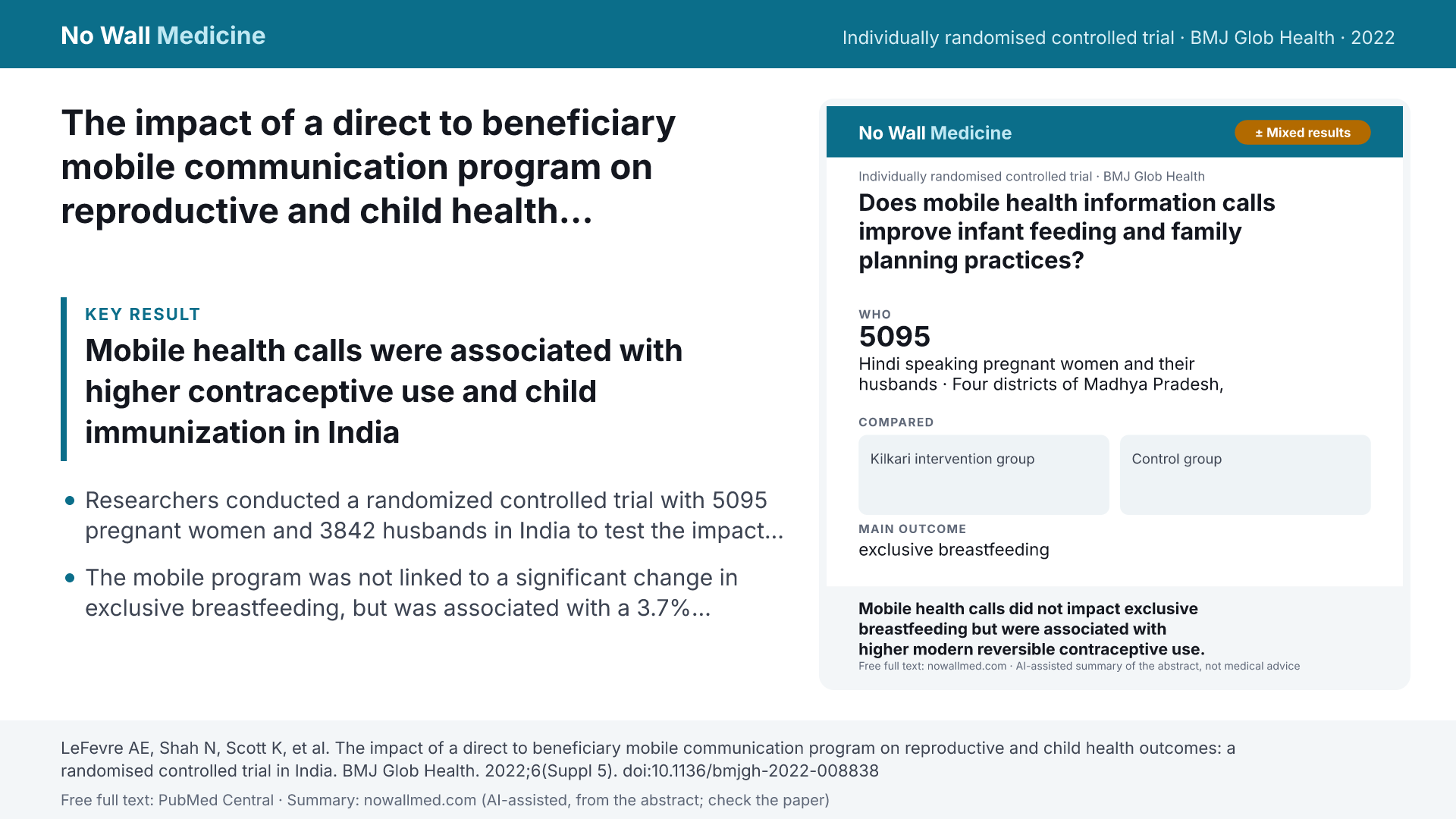
Mobile health calls were associated with higher contraceptive use and child immunization in India
The impact of a direct to beneficiary mobile communication program on reproductive and child health outcomes: a randomised controlled trial in India
Individually randomised controlled trialMixed results
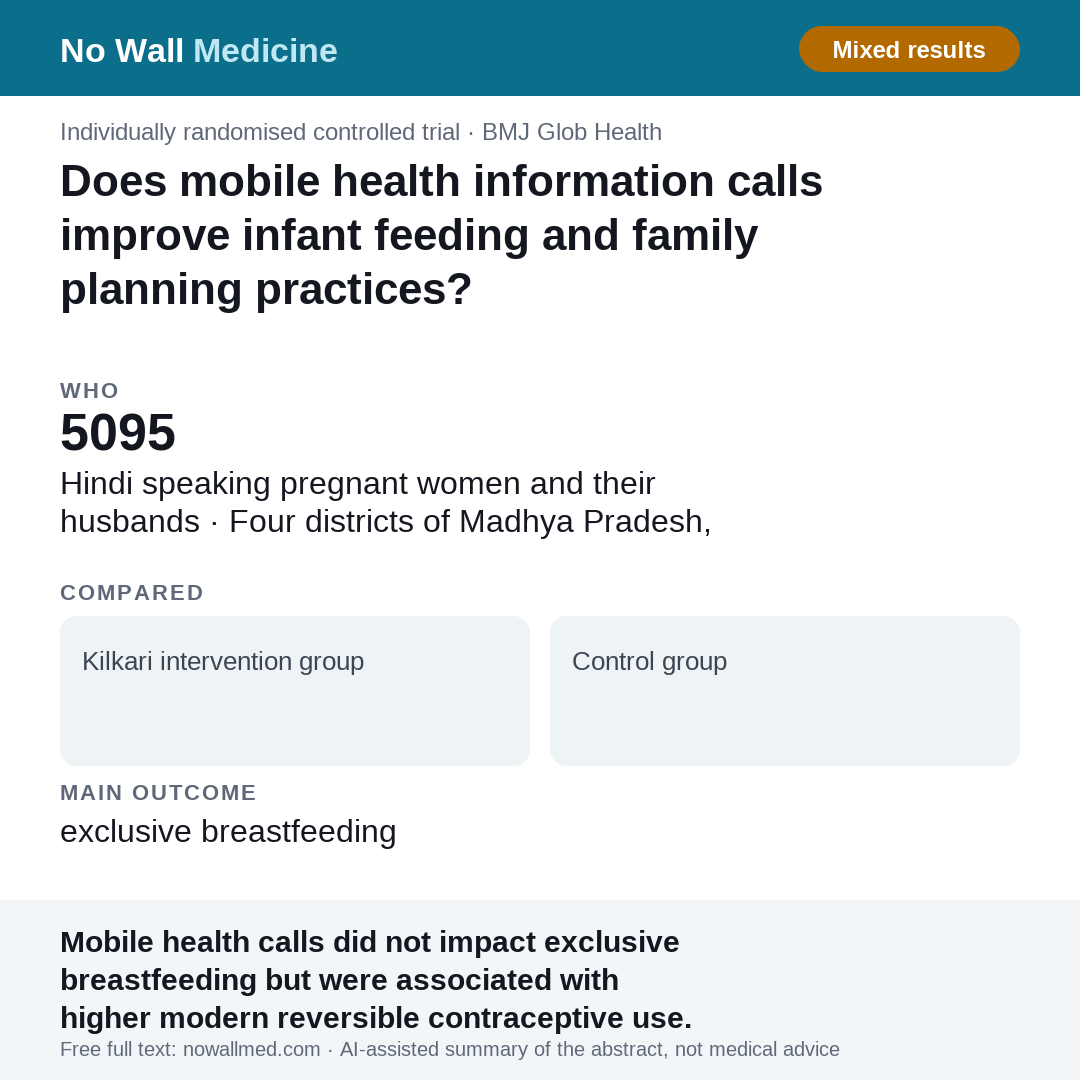
Does mobile health information calls improve infant feeding and family planning practices?
Who
5095
Hindi speaking pregnant women and their husbands · Four districts of Madhya Pradesh, India
Compared
Kilkari intervention group
Control group
Main outcome
exclusive breastfeeding
Result: relative risk 1.04 (95% CI 0.88 to 1.23)
Bottom line: Mobile health calls did not impact exclusive breastfeeding but were associated with higher modern reversible contraceptive use.
BMJ Glob Health · 2022-07-14Download image
Clinical question: Does mobile health information calls improve infant feeding and family planning practices?
Why it matters: Evidence is limited regarding whether large-scale mobile health information programs improve infant feeding and family planning practices in low-resource settings.
Key points
- Researchers conducted a randomized controlled trial with 5095 pregnant women and 3842 husbands in India to test the impact of mobile health information calls.
- The mobile program was not linked to a significant change in exclusive breastfeeding, but was associated with a 3.7% higher use of modern reversible contraceptives.
- Children of women who listened to the calls had 2.8% higher immunization rates at 10 weeks of age.
Headline and key points written with AI from the paper’s abstract, with every number checked against it. Read the paper before relying on them.
Was this summary helpful?
Abstract
Background
Direct-to-beneficiary communication mobile programmes are among the few examples of digital health programmes to have scaled widely in low-resource settings. Yet, evidence on their impact at scale is limited. This study aims to assess whether exposure to mobile health information calls during pregnancy and postpartum improved infant feeding and family planning practices. Methods
We conducted an individually randomised controlled trial in four districts of Madhya Pradesh, India. Study participants included Hindi speaking women 4-7 months pregnant (n=5095) with access to a mobile phone and their husbands (n=3842). Women were randomised to either an intervention group where they received up to 72 Kilkari messages or a control group where they received none. Intention-to-treat (ITT) and instrumental variable (IV) analyses are presented. Results
An average of 65% of the 2695 women randomised to receive Kilkari listened to ≥50% of the cumulative content of calls answered. Kilkari was not observed to have a significant impact on the primary outcome of exclusive breast feeding (ITT, relative risk (RR): 1.04, 95% CI 0.88 to 1.23, p=0.64; IV, RR: 1.10, 95% CI 0.67 to 1.81, p=0.71). Across study arms, Kilkari was associated with a 3.7% higher use of modern reversible contraceptives (RR: 1.12, 95% CI 1.03 to 1.21, p=0.007), and a 2.0% lower proportion of men or women sterilised since the birth of the child (RR: 0.85, 95% CI 0.74 to 0.97, p=0.016). Higher reversible method use was driven by increases in condom use and greatest among those women exposed to Kilkari with any male child (9.9% increase), in the poorest socioeconomic strata (15.8% increase), and in disadvantaged castes (12.0% increase). Immunisation at 10 weeks was higher among the children of Kilkari listeners (2.8% higher; RR: 1.03, 95% CI 1.00 to 1.06, p=0.048). Significant differences were not observed for other maternal, newborn and child health outcomes assessed. Conclusion
Study findings provide evidence to date on the effectiveness of the largest mobile health messaging programme in the world. Trial registration number
Trial registration clinicaltrials.gov; ID 90075552, NCT03576157.
Abstract reproduced under the article’s CC BY licence.
Subject terms
Cite this article
LeFevre AE, Shah N, Scott K, et al. The impact of a direct to beneficiary mobile communication program on reproductive and child health outcomes: a randomised controlled trial in India. BMJ Glob Health. 2022. doi:10.1136/bmjgh-2022-008838
Spotted a mistake? Suggest a correction