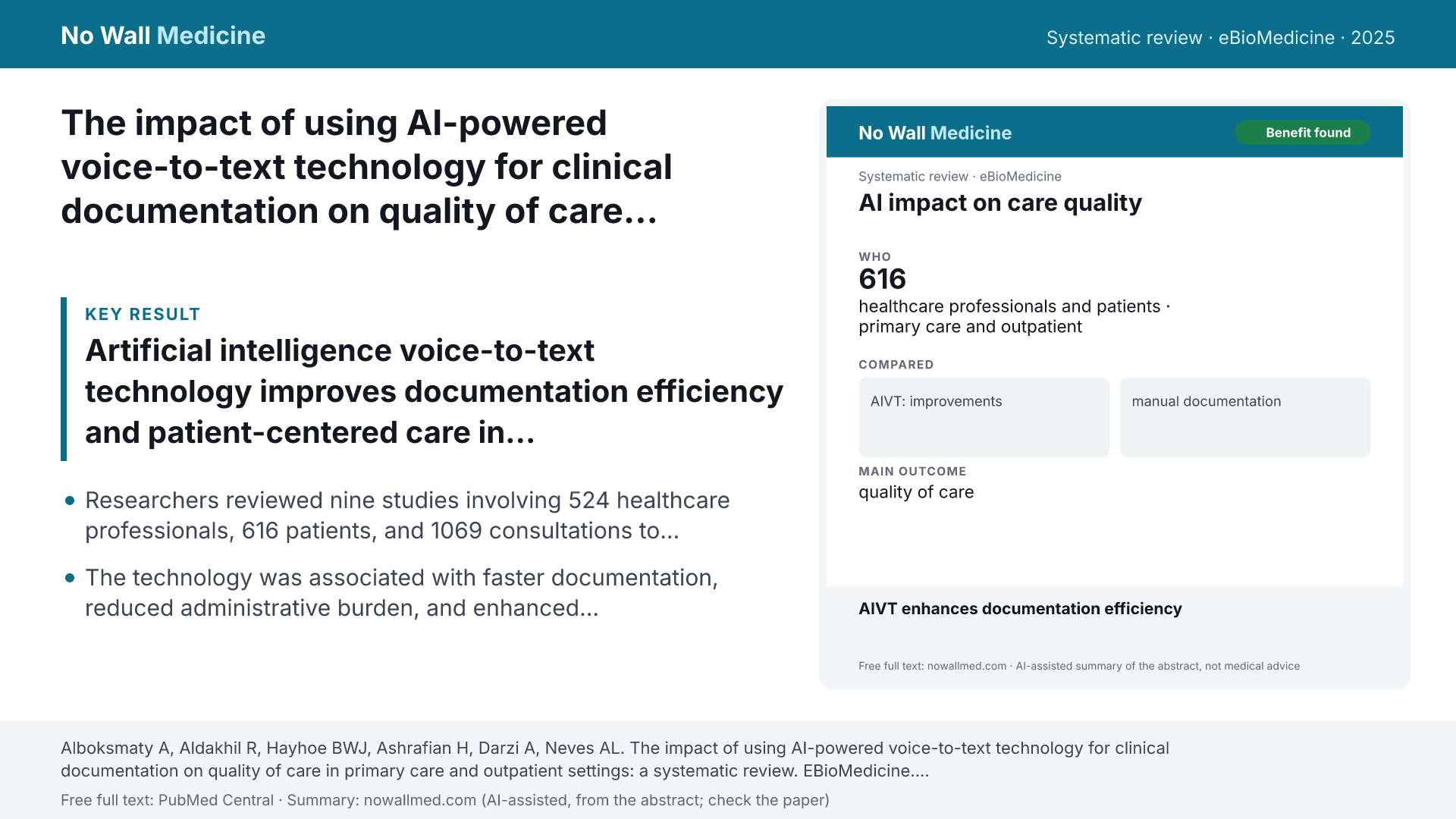
Artificial intelligence voice-to-text technology improves documentation efficiency and patient-centered care in outpatient settings
The impact of using AI-powered voice-to-text technology for clinical documentation on quality of care in primary care and outpatient settings: a systematic review
Systematic reviewBenefit found
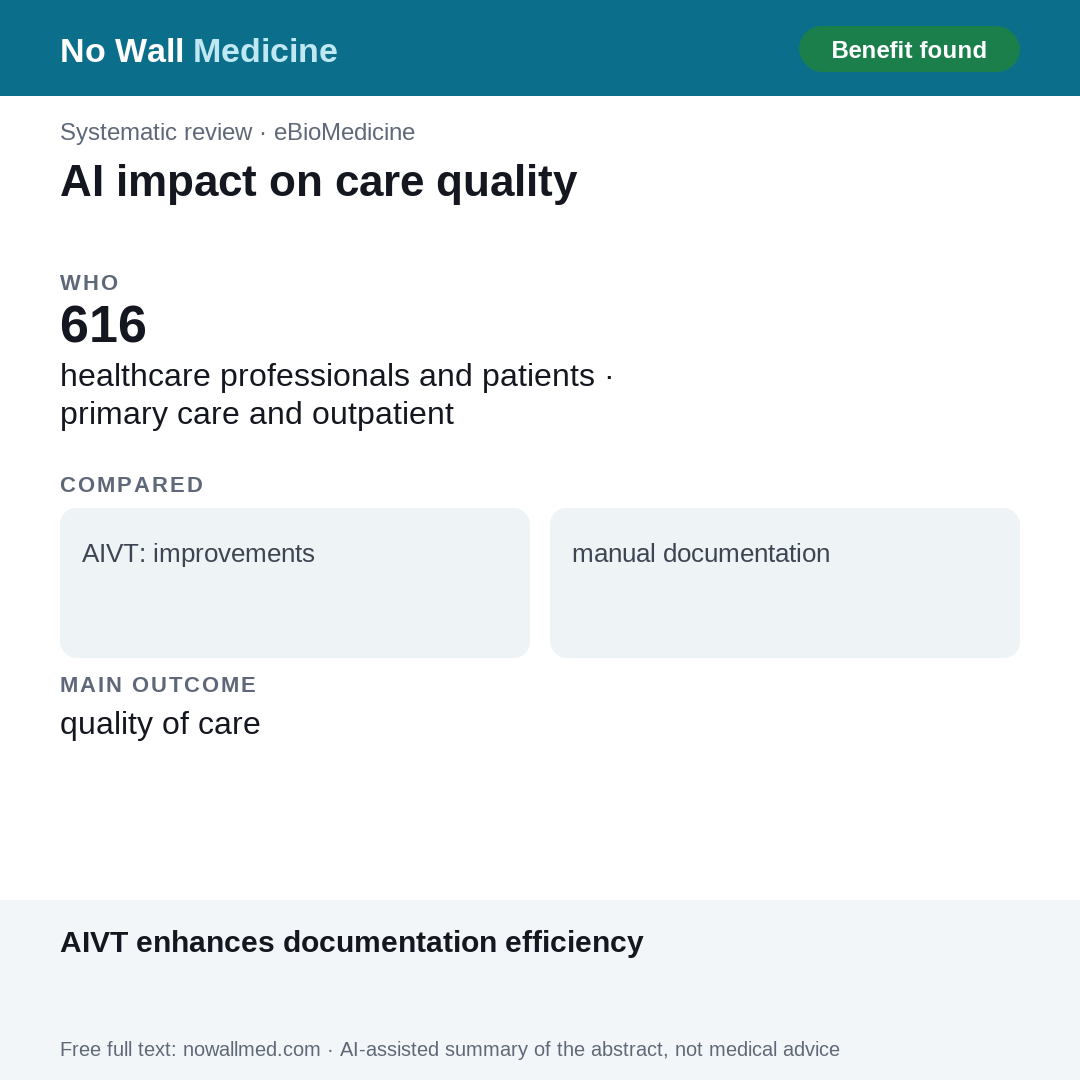
AI impact on care quality
Who
616
healthcare professionals and patients · primary care and outpatient
Compared
AIVT: improvements
manual documentation
Main outcome
quality of care
Bottom line: AIVT enhances documentation efficiency
Limitation: study heterogeneity
Funded by: National Institute for Health
eBioMedicine · 2025-07-21Download image
Why it matters: Clinicians face a high documentation burden during consultations, and it is unclear how artificial intelligence voice-to-text technology impacts various components of care quality.
Key points
- Researchers reviewed nine studies involving 524 healthcare professionals, 616 patients, and 1069 consultations to assess artificial intelligence voice-to-text technology.
- The technology was associated with faster documentation, reduced administrative burden, and enhanced patient-provider interaction in studies assessing effectiveness, patient-centeredness, and efficiency.
- Findings regarding safety were inconclusive, as three of six studies raised concerns regarding transcription errors.
Limitation the authors note: The authors noted concerns regarding transcription errors and the generalisability of findings due to limited diversity and controlled simulation settings.
Headline and key points written with AI from the paper’s abstract, with every number checked against it. Read the paper before relying on them.
Was this summary helpful?
Subject terms
Cite this article
Alboksmaty A, Aldakhil R, Hayhoe BWJ, Ashrafian H, Darzi A, Neves AL. The impact of using AI-powered voice-to-text technology for clinical documentation on quality of care in primary care and outpatient settings: a systematic review. eBioMedicine. 2025. doi:10.1016/j.ebiom.2025.105861
Spotted a mistake? Suggest a correction