The impact of using AI-powered voice-to-text technology for clinical documentation on quality of care in primary care and outpatient settings: a systematic review
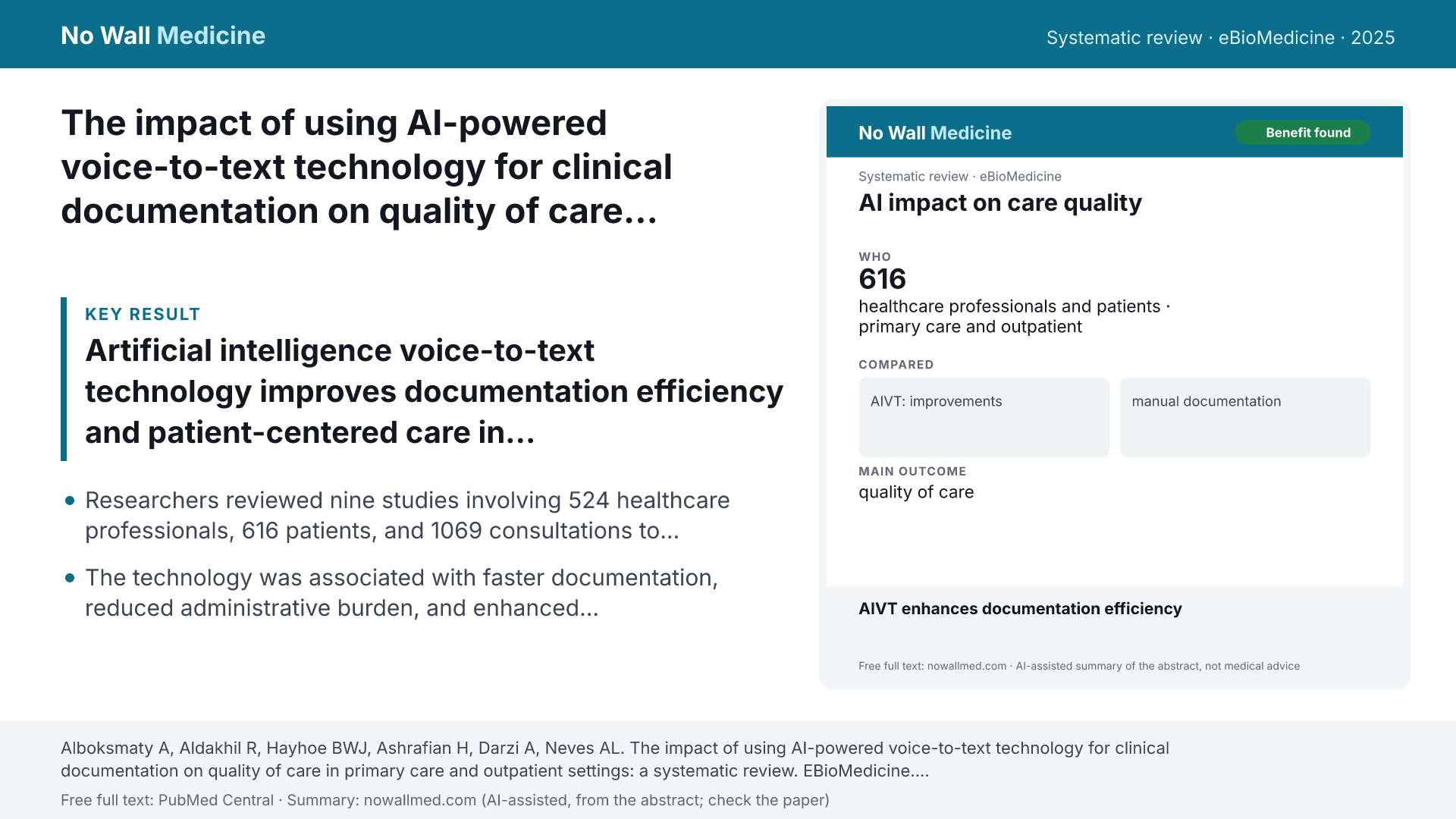
Key result: Artificial intelligence voice-to-text technology improves documentation efficiency and patient-centered care in outpatient settings
Key points
- Researchers reviewed nine studies involving 524 healthcare professionals, 616 patients, and 1069 consultations to assess artificial intelligence voice-to-text technology.
- The technology was associated with faster documentation, reduced administrative burden, and enhanced patient-provider interaction in studies assessing effectiveness, patient-centeredness, and efficiency.
- Findings regarding safety were inconclusive, as three of six studies raised concerns regarding transcription errors.
Why it matters: Clinicians face a high documentation burden during consultations, and it is unclear how artificial intelligence voice-to-text technology impacts various components of care quality.
Limitation the authors note: The authors noted concerns regarding transcription errors and the generalisability of findings due to limited diversity and controlled simulation settings.
Discussion prompts
- Would these patients look like yours? Who was left out?
- Is the main outcome one that matters to patients?
- Is the difference large enough to change what you do?
Cite: Alboksmaty A, Aldakhil R, Hayhoe BWJ, Ashrafian H, Darzi A, Neves AL. The impact of using AI-powered voice-to-text technology for clinical documentation on quality of care in primary care and outpatient settings: a systematic review. EBioMedicine. 2025;118:105861. doi:10.1016/j.ebiom.2025.105861
Free full text: PubMed Central · Summary and visual abstract: nowallmed.com/a/the-impact-of-using-ai-powered-voice-to-text-technology-for-clinical-45vx05/ (AI-assisted from the abstract; check the paper before relying on it).